PART 1: THE CONFESSION NOBODY ASKS FOR
1. Let Me Say This Without Pretending to Be Nice
Let me start with a sentence that already makes people uncomfortable.
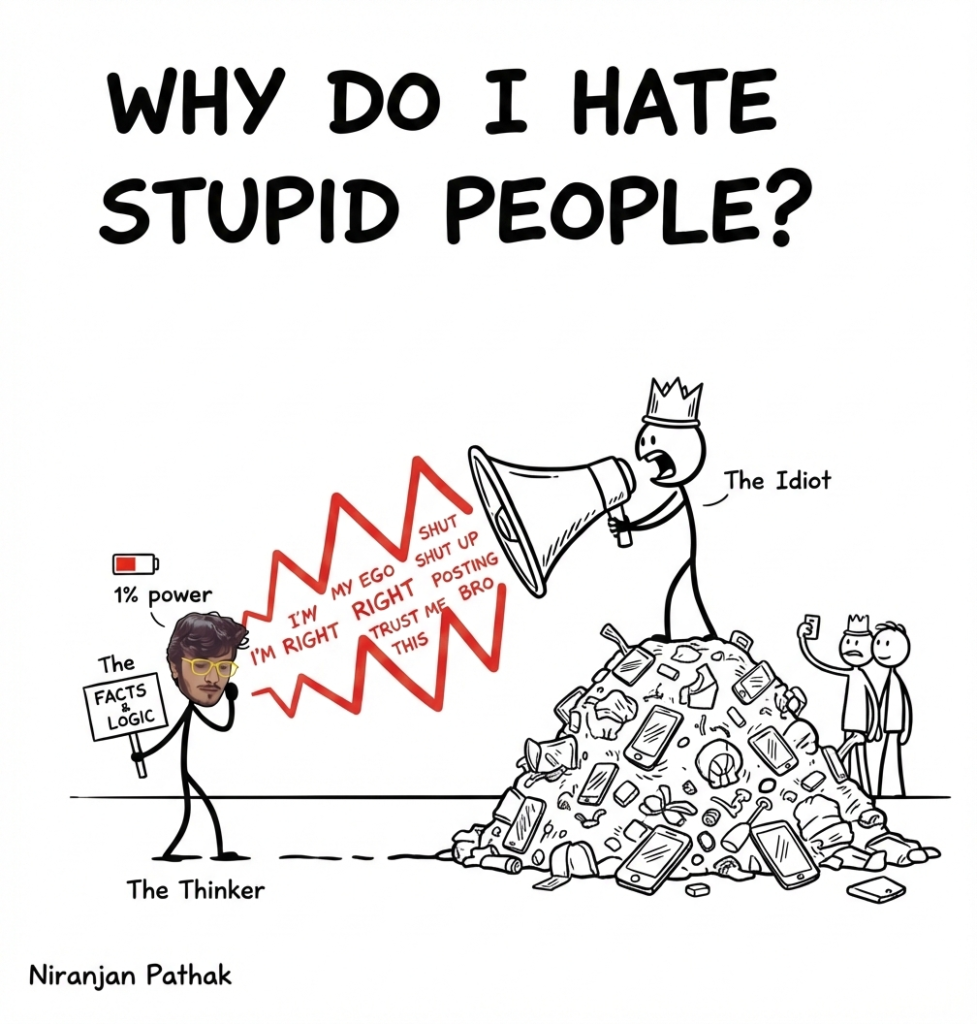
I am tired of stupid behavior.
Not tired in a dramatic, crying-in-the-corner way. Tired in a deep, bone-level, soul-drained way. The kind of tired where you do not want to argue anymore, you do not want to explain anymore, and you definitely do not want to smile and nod while someone confidently says something that makes absolutely no sense.
This blog is not written to sound kind. It is written to sound honest.
We live in a culture where being polite is considered more important than being correct. Where calling out nonsense is seen as rude, but spreading nonsense with confidence is somehow acceptable. That imbalance is what pushed me to write this.
This is not an attack on people. This is an attack on a mindset. A mindset where thinking is optional, learning is avoided, and being loud replaces being right.
And before someone rushes to the comment section with a moral lecture, let me make this clear.
If you are wrong but willing to learn, you are not stupid. If you are uninformed but curious, you are not stupid.
But if you are proudly wrong, aggressively ignorant, and emotionally allergic to facts, then yes, this blog is about you.
2. This Is Not About Intelligence or IQ
This is where most people misunderstand the conversation.
Stupidity is not low IQ.
Some of the most academically qualified people I have met say the dumbest things with complete confidence. Degrees do not protect you from bad thinking. Money does not protect you from nonsense. Fame definitely does not protect you from public embarrassment.
Stupidity is not about how much you know. It is about how you deal with what you do not know.
An intelligent person can be wrong and still be calm. A stupid mindset turns being wrong into a personal attack. That is the difference.
You can see it instantly.
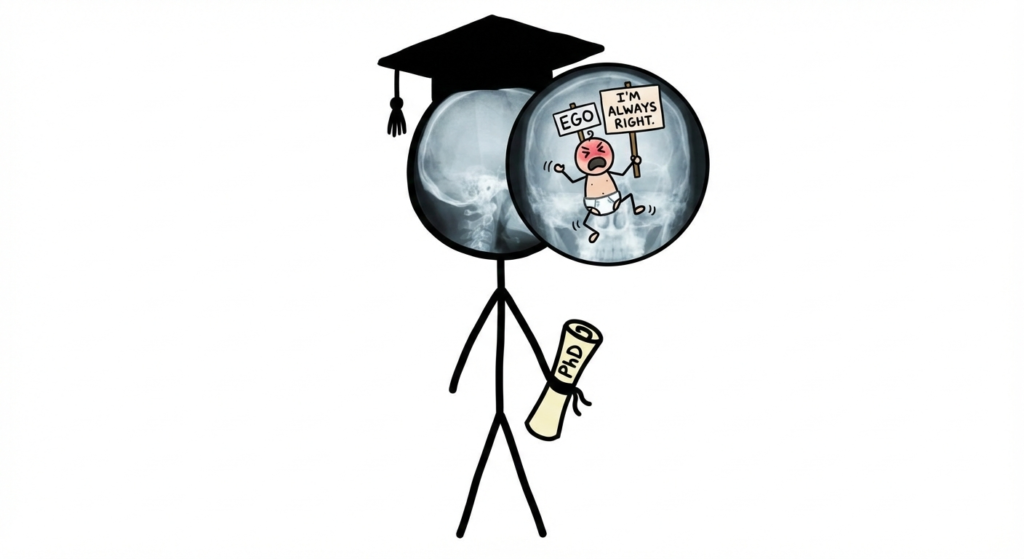
Correct someone gently and watch how they react. If the response is curiosity, growth is possible. If the response is anger, denial, or emotional drama, you are not dealing with intelligence. You are dealing with ego dressed up as confidence.
This blog is not praising smart people or insulting less educated ones. It is questioning why thinking has become optional and why refusing to think is defended so aggressively.
3. I Don’t Hate Ignorance, I Hate Refusal to Learn
Ignorance is human. Every single person on this planet is ignorant about something.
Refusal to learn is a choice.
That choice usually comes from fear. Fear of being exposed. Fear of looking foolish. Fear of admitting that maybe, just maybe, someone else knows more.
The moment someone chooses comfort over curiosity, ignorance hardens into stupidity.
This is where things get ugly.
Instead of learning, people defend their half-baked ideas. Instead of asking questions, they attack the questioner. Instead of growing, they double down.
That is not a lack of information. That is a lack of character.
And the worst part is that this behavior is rewarded. Loud confidence gets attention. Calm uncertainty gets ignored. So people learn the wrong lesson.
They learn that sounding sure matters more than being right.
4. The First Time I Realized Stupid Behavior Is Everywhere
There is usually a moment when patience breaks.
For me, it was not a single argument or a single person. It was a pattern. The same conversations repeating. The same shallow logic. The same emotional reactions when facts entered the room.
It could be a workplace discussion where the loudest voice dominates without understanding the topic. It may be a conversation at work where the person with the loudest voice controls the conversation without knowing the subject.
That was the moment I realized something uncomfortable.
Stupid behavior is not rare. It is normalized.
And questioning it makes you look like the problem.
You are told to relax. To not overthink. To let people have opinions. All while those opinions quietly shape decisions, influence others, and spread like unchecked nonsense.
This part of the blog exists to explain why frustration builds. Why silence starts feeling heavier than speaking up. And why eventually, patience runs out.
This is not bitterness. It is awareness.
And awareness, once it kicks in, does not let you unsee the problem.
PART 2: WHAT STUPIDITY REALLY IS
5. Stupidity Is Emotional, Not Intellectual
Most people imagine stupidity as a lack of information. That picture is comforting because it suggests a simple fix. Just teach them. Just explain it better. Just show the data.
That idea is wrong.
Stupidity, the kind that drains your patience, is rarely about missing facts. It is about emotions. Ego. Fear. Pride. Insecurity. The fragile need to feel important in a world that does not offer that feeling easily.
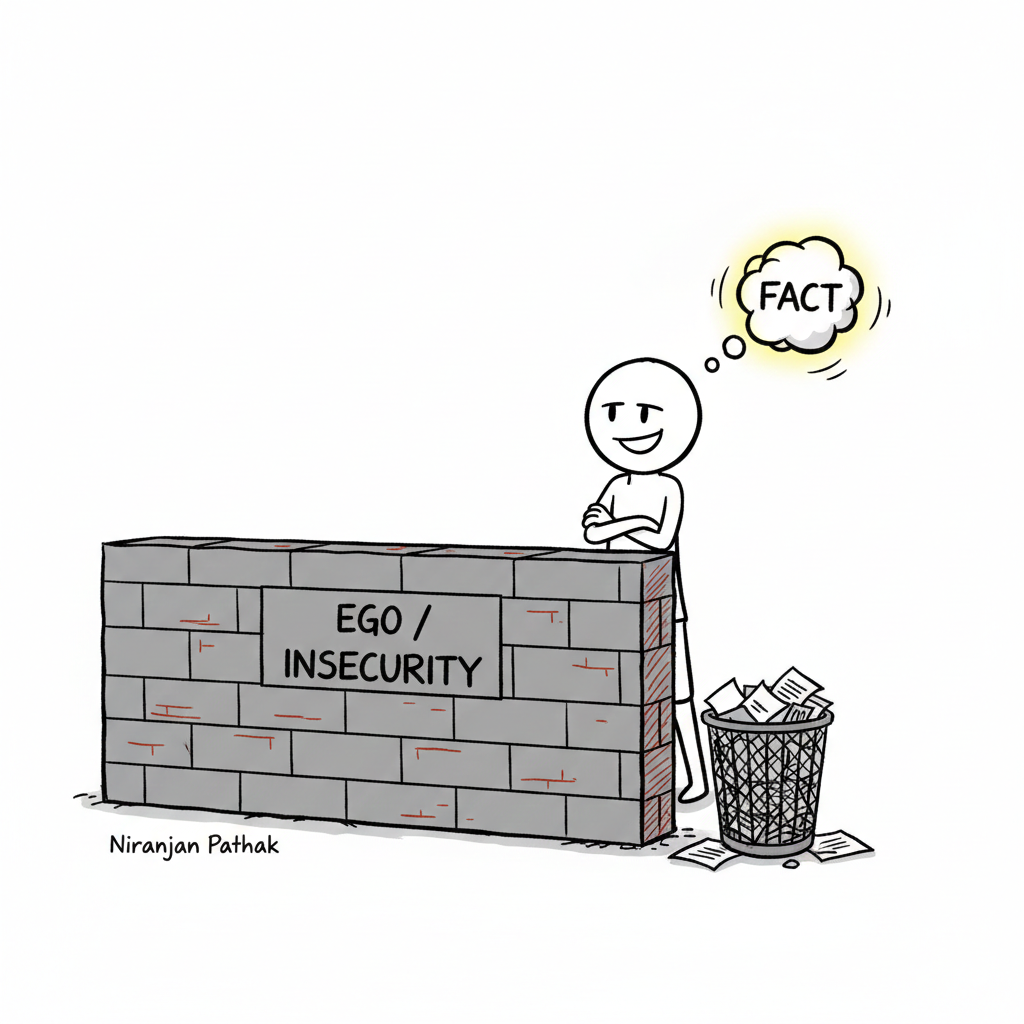
When someone reacts angrily to being corrected, that is not an intellectual response. That is an emotional one. When someone refuses evidence because it makes them uncomfortable, that is not logic failing. That is ego panicking.
Thinking requires emotional stability. You need to tolerate uncertainty. You need to sit with the discomfort of being wrong. You need the maturity to say, “I might be missing something here.”
Stupid behavior avoids all of that.
It chooses emotional comfort over intellectual honesty. And once you see this pattern, you cannot unsee it.
6. Thinking Is Hard and Stupid Behavior Avoids Effort
Real thinking is exhausting.
It demands focus. It asks you to slow down. It forces you to question your beliefs instead of defending them like property.
Stupid behavior is not always about inability. Many times, it is about refusal.
Why struggle with complexity when a simple answer feels good? Why analyze when you can repeat a catchy sentence? Why read deeply when a headline already confirms what you want to believe?
Mental laziness is rewarded everywhere. Quick takes get applause. Long explanations get ignored. Certainty feels better than curiosity.
So people choose the easy route.
They reduce complicated issues into childish binaries. Right or wrong. Good or bad. Us or them. Anything more complex threatens their sense of control.
This is not stupidity as an accident. This is stupidity as a lifestyle choice.
7. The Addiction to Being Right
Being right feels good. It feeds the ego. It gives a sense of superiority. It creates the illusion of control.
Now imagine being addicted to that feeling.
Stupid behavior is often driven by the need to always be right, not the need to be accurate. Truth becomes secondary. Winning becomes everything.
This is why facts bounce off.
Accepting new information would mean admitting past mistakes. That admission feels like loss. And some people would rather protect their pride than update their thinking.
So they argue harder. They raise their voice. They repeat the same weak points with more confidence, hoping volume will replace validity.
This is how conversations turn into performances.
8. Why Saying “I Don’t Know” Feels Like Weakness
“I don’t know” is one of the strongest sentences a person can say.
It signals honesty. It signals openness. It signals the beginning of learning.
Yet for many, those three words feel humiliating.
Stupid behavior treats uncertainty like a threat. Not knowing feels like exposure. Like someone might see through the image they are desperately trying to maintain.
So instead of admitting uncertainty, people bluff. They guess. They speak confidently about things they barely understand.
The goal is not clarity. The goal is image protection.
And image protection has no interest in truth.
9. Stupidity and the Dunning Kruger Effect in Real Life
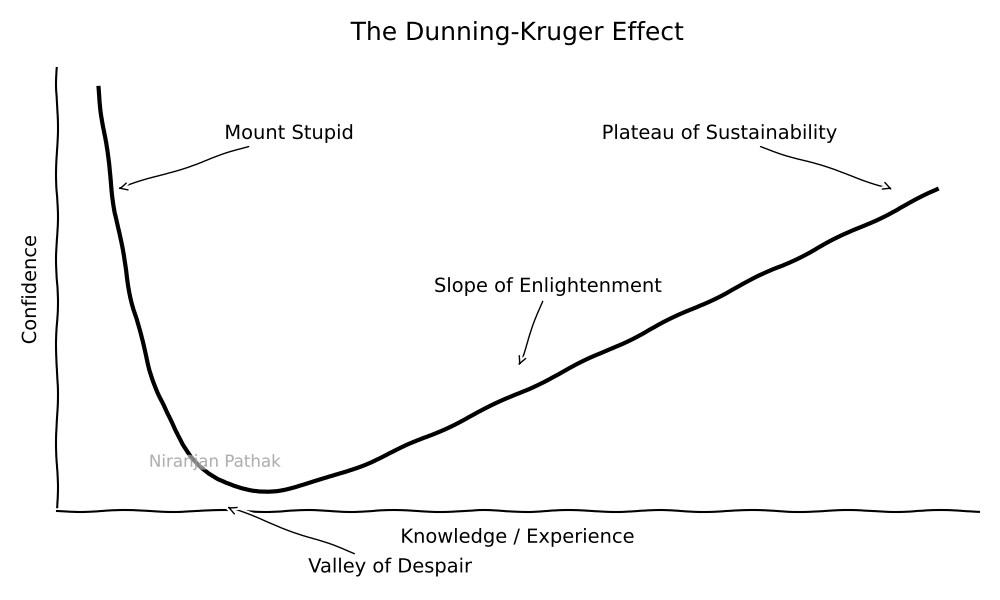
There is a well-known psychological pattern where people with low competence overestimate their ability, while people with high competence underestimate theirs.
You do not need to memorize the term to recognize the behavior.
The loudest person in the room is rarely the most informed. The most confident speaker often understands the least. Meanwhile, the person who actually knows the subject speaks carefully, with qualifiers and context.
Stupid behavior mistakes caution for weakness.
Confidence without substance looks impressive to those who do not know better. That is why it spreads so easily.
It creates a dangerous loop. Confidence gets rewarded. Reward reinforces confidence. And eventually, ignorance starts believing it has authority.
This is how bad ideas survive far longer than they should.
PART 3: STUPIDITY IN THE AGE OF THE INTERNET
Social Media Gave Stupid People a Stage
Why every dumbfuck now thinks he is a philosopher
Before social media, stupidity had boundaries.
If you said something stupid, it usually died in the room where you said it. Maybe your friends laughed. Maybe someone corrected you. Worst case, you were embarrassed and learned to shut up next time.
The internet destroyed that natural filter.
Now every dumb opinion has a platform, every half thought has an audience, and every loud idiot with confidence thinks he is “spreading truth.” You no longer need understanding. You just need ‘reach’.
Social media does not ask, “Do you know what you are talking about?”
It asks, “Can you keep people watching for ten seconds?”
That is how stupidity gets upgraded from personal flaw to public performance.
A dumb person today does not feel dumb. He feels important. He feels heard. He feels validated by likes from other people who also have no idea what is going on.
So suddenly everyone is a philosopher. Everyone has “deep thoughts.” Everyone is “questioning the system.” Most of them are just repeating something they heard from another dumb person with a bigger following.
This is not freedom of expression. This is mass confusion pretending to be wisdom.
Reels, Tweets and Podcasts: Short Content for Short Thinking
Why depth died and stupidity went viral
Short content did not make people stupid. It just made stupidity faster and louder.
Reels reward punchlines, not context. Tweets reward outrage, not accuracy. Podcasts reward confidence, not competence.
Depth takes time. Nuance needs space. Real understanding cannot be compressed into thirty seconds without being butchered.
But stupid content loves short formats.
Why? Because stupidity thrives on simplicity.
Complex issues get reduced to slogans. Serious topics get turned into jokes or rage clips. Anyone who says “it depends” is ignored. Anyone who screams “this is the truth” gets shared.
That is how depth dies.
And when depth dies, stupidity goes viral.
You can see it everywhere. Relationship advice boiled down to one toxic sentence. Mental health reduced to motivational nonsense. Finance explained by people who cannot read a balance sheet.
It feels empowering because it feels easy.
Thinking is hard. Reacting is effortless.
Engagement Rewards Outrage, Not Intelligence
How algorithms push dumb opinions to the top
Here is the part most people do not want to accept.
Social media platforms are not neutral.
They are not designed to educate you. They are designed to keep you scrolling.
Anger works. Fear works. Certainty works. Calm intelligence does not.
Smart content often sounds boring because it is honest. It admits uncertainty. It explains limits. It avoids absolute claims.
Stupid content does the opposite.
It points fingers. It oversimplifies. It tells you that everyone else is wrong and you are special for watching this video.
So the algorithm does what it is programmed to do. It pushes whatever triggers the strongest emotional response.
That is why dumb opinions look popular. Not because they are correct, but because they perform well.
When you see a stupid take everywhere, it starts feeling normal. When it feels normal, it starts feeling true.
That is how nonsense becomes mainstream.
Why Loud Idiots Get More Followers Than Quiet Thinkers
Confidence sells even when it is complete nonsense
Quiet thinkers hesitate.
They read. They check. They reconsider. They speak carefully because they understand how little they actually know.
Loud idiots do none of that.
They speak in absolutes. They never say “I might be wrong.” They insult critics instead of responding to them. They confuse volume with authority.
To an untrained audience, confidence looks like intelligence.
That is the scam.
This is why influencers who oversimplify complex topics grow faster than experts who explain them properly. One flatters the audience. The other demands effort.
Most people choose flattery.
Influencers Who Made Stupidity Go Viral
Let us talk about real examples, because patterns become clearer when names are attached.
Take wellness influencers who promote detoxes, miracle cures, or anti science ideas. Gwyneth Paltrow’s Goop became famous not because it was smart, but because it sold comforting nonsense to people who wanted easy answers wrapped in luxury.
Look at influencers during the pandemic who downplayed safety, mocked science, or treated a global crisis like a joke. Jake Paul received massive backlash for reckless behavior, yet his popularity survived because outrage still counts as attention.
Then there are finance and crypto influencers who confidently promoted projects they barely understood. Thousands of followers lost money while these creators shrugged and called it “risk.” Ignorance plus confidence ruined real lives.
And the motivational crowd deserves a special mention. Influencers who shout hustle slogans while saying absolutely nothing of value. Work harder. Sleep less. Grind more. No context. No balance. Just noise.
Now, they are not necessarily evil. But they are fucking irresponsible.
And irresponsibility with influence is dangerous.
Why People Still Follow Them
This part hurts, but it matters.
Stupid influencers exist because people want them to exist.
They make life feel simpler. They offer certainty in a confusing world. They tell you what you want to hear instead of what you need to think about.
Following someone who sounds sure is comforting.
Questioning someone who sounds sure is exhausting.
So people choose comfort.
And the algorithm rewards that choice again and again.
PART 4: FAMOUS PEOPLE AND PUBLIC STUPIDITY
Why Famous People Expose Their Stupidity Publicly
Money, fame and the illusion of intellectual superiority
Fame does something dangerous to the human brain.
It removes feedback.
When you are famous, people clap before you finish speaking. They defend you before you explain yourself. They assume intelligence just because success exists.
That is where stupidity quietly grows.
Famous people start believing that success in one area automatically qualifies them to speak on everything. Acting becomes philosophy. Singing becomes political theory. Building a company becomes proof of universal wisdom.
This is not confidence. This is illusion.
Money does not make you smarter. Fame does not deepen your thinking. It just amplifies whatever is already there.
If you were thoughtful before, you might become insightful.
If you were reckless before, you become a public idiot.
And the internet makes sure everyone sees it.
Elon Musk: Genius, Idiot or Both
When innovation meets ego and tweets ruin credibility
Elon Musk is not a simple case.
Sometimes Elon Musk tweets like a 12 year old kid who just discovered unlimited internet and zero supervision. One minute it is rockets and AI. Next minute it is meme level shitposting at 2 AM like he just won an argument in a Discord server.
You are running billion dollar companies, bro. Why does this feel like “who gave this genius a phone and no adult monitoring?”
First things first… I’m not an Elon Musk hater. I’m actually a huge fan of him. If he were Indian, or if I were American, or if I had even slightly known him, I probably would’ve asked his daughter to marry me (just kidding, obviously!). Check out my tweet below and you’ll understand where I was coming from.
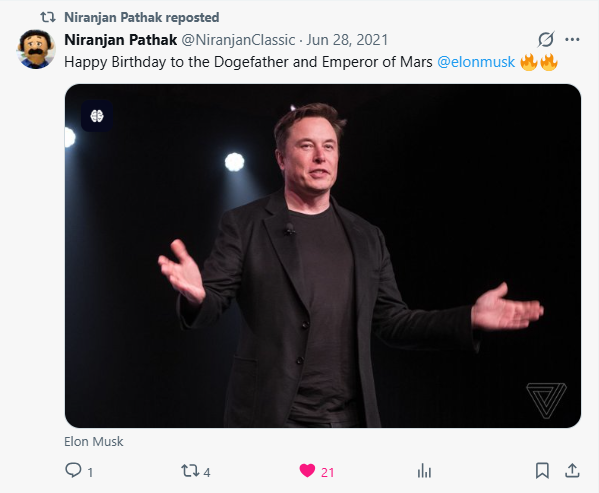
It is that chaotic mix of visionary brain and “chronically online gremlin” energy that makes people laugh and question reality at the same time.
He is undeniably intelligent in certain domains. Engineering. Vision. Execution. That part is real.
The problem starts when intelligence mutates into intellectual arrogance.
Musk’s habit of tweeting impulsively, commenting on topics he barely understands, and mocking critics publicly has damaged his credibility more than any competitor ever could.
When a man capable of building rockets starts acting like a teenager with a WiFi connection, people get confused. In the same timeline, genius and stupidity start to cohabit.
His tweets about finance, politics, and global issues often lack nuance and restraint. And instead of reconsidering, he doubles down. That is not intelligence failing. That is ego refusing correction.
This is how smart people become stupid in public.
Not because they lack intelligence, but because they stop respecting it.
Kanye West and the Tragedy of Unchecked Stupidity
How fame protects stupidity from consequences
Kanye West is one of the clearest examples of talent being hijacked by unchecked behavior.
Musical genius does not automatically translate to emotional maturity or intellectual discipline. Yet for years, Kanye was treated like everything he said carried depth, simply because he was famous.
Problematic statements. Reckless interviews. Harmful opinions delivered with full confidence.
And still, people defended him.
Why?
Because fame creates excuses.
Mental health discussions became shields against accountability. Artistic brilliance became justification for saying outrageous things. Instead of intervention, the world offered microphones.
This is what happens when fame removes consequences.
Stupidity stops being corrected. It starts being protected.
Andrew Tate and the Business of Being a Stupid Man
How stupidity became a masculine brand
Andrew Tate is not stupid in the traditional sense. That makes his case worse.
He understands exactly what he is doing.
He monetized outrage. He turned exaggerated masculinity into a product. He packaged shallow thinking as confidence and sold it to insecure men who wanted easy answers.
His remarks are frequently overly dramatic, oversimplified, and purposefully provocative. Not because they are particularly true, but just because they are so well-known.
Stupidity here is not accidental. It is strategic.
By reducing complex gender, social, and emotional issues into aggressive slogans, he made stupidity feel powerful.
That is the danger.
When stupidity feels empowering, people stop questioning it.
Celebrities Who Should Have Shut Up
Real examples of public self destruction through dumb opinions
History is full of celebrities who ruined their image simply by speaking too freely about things they did not understand.
Actors making reckless political claims without context. Athletes spreading misinformation during serious crises. Influencers dismissing science because it conflicted with their brand.
These moments are not mistakes. They are exposures.
They reveal a truth people do not want to accept.
Being famous does not mean being informed.
And when ignorance meets a massive audience, damage follows.
Careers suffer. Trust erodes. Public respect disappears.
All because someone thought silence was beneath them.
Why People Still Defend Obviously Stupid Behavior
Tribalism, hero worship and emotional blindness
This is the most uncomfortable part.
Stupid behavior survives because audiences protect it.
Fans do not follow logic. They follow identity.
If criticizing a celebrity feels like criticizing yourself, you will defend them no matter what they say. Evidence becomes irrelevant. Context becomes optional. Excuses multiply.
This is tribal thinking.
Hero worship shuts down critical thought. Emotional attachment replaces reason. And stupidity gets a free pass as long as it comes from the right person.
That is how public nonsense keeps repeating.
Not because people are unaware.
But because they are unwilling to let go.
PART 5: STUPIDITY, POWER AND DAMAGE
When Stupid People Get Power
Why authority magnifies stupidity
Stupidity is annoying in normal people.
In powerful people, it becomes destructive.
Power does not create intelligence. It removes resistance. When someone stupid gains authority, their bad thinking is no longer challenged. It is enforced.
At lower levels, stupidity gets corrected by reality. You mess up, you face consequences. You say something dumb, someone calls you out.
Power removes that feedback loop.
Suddenly, bad ideas are protected by titles. Weak thinking is defended by loyal followers. Poor decisions are reframed as bold leadership.
Authority does not fix stupidity. It puts it on a larger stage.
And the damage multiplies.
Politicians and Policy Made by Dumb People
How ignorance at the top destroys lives at the bottom
Most people imagine political failure as corruption or evil intent.
In reality, a lot of damage comes from ignorance mixed with confidence.
Policies created without understanding economics. Laws passed without understanding human behavior. Decisions made for applause instead of long term impact.
When leaders do not understand the systems they control, people suffer quietly. Jobs disappear. Education weakens. Healthcare collapses. Inflation rises.
The worst part is that the consequences rarely hit the decision makers first.
They live comfortably. The public absorbs the damage.
Stupidity in leadership is not harmless. It is expensive.
Why Voters Love Stupid Leaders
The uncomfortable mirror nobody wants to look into
This is where people get defensive.
Stupid leaders are popular because they are relatable.
They speak simply. They avoid complexity. They offer easy enemies and easy solutions. They make people feel smart without demanding effort.
A leader who says, “This is complicated and will take time” sounds weak.
A leader who says, “I will fix everything quickly” sounds strong.
Even if it is nonsense.
Stupid leadership feels comforting. It reduces anxiety. It avoids responsibility. It replaces thinking with belief.
And belief is easier than understanding.
This is not just a leadership problem. It is a collective one.
Stupidity Disguised as Confidence in Leadership
Why loud leaders feel safe to dumb people
Confidence is persuasive. Even when it is fake.
Loud leaders dominate attention. They interrupt. They insult. They simplify. They project certainty even when they are guessing.
To someone who struggles with complexity, that confidence feels safe.
A quiet, thoughtful leader who weighs options can look unsure. A loud one looks decisive.
Stupidity knows this trick well.
That is why demagogues thrive. They turn insecurity into certainty and sell it as strength.
And once people emotionally invest, facts no longer matter.
The louder the leader, the less people listen to reality.
Alright. Here is PART 6, same rules, same tone, AdSense-safe profanity, grounded in real life. This is the part where people quietly recognize someone they know. Or themselves.
PART 6: EVERYDAY STUPIDITY WE ALL SUFFER FROM
The Office Dumbfuck
The coworker who talks the most and understands the least
Every office has one.
The guy who speaks first in meetings and longest in discussions. The one who confidently explains things he barely understands. The one who uses buzzwords like strategy, synergy, optimization, and alignment while contributing absolutely nothing of substance.
He is not the smartest. He is just the loudest.
This person survives not because he is competent, but because confidence creates illusion. Managers mistake assertiveness for leadership. Colleagues confuse talking for thinking.
When things go wrong, the Office Dumbfuck is never responsible. He was “misunderstood.” He was “not aligned.” Somehow, the blame always floats away from him.
Working with such people is exhausting because logic does not defeat volume. Facts do not interrupt confidence. And correcting them makes you look aggressive, while their stupidity gets labeled as enthusiasm.
That is how stupidity quietly climbs the corporate ladder.
The WhatsApp University Graduate
Fake forwards, half knowledge and full confidence
This species deserves its own research paper.
The WhatsApp University Graduate consumes information exclusively through forwarded messages. No sources. No context. No verification. Just screenshots, cropped headlines, and emotional language.
And yet, the confidence is unmatched.
They will explain medicine to doctors, economics to economists, and geopolitics to people who actually studied it. Any attempt to correct them is met with suspicion.
“Main toh bas bol raha hoon.”
“I read it somewhere.”
“Everyone is saying it.”
Everyone is not saying it. A random uncle with bad grammar said it.
These people are not curious. They are committed to being right. They do not want knowledge. They want validation.
And WhatsApp rewards them by making misinformation feel like community wisdom.
The Argument Lover Who Knows Nothing
Why some people argue just to feel alive
Some people do not argue to understand. They argue to win.
These are the ones who jump into every discussion with zero preparation and full aggression. They interrupt. They raise their voice. They change topics when cornered.
Facts do not matter to them. Consistency does not matter. The goal is dominance, not truth.
Arguing gives them a sense of identity. It makes them feel relevant. Without conflict, they feel invisible.
That is why logic never works on them.
They are not debating ideas. They are protecting their ego.
Engaging with such people is not intellectual discussion. It is emotional labor.
And it drains you faster than silence ever could.
The Victim Complex of Stupid People
How they cry oppression when corrected
One of the most predictable patterns of stupidity is victimhood.
Correct a stupid statement and suddenly you are attacking them. Ask for evidence and suddenly you are arrogant. Question their logic and suddenly you are disrespectful.
Stupid people hate accountability. So they reframe correction as oppression.
They do not say, “I might be wrong.”
They say, “You are trying to silence me.”
This tactic works because it shifts focus. Instead of discussing ideas, the conversation becomes about feelings.
And feelings are harder to challenge than facts.
Victimhood becomes armor. It protects stupidity from scrutiny.
Once someone adopts this mindset, learning stops completely. Everything becomes personal. Growth becomes impossible.
PART 7: WHY STUPID PEOPLE HATE SMART PEOPLE
Intelligence Makes Stupid People Insecure
Why they call thinking arrogance
Smart people make stupid people uncomfortable without saying a word.
It is not intelligence itself that triggers them. It is the mirror intelligence holds up.
A thoughtful person asks questions. A stupid person hears judgment. A smart person pauses before answering. A stupid person reads that pause as weakness or superiority.
So they flip the narrative.
Thinking becomes arrogance. Curiosity becomes overthinking. Depth becomes pretentiousness.
This is easier than admitting insecurity.
Because admitting insecurity would require self awareness. And self awareness is exactly what stupid behavior avoids.
Instead of rising up, they try to pull others down. Instead of learning, they mock learning.
It is not hatred of intelligence. It is fear of exposure.
Mocking Books, Reading and Depth
Why anti intellectualism is fashionable
There was a time when reading was respected.
Now it is suspicious.
People proudly announce that they do not read. That they learn from experience only. That books are outdated. That thinking too much ruins life.
This is not confidence. This is defensive ignorance.
Books represent effort. Depth represents discipline. Knowledge represents the possibility that someone else knows more.
So stupid culture attacks them.
Reading becomes boring. Intelligence becomes elitist. Experts become untrustworthy. Personal opinion becomes sacred.
This is how anti intellectualism spreads.
Not because books failed people, but because books demand something people do not want to give.
Attention. Humility. Time.
Why Stupid People Love Simple Answers
Black and white thinking for a complex world
The world is complicated.
Politics, relationships, economics, mental health, identity. None of these fit into neat boxes.
Stupid thinking cannot handle that.
So it simplifies everything.
Good versus evil. Right versus wrong. Heroes versus villains. Us versus them.
Nuance feels threatening. Complexity feels exhausting. Gray areas feel unsafe.
Simple answers offer emotional relief. They reduce anxiety. They remove responsibility.
You do not have to think if someone else already decided the truth for you.
That is why slogans beat explanations. That is why loud certainty beats careful reasoning.
Stupidity does not want truth. It wants comfort.
PART 8: THE EXHAUSTION OF DEALING WITH IDIOTS
Arguing With Stupid People Is Mental Self Harm
Why logic fails and rage takes over
At some point, you realize something painful.
You cannot win.
You bring facts. They bring feelings. You explain calmly. They raise their voice. You stay consistent. They change arguments.
Logic does not fail because it is weak. It fails because it is not the language being spoken.
Stupid arguments are not about truth. They are about dominance.
And once you see that, arguing feels pointless.
You walk away angry, drained, questioning your own sanity. Not because you were wrong, but because you expected reason where there was none.
That is why engaging too much becomes self harm.
Why I Stopped Explaining Myself
Emotional burnout and choosing silence
There comes a moment when you stop correcting people.
Not because you agree with them. But because you value your peace more than their ignorance.
Explaining yourself repeatedly is exhausting. Especially when explanations are not wanted.
Stupid people do not ask to learn. They ask to be validated.
So silence becomes a boundary.
Not arrogance. Not defeat.
Survival.
You save your energy for conversations that grow you, not ones that drain you.
The Cost of Being Aware in a Stupid World
Loneliness, frustration and quiet rage
Awareness is heavy.
Once you see patterns of stupidity, you see them everywhere. In offices. In families. Online. In leadership.
You start feeling isolated. Not superior. Just alone.
It becomes harder to connect casually. Harder to ignore nonsense. Harder to pretend things are fine.
There is frustration in watching avoidable damage repeat itself. There is rage in knowing better and being powerless to fix it.
And there is loneliness in realizing that thinking deeply is a minority activity.
This is the quiet cost of awareness.
PART 9: THE UNCOMFORTABLE SELF CHECK
Yes, I Am Stupid Too Sometimes
The honesty that keeps this blog from becoming bullshit
Let’s get this out of the way.
I am not exempt.
If this entire blog reads like a rant from someone standing on a moral mountain, then it has failed. Because stupidity is not a species. It is a state.
I have said dumb things with confidence. I have argued while being wrong. I have doubled down instead of backing off. I have ignored facts because they were inconvenient. I have spoken when I should have listened.
That is stupidity.
The difference is not purity. The difference is admission.
The moment you refuse to acknowledge your own stupidity, this stops being analysis and becomes ego masturbation. And ego is the birthplace of every dumbfuck this blog criticizes.
Self awareness does not make you smart.
But lack of it guarantees stupidity.
The Difference Between Temporary Stupidity and Permanent Dumbfuckery
Growth versus ego
Everyone is stupid sometimes.
You misjudge a situation. You react emotionally. You fall for misinformation. You let bias drive your opinion.
That is temporary stupidity.
Permanent dumbfuckery begins when correction feels like an attack.
When evidence threatens identity.
When learning feels humiliating.
When changing your mind feels like losing.
Temporary stupidity says, “I didn’t know.”
Permanent stupidity says, “I don’t need to know.”
Growth lives in the gap between ignorance and curiosity. Ego fills that gap with noise.
Smart people are not people who are always right. They are people who are willing to be wrong without collapsing.
Stupid people are not people who lack intelligence. They are people who protect their ego at all costs.
That is the real divide.
How Smart People Accidentally Become Stupid
When pride replaces curiosity
Here is the part nobody likes to admit.
Intelligence does not immunize you from stupidity. Sometimes it accelerates it.
When you are used to being right, you stop checking yourself. When people praise your intelligence, you start trusting your instincts more than evidence. When you build an identity around being smart, admitting ignorance feels dangerous.
So you defend instead of explore.
You argue instead of ask.
You perform intelligence instead of practicing it.
This is how smart people rot.
Not from lack of knowledge, but from lack of humility.
The smartest minds in history kept one trait intact: discomfort. They stayed curious. They stayed unsure. They stayed open to being corrected.
The moment curiosity dies, intelligence becomes decoration.
And decoration cannot think.
The Point of This Section
This blog is not about calling people idiots to feel superior.
It is about drawing a line.
A line between ignorance and arrogance.
Between learning and defending.
Between thinking and posturing.
If you read this and only saw other people, you missed the point.
The real test is this:
When was the last time you changed your mind?
If the answer makes you uncomfortable, good.
That discomfort is intelligence waking up.
PART 10: THE FINAL TRUTH
Stupidity Is Not Harmless, It Is Fucking Dangerous
Real consequences, real damage
Stupidity is often treated like a joke. A personality flaw. A harmless quirk.
It is not.
Stupidity crashes economies. It spreads misinformation. It elects the wrong people. It destroys relationships. It ruins systems built by people who actually thought things through.
The most dangerous mistakes in history were not made by evil geniuses. They were made by confident idiots with power, followers, and zero self doubt.
A stupid decision at the top trickles down as suffering at the bottom. And when questioned, stupidity never apologizes. It doubles down.
That is what makes it dangerous. Not ignorance. Certainty without understanding.
Why Calling Out Stupidity Is Not Cruel
Truth versus toxic politeness
Some people say calling out stupidity is mean.
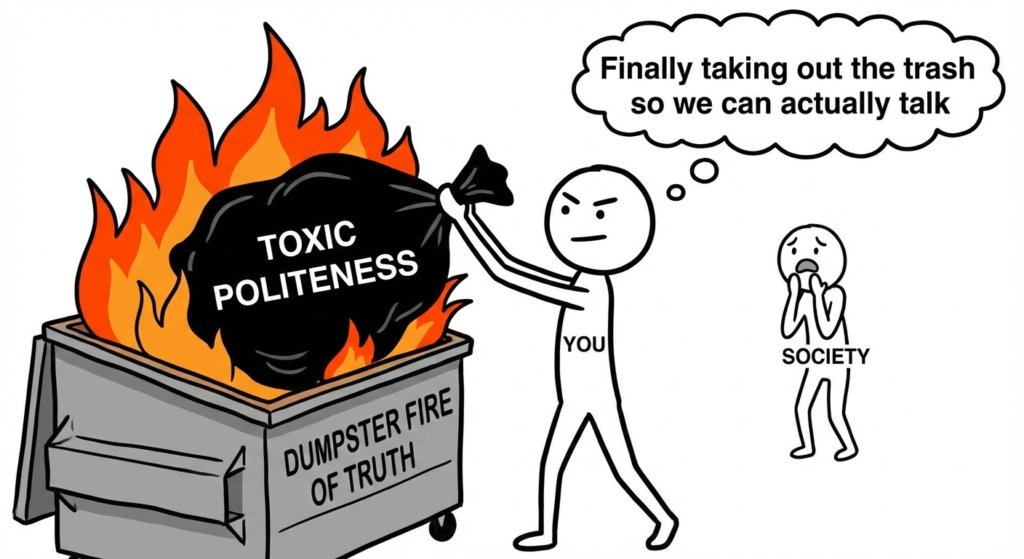
No. What is mean is letting bad ideas spread unchecked because you wanted to sound polite.
Toxic politeness protects nonsense. It allows bullshit to grow comfortably. It teaches people that confidence matters more than competence.
Calling out stupidity is not cruelty. It is social hygiene.
Not every opinion deserves respect. Not every take deserves a platform. And not every loud voice deserves silence in response.
Truth does not owe comfort to stupidity.
If This Blog Offended You, Good
Why discomfort is the beginning of thinking
If this offended you, pause before reacting.
Ask yourself why.
Was it because you recognized someone you know? Or because you recognized yourself?
Anger is often a defense mechanism for fragile beliefs. Discomfort is what happens when certainty cracks.
Thinking begins exactly there.
If this blog made you uncomfortable, it did its job. Growth does not come from validation. It comes from friction.
Comfort keeps people stupid. Discomfort forces reflection.
Final Monologue: Intelligence Is a Responsibility
The ending that leaves no room for excuses
Intelligence is not about sounding smart.
It is not about winning arguments.
It is not about mocking idiots on the internet.
Intelligence is responsibility.
The responsibility to question yourself.
The responsibility to shut up when you do not know.
The responsibility to change your mind when reality demands it.
The responsibility to not spread bullshit just because it feels good.
The world does not need more opinions. It needs better thinking.
And if you are capable of thinking deeply and choose not to, that is not ignorance. That is negligence.
Stupidity is not a lack of intelligence.
It is the refusal to use it.
And that refusal has a cost.
For everyone.