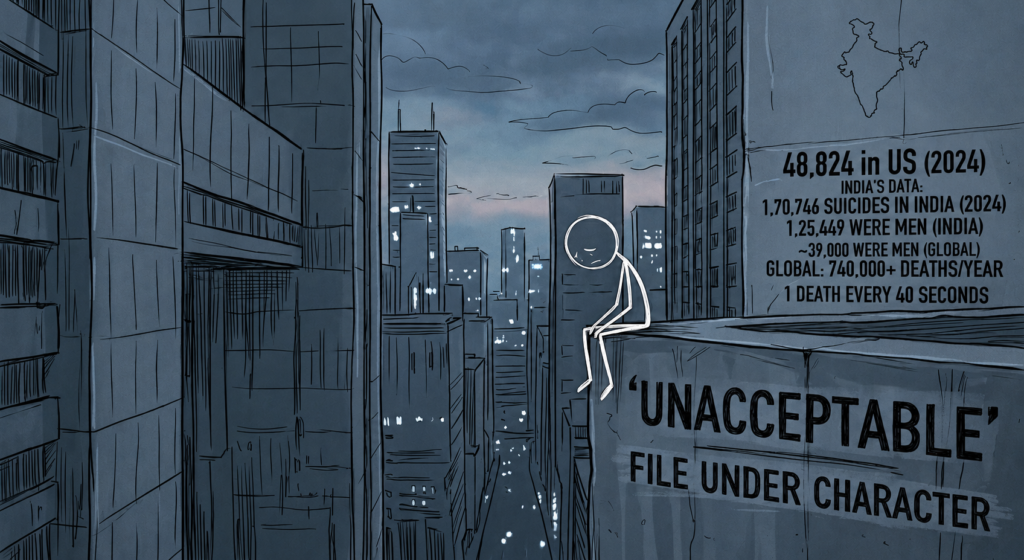
Men aren’t dying because nobody has the data. They’re dying because of what we’ve decided the data means.
In 1980, a woman named Candy Lightner lost her thirteen-year-old daughter to a drunk driver and refused to accept the answer she was given, which was essentially: these things happen.
What followed is one of the most successful public health campaigns in modern history. Laws changed. The drinking age moved. Enforcement hardened. And this is the part that mattered most the category changed. Drunk driving stopped being a bad night and became a crime. A guy who’d had a few and drove home stopped being an unlucky idiot and became a person who did something unforgivable.
Drunk driving killed 11,904 Americans in 2024. That’s down more than 40% from where it was, and MADD estimates the movement has saved something close to half a million lives.
Now hold that number 11,904 next to this one.
In 2024, suicide killed 48,824 Americans. Roughly 39,000 of them were men.
Four times the death toll. No Candy Lightner. No category shift. No law. No campaign your uncle could name.
And that’s just one country. Widen the lens and it gets worse, not better. The World Health Organization counted about 727,000 suicide deaths worldwide in 2021. The Global Burden of Disease estimate runs closer to 740,000 roughly one death every 43 seconds, all day, every day, forever. Nearly three-quarters of them happen in low- and middle-income countries, where mental health services are thinnest and the data is worst.
Men die at more than twice the female rate globally. In high-income countries the ratio is over three to one. In parts of Eastern Europe it’s closer to five.
I want to be careful here, because this is where these articles usually go stupid. I’m not saying nobody cares about suicide. Plenty of people care enormously clinicians, researchers, the person staffing a crisis line at 3 a.m. tonight in Bengaluru or Bristol or Seoul. And I’m not running the tired comparison where men’s problems get weighed against women’s on a scale, as though sympathy were a fixed quantity that has to be taken from someone before it can be given.
I’m making a narrower and, I think, harder point.
We know exactly what a society looks like when it decides a cause of death is unacceptable. We’ve watched it happen, repeatedly, in living memory. Drunk driving. Smoking. HIV. Seatbelts. Every time, the same sequence: the deaths get reclassified from unfortunate to intolerable, and then, only then, does everything else move.
Male suicide has never been through that sequence. Not in America. Not in India. Not in Britain, Korea, Australia, Russia, or Lesotho.
The bodies are counted meticulously. The CDC publishes them. The ONS publishes them. India’s National Crime Records Bureau publishes them. Japan’s National Police Agency publishes them monthly. Statistics Korea publishes them. The WHO aggregates all of it into a global estimate every few years, in tables, with footnotes about methodology.
And then, in most places, nothing happens.
That gap between how well-documented this is and how little follows from it is the actual subject of this article. Because it isn’t an information problem. Everybody has the information.
It’s a classification problem.
Why I’m writing this
Here’s my thesis, stated plainly so you can disagree with it properly:
When a woman is suffering, we tend to file it under health. When a man is suffering, we tend to file it under character.
Same underlying condition. Different folder. And the folder determines everything that happens next whether he gets treatment or contempt, whether people rally or withdraw, whether the story ends with “she was struggling” or “he was a mess.”
A depressed woman is someone who needs help.
A depressed man is a drunk. A deadbeat. An angry guy. A workaholic who’s never home. A loser who can’t hold a job. A guy who let himself go. A guy who’s difficult. A guy who’s checked out. A guy who’s just like that.
Notice that not one of those descriptions is a diagnosis. Every one of them is a verdict. They describe a man’s worth, not his condition.
And this isn’t a linguistic quibble. It has a body count, and I can show you the mechanism.
I’m writing this because I don’t think men’s mental health is failing for lack of awareness. There’s more awareness now than at any point in human history. There are campaigns and ribbons and Movember and infographics and a thousand LinkedIn posts every October. Awareness is not the bottleneck.
The bottleneck is that we look directly at male suffering and see something else. We look at it and see a character flaw. And so does he. That’s the part that makes it lethal the misclassification isn’t just something done to men by an uncaring culture. It’s the operating system running inside the man’s own head, which is why, at the moment he most needs to say something, he doesn’t.
That’s why this matters to me. Not because men are the biggest victims. Because this is one of the only major causes of death where the primary thing standing between the suffering and the treatment is what people believe they’re looking at.
You can’t legislate your way out of that alone. You can’t fund your way out of it alone. It changes when enough people change how they see.
Which means, and I mean this, an article can actually matter here. That’s rare enough that I’m going to take the shot.
The mechanism, step by step
Let me show you how the misfiling actually happens, because if I just assert it, you’re entitled to shrug.
Step one: male depression doesn’t look like depression.
Our diagnostic instruments were built around a particular presentation: sadness, tearfulness, hopelessness, worthlessness, an ability and willingness to describe an internal state. Fill in the questionnaire, score above the threshold, get the label.
Male depression frequently doesn’t present that way. It presents as irritability. Aggression. Emotional flatness rather than emotional pain. Risk-taking. Compulsive work. Withdrawal. And, above all, substance use because a bottle is a socially legible explanation for feeling like hell.
So a man walks into a clinic and describes fatigue, a short temper, and drinking too much.
And he gets read as an angry guy with a drinking problem.
Which he is. That’s the trap. The description is accurate. It’s just not the diagnosis, and clinicians miss it constantly.
We even have a clean experiment on this. In the 1980s, on the Swedish island of Gotland, researchers trained every general practitioner on the island to recognise and treat depression. The island’s suicide rate dropped by roughly 60%. Enormous success. Except when they disaggregated the result, almost the entire improvement came from women. Male suicides barely moved.
The lead researcher, Wolfgang Rutz, drew the obvious and uncomfortable conclusion: the men at risk weren’t being missed by the treatment. They weren’t in the building. And of the ones who were in the building, the standard instrument couldn’t see them, because the standard instrument was asking about sadness and they had come in about something else.
So Rutz built a different scale one that asks about irritability, anger, burnout, restlessness, and alcohol use rather than tearfulness. Later work found the difference is not marginal. In a study of Danish men being treated for alcohol dependence, the male-oriented scale identified major depression in 39% of them. The conventional depression inventory found 17%.
Read that again. Same men. Same room. Same afternoon. One instrument found less than half of what the other found.
The illness was there the whole time. The ruler was the wrong shape.
Step two: the man performs the misdiagnosis on himself first.
He doesn’t think “I might be depressed.” He thinks “I’ve become a shit person.” He thinks he’s gotten lazy, weak, bitter, difficult. He experiences his own symptoms as evidence of moral decay, because that’s the only vocabulary he was ever issued.
So he doesn’t seek help. Seeking help would be admitting he’s the guy he’s afraid he’s become.
Step three: the numbers do exactly what you’d predict.
In the U.S. in 2024, 13.4% of men took medication for their mental health, against 24.9% of women. For counselling or therapy: 10.9% of men against 16.9% of women. Estimates suggest around 41.6% of men with a diagnosable mental illness get any treatment at all, versus 56.9% of women. In the UK, only about a third of NHS Talking Therapies referrals in 2023–24 were men.
And then the numbers that end the argument.
A meta-analysis pooling twenty studies across North America and Western Europe looked at how many people who died by suicide had been in contact with mental health services in the year before their deaths. Overall: about a quarter. Just 25.7% had touched inpatient or outpatient specialist care in the entire final year of their lives.
And when they broke the inpatient figures down by sex, women were nearly twice as likely to have had that contact as men 35.0% versus 19.7%.
But here’s the detail that should genuinely keep clinicians awake. Other research has consistently found that most people who die by suicide did see a doctor. Not a psychiatrist a GP, a family physician, an emergency department. In the year before death, the majority had been in a consulting room with someone holding a stethoscope.
So it isn’t quite true that these men are invisible. Many of them are seen. They’re seen with back pain, insomnia, “stress,” gastric trouble, hypertension, a drinking problem, a request for something to help them sleep.
They are in the building. We just log them under a different heading and send them home.
You cannot treat what never gets classified as an illness. And a man who believes his depression is a character defect will not seek treatment for it, any more than you’d go to a doctor about being a coward.
Step four: the paradox that proves it.
Here’s the fact that should be the headline of every article on this subject, and almost never is.
Women are diagnosed with depression at higher rates than men. Women report suicidal ideation more. Women attempt suicide roughly two to three times as often.
And men die roughly three to four times as often, in country after country after country.
Researchers call this “the gender paradox of suicide,” which is an academic phrase for: the group reporting less distress is the group producing more corpses.
There are only three ways to explain that. Either men genuinely suffer less but leap to lethal action anyway, which nobody credible believes. Or it’s entirely about method lethality which explains a real part of it, and I’ll come back to why that matters enormously for policy, but it does not explain the whole gap, because the gap persists across countries with wildly different access to lethal means. Or:
Men are suffering comparably, and our detection systems can’t see it.
The paradox isn’t a curiosity. It’s a diagnostic. It’s the sound of an instrument failing.
The world tour: same folder, different alphabet
I could stop here and you’d be entitled to say: fine, but that’s a Western clinical story. DSM criteria, therapy culture, insurance codes.
So let’s travel.
The global frame
An estimated 727,000 people died by suicide worldwide in 2021, according to the WHO’s most recent global health estimates. That’s up from 703,000 in 2019, even though the age-standardized rate ticked down slightly, from 9.0 to 8.9 per 100,000 a population growing faster than the rate is falling.
Suicide is the third leading cause of death globally among 15–29-year-olds. More than half of all suicides happen before the age of fifty. And 73% occur in low- and middle-income countries, which is precisely where mental health infrastructure barely exists.
The male rate globally was 12.3 per 100,000, against 5.6 for women. In high-income countries specifically, the ratio widens to about 3.2 to 1.
The WHO African Region records the highest male rate of any region 18.4 per 100,000. South-East Asia records the highest female rates, at 8.3. The Eastern Mediterranean Region reports the lowest overall, though reporting quality there is a genuine question rather than a footnote.
One more piece of global context, because it’s the closest thing to good news in this entire article: between 1990 and 2021, the global age-standardised suicide rate fell by almost 40%. For women it fell by more than half. For men it fell by about a third.
Even the progress is unequal. The men came down slower.
India: 1,25,449 men
I’ll start here, because it’s home, and because India carries the largest absolute burden on earth.
The National Crime Records Bureau’s Accidental Deaths and Suicides in India report for 2024, released only in May 2026, records 1,70,746 suicides. That’s a national rate of 12.2 per 100,000, a hair below 2023’s 12.3 and 2022’s 12.4.
The gender split:
Male: 1,25,449 — 73.5%
Female: 45,245 — 26.5%
Transgender: 52
And the share is moving. Men were 71.8% of the total in 2022. 72.8% in 2023. 73.5% in 2024. The gap is not closing. It is widening, quietly, a percentage point at a time, during exactly the years India has been building out its national mental health helpline.
Now look at who these men are.
Daily wage earners are the single largest occupational category 31.0% of all suicides in 2024, up from 26.4% in 2022. Nearly a third. Housewives are second at 13.0%. Self-employed, 10.5%. Salaried and professional, 9.9%. Unemployed, 8.7%. Students, 8.5% a record 14,488 young people, the number that finally made the newspapers.
In 2023, two-thirds of everyone who died 1,13,416 people earned less than one lakh rupees a year.
The farming sector: 10,786 deaths in 2023. Of the 4,690 farmers and cultivators, 4,553 were men. Of the 6,096 agricultural labourers, 5,433 were men. Maharashtra alone accounted for 38.5% of farm-sector suicides; Karnataka another 22.5%. Two states, more than sixty percent of the dead.
I live in Maharashtra. This is not an abstraction to me. It’s a district over.
The stated causes, as the NCRB records them: family problems, 33.5%. Illness, 17.9%. Marriage-related issues, 8,524 deaths. Bankruptcy or indebtedness, 7,529. Unemployment, 2,479. Drug abuse and alcoholic addiction, 7.6% and climbing every year for three years running.
I want to say something honest about this data, because it would be easy to misuse it. The NCRB reduces every death to a single cause, which is not how suicide works. It’s police-recorded data in a country where stigma is heavy and, until the Mental Healthcare Act of 2017, attempting suicide was effectively criminalized which means underreporting is not a theoretical concern. The real numbers are almost certainly higher. The Lancet has published estimates well above the official count.
But here’s what the Indian data does establish beyond argument, and it’s the thing I most want you to sit with:
India’s crisis is not primarily a story about men who can’t articulate their feelings in a therapy room. It’s a story about men being economically crushed, and then, when they break under it, being classified as weak rather than broken.
A daily wage earner in Nashik or Vidarbha or Bihar is not failing to access cognitive behavioural therapy. There is no therapy to access. India has roughly 0.75 psychiatrists per 100,000 people, against a WHO benchmark of three. The National Mental Health Survey estimated a treatment gap somewhere between 70% and 92%. Mental health takes about 1% of the union health budget.
So the misfiling in India works differently, but it works the same way. In the West, a suffering man is filed under character and told he’s difficult. In India, a suffering man is filed under circumstance bad crop, bad debt, bad luck, God’s will and told he should have been stronger. Either way, the folder is not marked “health,” and nobody comes.
Different continent. Same drawer.
United States: 38,977 men
48,824 deaths in 2024. Down about 1% from 2023’s 49,316, and down about 4% from the 2022 peak. Progress, and I won’t bury it.
Of those, 38,977 were male against 9,847 female. Just under 80%. The male age-adjusted rate stands at roughly 22.3 per 100,000, about four times the female rate.
But underneath the improving headline is a trend going the other way: firearm suicides reached their highest level ever recorded in 2024, accounting for 57% of all American suicides, up from 50% a decade earlier. Overall deaths fell. Deaths by the most lethal available method rose.
This is the single most important policy fact in the American section, and I’ll return to it, because it’s the difference between an argument and a plan.
Historical note, and it’s the one that unsettles me most: in 1972, men were 71% of American suicides. By 2023 they were around 80%. Across five decades of expanding mental health awareness, expanding therapy access, expanding vocabulary, expanding everything the male share of the dead went up.
United Kingdom: the highest count in decades
7,147 suicides were registered across the UK in 2024 the highest absolute number in decades. In England and Wales alone, 6,190 registrations, an age-standardized rate of 11.4 per 100,000, the highest since 1999.
The male rate: 17.6 per 100,000. The female rate: 5.7.
The highest-risk group in England and Wales is men aged 50 to 54, at 27.5 per 100,000.
And Wales deserves its own paragraph. 337 Welsh men died by suicide in 2024 the highest number since ONS records began in 1981. The Welsh male rate hit 25.0 per 100,000, also an all-time record. Men were 77% of Welsh suicides. Since 1981, the male rate in Wales has risen 56%. The female rate has fallen 24%.
Two lines on the same chart, running in opposite directions, for four decades, in a country with universal healthcare and a national suicide prevention strategy.
Suicide remains the leading cause of death for men under 50 in the UK. Not cancer. Not heart disease. Not road accidents. That.
One occupational detail I can’t leave out, because it echoes India: construction workers in the UK have a suicide risk roughly 3.7 times the national average. In 2024, 355 people in skilled construction and building trades died by suicide in England and Wales.
Men who build things. Men who work outdoors. Men whose bodies are the asset.
Australia: 76.5% male, and the map matters
3,307 deaths in 2024, a crude rate of 12.2 per 100,000. More than three-quarters 76.5%… were male. The male age-standardised rate was 18.3 against 5.5 for women.
Suicide is the leading cause of death for Australians aged 15 to 44, and the leading cause of premature death overall. The median age at death was 46. On average, each person who died lost 34.4 years of life.
Now the geography, because it tells you something no national average can. Suicide rates in remote and very remote Australia run between 20.5 and 24.6 per 100,000. In the major cities: 9.9 to 10.9.
Roughly double, for the men furthest from anything.
Men aged 55–59 have the highest rate of any group under 80, at 30.9 per 100,000 and it climbed 22% in a single year. Men aged 60–64 saw an 18% jump between 2023 and 2024.
Middle-aged and older men, in the parts of the country nobody drives through.
South Korea: the developed world’s worst, and getting worse
14,872 deaths in 2024, up 6.4% year on year, the highest toll in thirteen years. The national rate reached 29.1 per 100,000, the highest since 2011 and almost three times the OECD average of 10.8.
South Korea has had the highest suicide rate in the OECD for years. Men die at about 2.5 times the rate of women; preliminary figures put the split near 10,300 men to 4,100 women.
And then this, which stopped me cold when I read it: in 2024, suicide became the number one cause of death for South Koreans in their forties, accounting for 26% of all deaths in that age group, overtaking cancer at 24.5%.
Not the leading cause of death among young people, where you might expect it. The leading cause of death for people in their forties. The mortgage-and-school-fees demographic. The people the whole economy is standing on.
Korea also has the elderly poverty problem stacked on top: rates among people over 80 are the highest of all, and researchers consistently point to the same driver old people who do not want to be a financial burden on their children.
Different age, identical logic. I am worth what I provide. I no longer provide. Therefore.
Japan: the country that actually did something
Now the one that gives me hope, and I need you to hold on to it, because everything else in this section is grim.
Japan’s suicides peaked in 2003 at 34,427 deaths, a crude rate around 27 per 100,000, in the long hangover of the 1997–98 financial crisis. It was a national emergency and the country eventually treated it as one.
In 2006, Japan passed the Basic Act on Suicide Countermeasures. Not an awareness campaign. A law. It established suicide prevention as a national responsibility, assigned duties to national government, prefectures, municipalities, employers and citizens, and was followed in 2007 by a cabinet-approved framework of general principles.
The philosophy written into it is worth quoting for its bluntness. Three founding premises: suicides are deaths people are driven to, not free choices; suicide is preventable; people in crisis are sending signals.
A 2016 revision went further and obligated every municipality not just prefectures to write and fund its own suicide prevention plan. Gatekeeper training programs. Coordination between mental health professionals, employers, schools and civic groups. Outreach on social media for younger cohorts.
The results:
2003: 34,427
2024: 20,320 (13,801 men, 6,519 women)
2025: 19,097 (13,117 men, 5,980 women)
2025 was the first year below 20,000 since records began in 1978. A third consecutive annual decline. The rate fell to 15.4.
That’s roughly a 45% reduction from peak. Tens of thousands of people who are alive.
It is not a perfect story. Japan’s rate is still high by OECD standards. Student suicides hit a record 529 in 2024 even as adult numbers fell, and the teen rate has been rising since 2017, a genuine and unsolved crisis inside a solved one. Men are still roughly seven in ten of the dead.
But no serious person can now claim these numbers are fixed by nature. Japan moved them. On purpose. With a statute, a budget, and municipal accountability.
Eastern Europe: where the gap is widest
Lithuania has spent decades near the top of the European tables. Its rate peaked above 40 per 100,000 in the chaos following the Soviet collapse and has fallen substantially since to 19.6 per 100,000 in both 2023 and 2024 but it remains roughly double the EU average, and the gender disparity is extreme: Lithuanian men die by suicide at around five times the rate of women. For men in the working years, 25 to 45, and again just before and after retirement, the rate has run somewhere between 48 and 86 per 100,000.
Russia’s official Rosstat figures put the rate around 11 per 100,000; WHO’s age-standardised estimate for 2021 is roughly 21.4, the discrepancy explained by suspected misclassification of intoxicated deaths as accidents or undetermined. Even by the conservative count, the male-to-female gap is severe.
And in this region, one variable dominates the research literature: alcohol. An autopsy study in the Vilnius region found that roughly 62% of men who died by suicide had alcohol in their blood, against 31% of women. Analyses across the former Soviet republics keep landing on harmful drinking as a principal explanation for both the level and the gender gap.
Which is exactly what I mean about the folder. In Vilnius or Vologda, a man who drinks himself into the ground is filed under vice. He is a drunk. Everyone knew he was a drunk. It was, in the retelling, a personality right up until it was a funeral.
The drinking wasn’t the disease. It was the only medicine he could buy without asking anyone for it.
Southern Africa, Latin America, and the parts nobody covers
The WHO’s African Region carries the world’s highest male suicide rate 18.4 per 100,000. Lesotho has the highest national rate on earth, at 28.7 per 100,000 by World Bank/WHO crude figures for 2021, and far higher on some modelled estimates. Eswatini follows at 27.2. Guyana, in South America, sits at 24.8, alongside Uruguay.
The infrastructure numbers in these places are genuinely hard to read. Eswatini has been reported to have roughly one psychiatrist for a population above 1.2 million. Guyana, around sixteen psychiatrists for over 826,000 people.
Meanwhile, four world regions saw suicide rates rise between 1990 and 2021 even as the global rate fell by 40%: Central Latin America, up 39%. Andean Latin America, up 13%. Tropical Latin America, up 9%. And high-income North America, up 7%.
The two ends of the development ladder, moving in the same wrong direction.
China: the exception that proves the whole argument
I’ve saved this one deliberately, because it’s the most important country in the piece and almost nobody includes it.
China was, for decades, the great exception to the global pattern. More Chinese women died by suicide than men a reversal found almost nowhere else, driven overwhelmingly by young rural women, in a country where an estimated 62% of suicides in 1995–99 involved pesticide self-poisoning.
Then two things happened. Mass urbanisation moved a generation off the farm. And China regulated highly hazardous pesticides out of rural households.
East Asia recorded the largest regional decline on earth 66% with China driving it. The steepest falls of all were among young rural women. The pattern that had made China unique largely dissolved.
Now hold that against everything above, because here is what it demonstrates:
The gender gap in suicide is not biology. It is context.
If men were simply built to die at four times the female rate, China couldn’t have spent decades doing the opposite. Bangladesh couldn’t run close to parity. Lithuania couldn’t be at five to one while other countries sit near two.
The ratio moves. It moves with alcohol policy, with economic shocks, with what’s stored in the shed, with what a culture believes a man is for. Something that varies from roughly 1:1 to roughly 5:1 across human societies is not a fact about male brains.
It is a fact about male circumstances, and the meanings we attach to them.
| Country/Region | Latest Annual Deaths | Male Share | Male Rate (per 100,000) | Female Rate (per 100,000) |
|---|---|---|---|---|
| World (2021) | ~727,000 | ~2 in 3 | 12.3 | 5.6 |
| India (2024) | 1,70,746 | 73.5% | — | — |
| United States (2024) | 48,824 | ~80% | ~22.3 | ~5.7 |
| Japan (2025) | 19,097 | 68.7% | — | — |
| South Korea (2024) | 14,872 | ~70% | — | — |
| United Kingdom (2024) | 7,147 | ~75% | 17.6 (England & Wales) | 5.7 (England & Wales) |
| Australia (2024) | 3,307 | 76.5% | 18.3 | 5.5 |
| Lithuania (2024) | ~566 | — | ~5× female rate | — |
Rates are drawn from different national systems and are not perfectly comparable — some crude, some age-standardised, some registration-year rather than death-year. Treat this as a shape, not a scoreboard.
Five things fall out of it.
One: the pattern is nearly universal, but the size of it is not. Men die more in almost every country on earth. But the multiplier ranges from near parity to five to one. Universality suggests something structural about how men are positioned in societies. The variation proves it isn’t fate.
Two: the gap widens as countries get richer. Globally the ratio is about 2.2 to 1. In high-income countries it’s 3.2 to 1. Development is supposed to fix things. Here, it appears to concentrate the harm on one sex. That should be studied far more seriously than it is, and my honest guess is that it has to do with how much of a man’s identity gets loaded onto paid work in societies where paid work is the only recognised contribution.
Three: the male curve tracks economic humiliation, not sadness. Look at when the spikes happen. Post-Soviet collapse in Russia and the Baltics. Japan after 1998. American deaths of despair after deindustrialisation. India’s daily wage earners at 31% and climbing while the country’s GDP rises. Korean men in their forties. These are not sadness curves. They’re usefulness curves. Male suicide behaves like a lagging indicator of economic dignity.
Four: where numbers fell, structure did it — not awareness. Japan passed a law. Sri Lanka banned highly hazardous pesticides and cut its national suicide rate by 70%, saving an estimated 93,000 lives over two decades at a direct government cost of under fifty dollars per life, with no measurable loss of agricultural yield. South Korea’s paraquat regulation moved its numbers. China restricted access and urbanised. Not a single one of these was a hashtag.
Five: the data itself is misfiled. India’s numbers come from police records in a country where the act was quasi-criminalised until 2017. Russia’s official rate is roughly half the WHO’s estimate. The WHO itself notes that stigma and legal concerns drive underreporting worldwide, and that a lack of data has led to systematic undercounting in low-income countries.
We are not looking at the full number anywhere. We are looking at the number that survived the paperwork.
The invoices
Once you see the misclassification, the rest of the data stops looking like a list of separate problems and starts looking like one problem billing us in different currencies.
Substance use
Globally, the WHO attributes 2.6 million deaths a year to alcohol and 0.6 million to psychoactive drug use. Two million of the alcohol deaths, and 0.4 million of the drug deaths, were men. Around three-quarters of all people living with alcohol use disorder worldwide are male. An estimated 400 million people live with alcohol or drug use disorders; 209 million with alcohol dependence.
In the U.S., roughly 16.4 million men (12.9%) meet criteria for alcohol use disorder against 10.7 million women (8.0%). The 2024 drug overdose death rate was 32.2 per 100,000 for men versus 14.1 for women. About seven in ten preventable opioid overdose deaths were male — 36,338 men against 14,750 women in one year.
Overdose deaths fell sharply in the U.S. in 2024, the largest single-year drop on record. Real progress, and I won’t bury it. But the ratio held. When the tide went out, men were still furthest up the beach.
In India, deaths recorded as drug overdoses rose nearly 50% in a single year, from 650 in 2023 to 978 in 2024, and suicides attributed to drug abuse and alcoholic addiction climbed from 6.8% of the total in 2022 to 7.6% in 2024.
Here is the thing I want you to notice about addiction. It is the perfect illustration of the whole argument, because addiction is the one form of male suffering that culture does recognise — and it recognises it as a vice.
A man who drinks himself to death has a moral failing. A man who drinks himself to death because he hasn’t been able to feel anything since his father died in 2009 has an illness.
Same man. Same liver. Same funeral. Which one we call it determines whether anyone intervenes.
The Vilnius autopsy data — 62% of male suicides with alcohol in the blood — is not a story about Lithuanian drinking culture. It’s a story about what happens when the only self-medication available is one that also lowers inhibition and raises impulsivity, and when using it marks you, socially, as a bad man rather than a sick one.
Work
The International Labour Organization estimates that nearly 3 million people die every year from work-related accidents and diseases. Roughly 2.6 million from disease, 330,000 from accidents.
The mortality rate: 51.4 per 100,000 working-age adults for men, against 17.2 for women. Agriculture, construction, forestry, fishing and manufacturing account for about 200,000 fatal injuries a year — and one in three fatal occupational injuries worldwide happens to an agricultural worker.
In the U.S., 5,070 people died from workplace injuries in 2024. Women were 8.1% of them — so men were nearly 92%. That share has been almost perfectly stable since 1992. In the UK, 95% of worker fatalities in 2024/25 were male. Somebody died on the job in America roughly every 104 minutes.
I include this in a mental health article deliberately, because I don’t think it’s separate. When a man’s entire sense of value is contingent on what he provides, he takes the shift on the scaffolding and the double on the rig and the night drive through fog. Not because he’s reckless. Because being a man who doesn’t provide feels, to him, worse than the odds.
And notice how the map lines up. One in three fatal work injuries globally is an agricultural worker. India’s largest suicide categories are daily wage earners and the farming sector. The UK’s highest-risk occupation is construction. Australia’s worst rates are remote and rural.
The same men keep showing up in both datasets. We just file one under “industrial safety” and the other under “mental health,” and nobody puts them in the same room.
Isolation
In 1990, 55% of American men reported six or more close friends. By 2021, 27%. The share reporting zero close friends went from 3% to 15% — a fivefold rise. One in five single, unpartnered American men reports no close friends at all. Time spent with friends dropped 37% between 2014 and 2023. Gallup found in 2025 that a quarter of American men aged 15–34 had felt lonely for much of the previous day, the loneliest young male cohort in the Western world.
I’ll be honest about the contested part: some researchers push back hard on the “male loneliness epidemic” framing, and Pew finds men and women report feeling lonely at roughly similar rates. Fair. That criticism deserves airtime, not a footnote.
But the gap that replicates isn’t in loneliness — it’s in support. Men have fewer close friends, weaker bonds with the ones they have, and a striking tendency to route their entire emotional life through a single romantic partner. Around three-quarters of men say they’d turn first to a spouse or partner when they need help.
One person. That’s the whole infrastructure.
Which means a breakup doesn’t cost a man a relationship. It costs him his only connection, in one move. It’s worth noting here that in India, nearly seven in ten men who die by suicide are married — and “family problems” is the single largest recorded cause at 33.5%. Marriage is not a safety net if it’s also the only rope.
And this isn’t soft. The U.S. Surgeon General’s 2023 advisory compared chronic loneliness to smoking fifteen cigarettes a day, with associated increased risk of heart disease (29%), stroke (32%), and dementia (50%).
And the summary invoice
Men live shorter lives than women in essentially every country on earth. In the U.S., the gap is around six years. Across Europe and Oceania, five to six. Research suggests that behavioural factors — smoking, drinking, risk, delayed care-seeking — explain roughly 3.2 of the 4.6 years of gap observed on average in developed countries.
Behaviour. Not biology. Not for most of it.
Five categories. One root. Every single one is a way of converting an internal problem into an external one — because an external problem is legible, and an internal one, for a man, is a character reference he can’t survive.
We would rather have a problem that makes sense than a feeling that doesn’t.
Why the misfiling survives
If the argument is this straightforward, why hasn’t it moved? Four reasons, and I think all four are real.
One: we’ve made male worth conditional, and conditional worth cannot admit weakness.
Somewhere around adolescence, most men absorb a contract nobody reads aloud: you will be valued in proportion to your usefulness. Be strong, be funny, be reliable, be the guy with the truck, be the guy who pays, be the guy who doesn’t complain — and you get a seat at the table.
Read the terms carefully and notice what’s absent. Nowhere does it say you’re loved for existing. Nowhere is there a clause covering the version of you with nothing to offer.
So when a man breaks, he doesn’t reach out — because reaching out means testing the contract, and on some pre-verbal level he is terrified of the result. He’s not afraid nobody will answer. He’s afraid someone will answer, and he’ll finally learn what he’s worth with nothing in his hands.
This is, I think, why the gap widens in richer countries. The more thoroughly a society organises itself around productivity, the more totally a man’s worth gets denominated in it — and the further he falls when the productivity stops.
Two: the zero-sum reflex.
Say “men’s mental health” out loud in most rooms and watch what happens. A significant number of people hear it as an opening move against women — as though acknowledging male pain requires withdrawing acknowledgment from someone else.
This reflex isn’t irrational. It’s earned. Enough people have used male suffering as a rhetorical crowbar — as a way of shutting down conversations about women rather than opening one about men — that the suspicion is reasonable.
But it’s still catastrophic, because it means the subject can only be raised by people willing to be misread, which selects hard for the exact people who should be nowhere near it. The reasonable are deterred and the grievance merchants aren’t. So the conversation gets ceded to them by default, and then everyone points at the resulting mess as proof that the subject was toxic all along.
It’s a self-fulfilling prophecy with a body count.
Three: men who suffer are sometimes also men who cause harm, and we’re bad at holding two facts.
This is the hardest one, so I’ll say it directly. Men commit the overwhelming majority of violent crime. They’re also the majority of homicide victims. Some of the men in these statistics were, in life, bad husbands, absent fathers, people who hurt others.
Both things are true simultaneously. A man can be responsible for damage he caused and be someone whose untreated illness went unnoticed for twenty years. Neither fact cancels the other. Suffering doesn’t excuse harm, and harm doesn’t forfeit the right to care.
But most public conversation cannot hold both. It picks one. And because men, in aggregate, are the more dangerous sex, the default pick has been to treat male pain as something that must first be earned — proven harmless, certified deserving — before it qualifies for the health folder.
That’s the deepest version of the misfiling, and it’s the one I’d most like to break.
No other patient population is asked to demonstrate moral standing before treatment.
We treat the emphysema of a man who smoked for forty years. We treat the liver of an alcoholic. We resuscitate people who were unkind. Medicine, at its best, doesn’t audit your character before it opens the door.
Except here. Here we audit.
Four: in most of the world, there is no door to knock on anyway.
This is the reason the Western version of this conversation keeps missing, and I want to end the section on it, because it’s the one that applies to the majority of the world’s suicides.
Seventy-three percent of global suicides happen in low- and middle-income countries. India has 0.75 psychiatrists per 100,000 people and spends about 1% of its health budget on mental health. Eswatini has been reported to have a single psychiatrist for over a million people. Guyana, around sixteen for a population of more than 826,000. The WHO notes the global median government spend on mental health is 2% of health budgets — unchanged since 2017.
You can hold the most sophisticated view in the world about male emotional literacy, and it will not matter to a cotton farmer in Yavatmal, because there is nothing at the end of the sentence he’d be learning to say.
Which means that for most of humanity, “get men to open up” is not a strategy. It’s a wish. The strategy has to include building the thing they’d be opening up to.
What actually happened in the parking lot
I sat in a grocery store parking lot for forty-one minutes once, unable to make myself go inside.
Nothing had happened. That’s what I need you to understand — no death, no diagnosis, no betrayal, no dramatic collapse. I had a job. I had people who loved me. I had a list with four things on it. And I sat there with my hands on the wheel of a parked car, engine off, and could not open the door.
I picked up my phone. Three hundred and forty-one contacts. I scrolled the whole list. Twice.
I didn’t call anyone.
Not because nobody would have picked up. Half of them would have. But every version of the sentence I rehearsed — hey man, weird question, got a minute? — ended with me sounding like a guy who couldn’t handle his own life.
And here’s the thing I’ve only understood since: I wasn’t hiding an illness. I didn’t know I had one.
I wasn’t a depressed man deciding not to disclose. I was a man who had privately concluded he’d become weak, and who was ashamed of it, and who had no more intention of announcing that than of announcing he’d started stealing.
That’s the whole argument in one guy in one car. The misclassification doesn’t happen in a clinic. It happens before the clinic, silently, in the man’s own head, and it’s the reason he never becomes a patient in the first place.
I went in. I bought eggs, coffee, dish soap, and bread. I drove home. I said the traffic was bad.
Years later I stood outside a crematorium for a man I’d known eleven years. Sunday football. Two trips. I knew his kids’ names, his team, his idiotic opinion about biryani, the exact face he made before lying about how much he’d had.
I did not know he was in trouble.
And afterwards, in that crowd of men in badly fitting formalwear, I listened to twenty of them say versions of the same sentence — I had no idea, he seemed fine, I should have called. Twenty men, each certain he’d missed something. And every one of them, if you’d asked privately, would have told you he wasn’t doing great either.
That’s not twenty individual failures. That’s a coordination failure. Every man is silent because every other man is silent, and the silence gets read as evidence that everyone else is fine, which makes each man more certain that his own struggle is uniquely shameful.
We were all in the water. We were all performing swimming. And the performance was so good that it fooled the other swimmers.
What changes if you reclassify
This is where I’d normally give you a self-help list. I’m going to give you three lists instead, because the honest answer is that this problem operates at three different scales and only one of them is about you personally.
Tier one: what you can do this week
Stop scanning for sadness. Scan for the male presentation.
You will almost never catch a man by asking if he’s sad. He’ll say no, and he’ll be telling the truth as he understands it. Watch instead for:
A fuse that’s gotten short in a way it wasn’t before
Withdrawal disguised as being busy
Drinking that has changed shape — earlier, alone, more
New recklessness with money, driving, sex, risk
Flatness. Not pain. Nothing where enthusiasm used to be
Sleep collapsed at one end or the other
A man who has stopped talking about the future
That last one is the loudest signal in the list and almost nobody knows to listen for it. When a man stops making plans, something has already happened.
If that list looks familiar, it should. It’s roughly what Wolfgang Rutz built into the Gotland scale after his island study found the men. It’s a clinical instrument. You can just use it at dinner.
Ask twice, and ask sideways.
“You good?” gets you “yeah, all good.” That’s a reflex, not information. Ask again — no, really, how are you actually doing — and then shut up and let the silence get uncomfortable. The real answer usually arrives about four seconds after you’d normally have changed the subject.
And do it side-by-side, not face-to-face. Driving, walking, working on something. Every man knows this instinctively; the most important conversations of your life probably happened in a car. Face-to-face is an interrogation. Shoulder-to-shoulder is a conversation.
Say the small version.
If you’re the one struggling: the reason you haven’t spoken isn’t only shame — it’s a genuine skills gap. You’ve had no practice, so the only version you can imagine is the enormous one, I need to tell you about my soul, and that’s unthinkable, so you say nothing.
Skip it. Say the small version. “Rough few weeks.” “Been off, honestly.” “Not great, actually.”
Three words instead of “I’m good.” You’re not opening a vein. You’re opening a door. And most of the time the other guy walks through it, because he’s been standing on the other side of it for a year.
Build a second and third connection, structurally.
If your entire emotional life runs through one person, that’s not devotion — it’s a single point of failure. Adult male friendship doesn’t happen spontaneously; research from the University of Kansas suggests something like 50 hours together to form a casual friendship and 200-plus for a close one. That’s not a metaphor. That’s a calendar.
So make it recurring and non-negotiable. Same day, same time. Football on Sunday, gym at 6:30, a standing call on the drive home. Boring cadence beats one great conversation every time.
If you’re worried someone is suicidal, ask directly.
Everyone fears that saying the word plants the idea. The evidence doesn’t support that. Asking plainly and calmly — are you thinking about killing yourself? — doesn’t increase risk, and it gives a man permission to put down something he’s been carrying alone. Then don’t panic or lecture or immediately solve. Stay. Listen. Help him get to real support, and if there’s immediate danger, don’t leave him alone.
And the reframe underneath all of it:
The stoic ideal was never feel nothing. That’s a mistranslation a lot of men have built an entire personality on. The original claim was about not being ruled by what you feel — which requires, obviously, that you first know what you feel.
A man who can’t name his internal state isn’t in control of it. He’s at its mercy, permanently, and it steers him into a bottle, a wall, or a divorce he never chose.
That’s not strength. That’s being remote-controlled by something you refuse to look at.
Naming it isn’t surrender. Naming it is the first act of command.
Tier two: what families, workplaces and communities can do
Train the people men actually meet.
Most men who die were seen by a doctor in their final year — a GP, an emergency department, a company medical officer. Not a psychiatrist. That’s the intervention point, and it’s being wasted, because primary care screens for sadness.
Gotland proved that training GPs works. It also proved that training them on the wrong symptom set mostly helps women. So the fix is specific: train frontline health workers to recognise irritability, escalating alcohol use, sleep collapse, somatic complaints without a clear cause, and recent economic shock as depression presentations — not as separate problems to be treated separately.
In India this means ASHA and ANM workers, Health and Wellness Centre staff, and the district hospital OPD, not a distant tertiary psychiatry department. Task-sharing with non-specialists is not a compromise here. Given 0.75 psychiatrists per 100,000, it’s the only version of this that can physically exist.
Go where the men are.
Every successful men’s mental health intervention I know of has this in common: it did not wait in a clinic. It went to the worksite, the barbershop, the sports club, the pub, the farmers’ cooperative, the shed.
Australia’s construction-industry programmes train workers as peer gatekeepers on site. The UK’s construction sector — 3.7 times the national suicide risk — is finally seeing employer-led schemes. Men’s Sheds spread from Australia across the world on exactly this principle: put men shoulder-to-shoulder over a task, and the conversation happens by itself.
If you run a company, especially one with shift workers, drivers, field staff, or anyone whose body is the asset: this is a workplace safety issue. Treat it with the same seriousness as a scaffold inspection.
Address the money, because for most of the world the money is the mental health crisis.
Thirty-one percent of India’s recorded suicides are daily wage earners. Two-thirds earn under a lakh a year. Bankruptcy and indebtedness were cited in 7,529 deaths in a single year.
Debt counselling, crop insurance that actually pays, timely procurement, functioning grievance redress, awareness of the schemes people are already entitled to — these are suicide prevention measures. They don’t look like mental health. They are.
The same principle applies in Ohio and Sunderland and Ulsan. When a man’s worth is denominated in provision, a shock to provision is a shock to worth. Income floors are psychiatric interventions with a different job title.
Tier three: what countries can do
Pass the law. Japan is the proof.
Not a campaign. A statute that names suicide prevention as a state obligation, assigns responsibility down to the municipal level, requires each municipality to publish and fund a plan, and mandates coordination between health, employment, education and civil society.
Japan went from 34,427 deaths in 2003 to 19,097 in 2025. Nobody made that happen with a hashtag.
Restrict access to lethal means. This is the highest-yield policy on earth and it is chronically ignored.
Sri Lanka reduced its national suicide rate by roughly 70% — one of the largest declines ever recorded anywhere — primarily by progressively banning highly hazardous pesticides. An estimated 93,000 lives saved over two decades, at under fifty dollars per life, without harming agricultural yields. South Korea’s paraquat regulation moved its numbers. China’s restrictions drove the largest regional decline on the planet.
The logic is brutally simple and very well evidenced: suicidal crises are frequently short. Impulse windows are measured in minutes and hours, not months. If the most lethal option is not within arm’s reach during that window, a very large number of people survive it — and most people who survive an attempt do not go on to die by suicide.
The American version of this conversation is about firearms, which accounted for 57% of U.S. suicides in 2024 and hit a record high that year. That’s a politically loaded sentence and I’m not going to pretend otherwise. But safe storage, waiting periods, and extreme risk protection orders have evidence behind them, and the evidence doesn’t care how anyone votes.
The Indian version is pesticides in rural households, and it’s a live, actionable, unfinished piece of policy that could save more Indian lives than any therapy expansion I can imagine.
Fund it, and fix the data.
One percent of a health budget is a statement of priority, whatever the policy documents say. And India’s suicide data arrives eighteen months late, from police records, in a country that only decriminalised the act in 2017. Russia’s official figure is roughly half the WHO’s estimate.
You cannot manage what you count badly and publish slowly.
Redesign the instruments.
If the standard depression inventory finds 17% where a male-oriented scale finds 39% in the same men, then every prevalence estimate we have for male depression is wrong, every service planning decision built on it is wrong, and every man screened out at the door was screened out by a ruler that was never built to measure him.
That is a solvable, technical, unglamorous problem. It should have been solved thirty years ago.
Why this matters, in one paragraph
I’ll put it as plainly as I can.
There is a category of human being whose suffering we have agreed to interpret as a defect of character rather than a condition of health. That interpretation is so thoroughly installed that its subjects enforce it on themselves — which is why the majority of them die without ever having reached specialist care, in Nashik and Newcastle and Nagoya alike. We have the numbers. We publish them annually, in a dozen languages, from a dozen national agencies. We are not confused. We simply looked at roughly half a million male deaths a year worldwide and decided, collectively and mostly unconsciously, that they described something about the men rather than something about the world.
They don’t. Depression is not a moral event. Isolation is not a personality. Emotional illiteracy is not a birth defect of the male brain; it’s a curriculum, and it was taught to us on purpose by people who were also taught it.
And a society that requires a man to prove he deserves compassion before he receives it will keep producing exactly what it’s producing — on schedule, in tables, with footnotes.
The last thing
If you’re the man in the parking lot — and statistically, some of you reading this are, right now, this week — I want to say one thing to you specifically.
The thing you’re most afraid of: that you’re a burden, that you’re failing, that the people who love you love a performance and not you, that if they saw the inside they’d go.
That isn’t insight. That’s the illness talking. It is the single most reliable, most documented, most predictable lie depression tells, and it tells the identical lie to every man, in every language, in every country in every table above — and every single one of them believes he’s the exception.
You’re not a burden. You’re a man having a hard time — which is something that happens to men, roughly all of them, at some point, and which is not a verdict on who you are.
And the people in your phone would rather be woken at 3 a.m. by you than at 8 a.m. by news of you. That’s not a sentimental claim. Ask anyone who’s lost someone. They all say the same sentence.
I wish he’d called.
Nobody is coming to reclassify this for you. Japan took a decade and an act of parliament. Sri Lanka took twenty years and a pesticide registry. There’s no cavalry arriving at your door this week, no national programme that’ll reach you in time. In most of the world, the infrastructure isn’t built yet.
But that’s not a reason to give up. It’s the reverse.
It means you’re the one who has to move first. Not because it’s fair — it’s monstrously unfair that the men with the least language are the ones who have to speak. But you’re the only one standing where you’re standing. You’re the only one who can send the text, ask your friend the second question, say “rough few weeks” instead of “all good.”
You’ve carried things nobody asked you to carry your whole life without complaint.
Carry this one too.
It’s lighter than what you’re already holding, and it’s the only one that lets you put the rest of it down.
If you need help right now
You don’t need to be in crisis to reach out. “I’m not doing well” is a complete sentence and a sufficient reason.
India: Tele-MANAS — 14416 (toll-free, 24/7, 20 languages). KIRAN — 1800-599-0019. AASRA — +91 9820466726.
United States & Canada: 988 Suicide & Crisis Lifeline — call or text.
UK & Ireland: Samaritans — 116 123.
Australia: Lifeline — 13 11 14. Beyond Blue — 1300 224 636.
South Korea: Suicide crisis hotline — 109.
Japan: Yorisoi Hotline — 0120-279-338.
Elsewhere: the International Association for Suicide Prevention maintains a global directory of crisis centres.
If someone is in immediate danger, contact emergency services and don’t leave them alone.
Sources
Global: WHO, Suicide worldwide in 2021: Global Health Estimates (2025); IASP summary of WHO 2021 estimates; IHME/Global Burden of Disease suicide analysis, The Lancet Public Health (2025); Our World in Data, suicide rates by sex and pesticide-ban analyses; World Bank/WHO Global Health Observatory suicide mortality indicator (SH.STA.SUIC.P5).
India: NCRB, Accidental Deaths & Suicides in India 2022, 2023 and 2024 (ADSI 2024 released May 2026); Suicide Prevention India Foundation analysis of ADSI 2024; Centre for Mental Health Law & Policy / Keshav Desiraju India Mental Health Observatory analysis of NCRB data; Indian Journal of Psychiatry (2025) on India’s mental health treatment gap; National Mental Health Survey 2015–16.
United States: CDC WISQARS Fatal Injury Reports (2024); AFSP suicide statistics (2024 data, retrieved 2026); KFF analysis of CDC WONDER 2014–2024; NCHS Data Brief, Mental Health Treatment Among Adults: United States, 2024; NCHS Data Brief No. 549 on overdose deaths; SAMHSA NSDUH (2024); NHTSA alcohol-impaired driving fatality data (2024); MADD historical impact estimates; BLS Census of Fatal Occupational Injuries (2024).
United Kingdom: ONS, Suicides in England and Wales: 1981 to 2024; House of Commons Library suicide statistics briefing; Samaritans latest suicide data; Centre for Policy Research on Men and Boys, Welsh male suicide analysis 2024; UK HSE work-related fatality statistics (2024/25).
Australia: ABS, Causes of Death, Australia, 2024 and Intentional self-harm (suicide) deaths, 2024; Mindframe/Everymind ABS data summary; Suicide Prevention Australia.
East Asia: Statistics Korea and Korea Foundation for Suicide Prevention (2024); OECD Society at a Glance 2024; Japan Ministry of Health, Labour and Welfare / National Police Agency suicide statistics (2024, 2025); Library of Congress on Japan’s Basic Act on Suicide Prevention (Act No. 85 of 2006, amended 2016); Nakanishi et al., IJERPH (2017) on the Basic Act’s effects.
Eastern Europe: WHO/World Bank age-standardised estimates for Russia and Lithuania (2021); CEPR analysis of Lithuanian suicide determinants; Razvodovsky on alcohol and the gender gap in the former Soviet republics.
Means restriction: Knipe et al. and Gunnell et al. on Sri Lanka’s pesticide regulations, The Lancet Global Health (2017) and BMC Public Health; Cha et al. on paraquat regulation in South Korea; BMC Public Health (2023) on HHP bans in Sri Lanka, India and China.
Detection and treatment gap: Walby et al., Contact With Mental Health Services Prior to Suicide: A Systematic Review and Meta-Analysis, Psychiatric Services (2018); Luoma et al., Contact With Mental Health and Primary Care Providers Before Suicide, American Journal of Psychiatry (2002); Rutz et al. on the Gotland study and the Gotland Male Depression Scale (1989–1995); validation studies of the GMDS in Denmark, Italy and Korea.
Substance use, work and isolation: WHO Global status report on alcohol and health and treatment of substance use disorders (2024); ILO, A Call for Safer and Healthier Working Environments (2023); Survey Center on American Life, The State of American Friendship (2021); Pew Research Center (2023, 2025); Gallup (2025); U.S. Surgeon General’s advisory on loneliness (2023); American Time Use Survey; Hall (University of Kansas) on friendship formation time.
A note on this piece: the parking lot and the crematorium are written as composite narrative. Statistics are drawn from the most recent official releases available at the time of writing; national figures use different methodologies (crude versus age-standardised rates, registration year versus death year) and should be read as indicative of scale rather than as a precise league table. Suicide data is undercounted almost everywhere.
If reading this brought something up for you, that’s worth paying attention to rather than pushing past. The numbers at the bottom of this page work whether or not you think your situation is serious enough.
Discover more from niranjanpathak.info
Subscribe to get the latest posts sent to your email.
Comments are off here. Come find me on social instead — I answer everything.