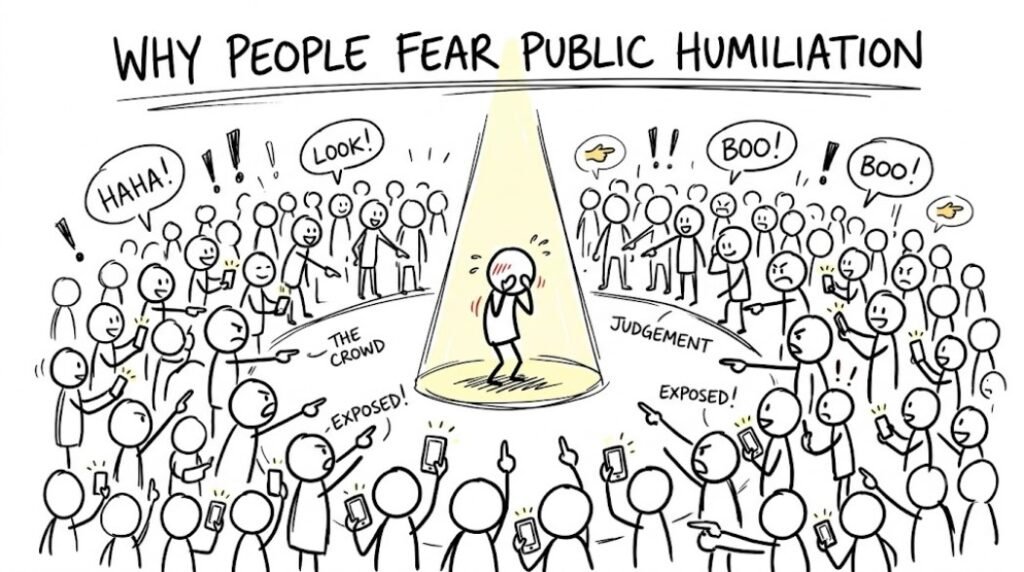
Imagine someone puts a gun to your head.
Not a movie gun. A real one. Cold metal behind your ear, the kind of cold that makes your whole body suddenly remember it has a body.
The man holding it is calm. Weirdly calm. Like a bank clerk explaining which box you forgot to tick.
He gives you a choice.
Option one: he shoots you.
Option two: you take off every piece of clothing and stand completely naked at a busy traffic signal for thirty minutes.
You exhale. Thirty minutes. Awful, but survivable. Your fingers are already on your shirt buttons.
Then he adds the catch.
It isn’t just random strangers at that signal.
Your boss is there. Your coworkers, including the one who smiles at you in meetings and forwards your mistakes to management. Your wife. Your children. Your parents. Your neighbours, including the aunty from the third floor who already has opinions about your life. Your college friends. People you’ve dated. People you spent years trying to impress. People who already dislike you and have been waiting, patiently, for exactly this moment.
And thousands of strangers.
Everyone has their phone out. Some are recording in 4K. One guy has gone live.
The light turns red. Then green. Then red again. Nobody moves, because nobody is driving anymore. They’re watching you.
Your mother’s face. Your ex, standing next to their new partner, trying not to smile and failing. Your manager, who will sit across from you in Monday’s meeting and know. And the video doesn’t disappear. It’s there next year. It’s there when your kid’s friends’ parents Google your name.
If you refuse, you die.
So.
What do you choose?
Don’t answer quickly. Picture the heat of the road under your bare feet. The horns. The specific, unbearable sound of someone you know saying your name.
Now notice something uncomfortable.
For a split second, some part of your brain seriously considered the bullet.
Not because you want to die. But a small, ancient, deeply unreasonable part of you looked at those thirty minutes and whispered:
How would I ever face those people again?
Hold on to that whisper. We’re going to follow it through your entire life.
The Daughter Problem
Now the man tilts his head and says:
“Fine. If you won’t do it, I’ll make your daughter do it instead.”
Watch what happens inside you.
The whole calculation collapses in half a second. No debate. You’re already pulling off your shirt. Thirty minutes? You’d stand there for thirty hours.
Wait. What just happened?
Five seconds ago, that humiliation felt so catastrophic that death was on the table. Now it’s a price you’d pay without blinking.
The humiliation didn’t change. Same signal. Same phones. Same aunty. What changed is what the humiliation means.
If you stand there to save your own skin, the story in your head is: Look at this pathetic person.
If you stand there to protect your child, the story becomes: Look at a parent who would do anything for their kid.
Same naked body. Completely different character.
In the first story, you’re the joke. In the second, you’re the shield. Love gives the humiliation a job. And once humiliation has a job, it stops being an attack on who you are and becomes an expression of who you are. Your identity as a protector, your sense of responsibility, becomes bigger than your reputation.
That’s the first big clue:
We don’t just fear humiliation. We fear what humiliation would mean about who we are in the eyes of other people.
Now, let me be careful, because the internet loves getting this wrong. I’m not claiming most people would literally choose a bullet over a bad afternoon. Nobody has run this experiment, and no scientist has proven humiliation is worse than death. You’ve probably heard that people fear public speaking more than dying. That idea comes from surveys where people ranked their fears, which is not the same as choosing death over a wedding toast. Jerry Seinfeld turned it into a famous joke: by that logic, the average guy at a funeral would rather be in the casket than giving the eulogy.
It’s a joke. It’s funny because it’s a little too close to home.
The point isn’t the exact math. The point is how disturbingly close the math gets.
Nobody Has a Gun to Your Head. You Choose Anyway.
Here’s the fucked-up part.
Nobody is pointing a gun at you. And yet you make decisions every day based on the same fear.
You just call it something else.
Being practical. Being responsible. Being realistic. Keeping the peace. Maintaining your image. Avoiding drama. Waiting for the right time. Protecting your reputation. Not wanting to look stupid.
Sometimes those are legitimate reasons. Sometimes waiting really is smart.
But sometimes they’re just fear of humiliation wearing a respectable shirt.
Fear shows up to your decisions dressed as Wisdom. It wears a crisp blazer and calls itself Strategy. And because it’s so well dressed, you let it run half your life without ever asking to see its ID.
Let’s check some IDs.
Why This Shit Hits So Hard
First, the reason humiliation feels so brutal isn’t that you’re weak. It’s that you’re human.
In 1995, psychologists Roy Baumeister and Mark Leary published an influential review arguing that humans have a fundamental “need to belong,” a deep drive to form and keep lasting relationships. When that need is threatened, it affects our emotions, our thinking and our wellbeing.
There’s also an evolutionary story many researchers find persuasive, though it’s a hypothesis, not something anyone watched happen. For most of history, humans lived in small groups. Getting pushed out wasn’t a vibe. It could mean no protection, no shared food, no help when you got sick. A brain that screamed at the first sign of disapproval may have kept its owner alive. Psychologist Paul Gilbert, for example, has written about shame as tied to how valued we are in the eyes of others, basically our social rank.
So your brain may be running software built for a world where being laughed out of the tribe could kill you. Now that software runs in a world where the “tribe” is a WhatsApp group with three uncles forwarding fake news.
Then there’s the famous brain research. In a 2003 study in Science, Naomi Eisenberger, Matthew Lieberman and Kipling Williams had people play a virtual ball-tossing game where the other players eventually stopped passing to them. Being excluded was associated with activity in a brain region also involved in the distress of physical pain.
People ran with that: “Rejection is literally physical pain!” Slow down. A 2014 study by Choong-Wan Woo and colleagues found that while the two experiences may involve overlapping brain regions, the detailed patterns of activity are different. The honest version: social pain and physical pain seem related in the brain, but they aren’t the same thing. Rejection doesn’t break your leg. It just seems to have a key to the same building.
And humiliation specifically? In a 2014 study, Marte Otten and Kai Jonas recorded brain activity while people read about humiliating, angering and happy scenarios. Humiliation showed signs of being an especially intense emotional experience.
So no, you’re not a drama queen. Humiliation is a heavyweight.
The Security Guard Who Protects the Wrong Thing
Psychologists have a name for the thing running your life here: fear of negative evaluation.
In 1969, David Watson and Ronald Friend created the Fear of Negative Evaluation Scale to measure how much people worry about being judged unfavourably. In 1983, Mark Leary published a shorter version, the Brief Fear of Negative Evaluation Scale. Researchers have long treated this fear as a core ingredient of social anxiety.
In human language: it’s how much of your brain is busy with “What are they going to think of me?”
It exists on a spectrum. Everyone has some. Having some doesn’t mean you have a disorder; it means you have a working social brain. For some people it becomes intense enough to seriously disrupt life, and that’s worth talking to a professional about. I’m not diagnosing anyone. I’m pointing at something nearly all of us carry.
Here’s how I picture it.
Fear of humiliation is a security guard who doesn’t protect your house. He protects the photo of your house. Someone could be quietly stealing your time, your ambitions, your happiness, and he wouldn’t blink. But the moment a neighbour might spot a crack in the paint, he’s on the radio calling for backup.
Behind that guard sits a PR agency. Mark Leary and Robin Kowalski described this machinery in 1990 as impression management: the constant work of monitoring and controlling how others see us. Your ego is a PR firm that never sleeps and bills you in anxiety.
Then comes the real killer: shame.
Researcher June Tangney and colleagues have spent years studying the difference between guilt and shame.
Guilt says: “I did something bad.”
Shame says: “There is something bad about me.”
You can fix a behaviour. You apologize, repair, move on. But you can’t apologize your way out of being you. Tangney’s work suggests guilt tends to push people toward making amends, while shame is more linked to hiding, denying or lashing out.
Humiliation is shame with an audience. Not just “there’s something bad about me,” but “there’s something bad about me and everyone just saw it.“
One more layer. Henri Tajfel and John Turner’s social identity theory holds that part of who we are comes from our groups and roles. The engineer. The good son. The successful one from your batch. The happy couple. When humiliation threatens those roles, it doesn’t feel like losing an argument. It feels like losing a piece of yourself.
Now let’s go look at your life.
The Job That Is Slowly Eating You
You hate your job. Not Monday-blues hate. Soul-level hate. The company treats you like a disposable pen. You haven’t learned anything in two years. Your manager gives feedback via passive-aggressive email at 11:47 p.m.
You know you should leave. You don’t.
Sometimes the reason is real. Rent is real. If quitting would put your family in trouble, staying isn’t cowardice. It’s responsibility.
But let’s be honest about what else is going on.
You picture a wedding. Some uncle you see twice a year, holding a plate of paneer, asking:
“So, beta, what are you doing these days?”
And you picture yourself saying:
“Nothing. I’m looking for a job.”
You can already see the pause. The tiny, polite recalculation of your worth. You picture your junior from college posting a promotion on LinkedIn while you refresh job portals in your pyjamas.
So you keep showing up to the place chewing through your soul like free cafeteria food.
Ask yourself:
Are you afraid of unemployment? Or afraid of being seen as unemployed?
Simple test: if nobody on earth would ever know you’d quit, would you still stay?
If the answer changes, you’ve found the security guard.
The Relationship Everyone Clapped For
Two people know their relationship is fucked. Their friends know. Their families have started using the tone people use around a patient.
But everyone has seen the Instagram pictures. The Goa trip. The anniversary post with a caption long enough to need chapters. They’ve told everyone how happy they are. The parents met. There was a function.
So breaking up doesn’t just mean ending a relationship. It means going back to the audience and saying, “Yeah… that didn’t work.” Deleting the posts, which somehow feels like a public confession.
So they stay. Not always because they love each other. Sometimes because leaving would require explaining themselves.
Leon Festinger called the discomfort of our actions clashing with our beliefs cognitive dissonance. One common way to ease it is to double down on choices we’ve already made, and the more publicly you’ve committed, the more admitting a mistake feels like admitting you’re a person who chooses badly.
Which raises an ugly question:
How much private suffering will you tolerate to avoid admitting in public that you chose wrong?
For a lot of people: years.
You Aren’t Buying the Object. You’re Buying the Reaction.
The phone that costs more than your first salary. The car slightly bigger than your parking space. The watch. The wedding with seven functions and a drone. The restaurant you picked because it would look good in a story.
How many did you need? And how many did you buy for the way people would look at you?
You aren’t buying the object. You’re buying the reaction.
The half-second when a colleague notices the logo. The “arre, new car?” in the parking lot. The object is the delivery vehicle. The actual product is other people’s eyes.
Thorstein Veblen described “conspicuous consumption” back in 1899: spending on visible goods to signal status. Modern research supports the idea. In field experiments with a bank in Indonesia, economist Leonardo Bursztyn and colleagues found evidence that demand for a platinum credit card was driven partly by status, not just its practical perks. And when people got a small boost to their self-esteem, their interest in the status card dropped.
Make people feel slightly better about themselves, and they need slightly less metal in their wallet to prove something.
Festinger also gave us social comparison theory in 1954: we judge ourselves partly by comparing ourselves to others. You don’t just ask “Am I okay?” You ask “Am I okay compared to them?” And every time you upgrade your life, you upgrade who “them” is. The finish line is on a treadmill.
Broke, But Make It Aesthetic
Follow that shopping cart to the credit card statement.
Three EMIs. A card maxed out so long it’s basically family. A salary that vanishes within ten days like a magician’s assistant.
And yet their Instagram looks like a luxury brochure. Brunch. Rooftops. A weekend in the hills.
They’re financially drowning while holding a Rolex above the water.
This isn’t just a stereotype. Economists Sumit Agarwal, Vyacheslav Mikhed and Barry Scholnick studied lottery winners in Canada and found that after someone won, their close neighbours became more likely to go bankrupt, with bigger wins linked to more bankruptcies nearby. The neighbours won nothing. They just watched someone else get richer. Separate research by Dimitris Georgarakos, Michael Haliassos and Giacomo Pasini found that Dutch households who believed their social circle earned more than them tended to borrow more.
None of this means everyone with a loan is a status junkie. But the pattern is hard to ignore: people take real financial risks to avoid looking like they’re falling behind.
Which gives us one of the great absurdities of modern life:
You can be broke as fuck and still look rich enough to impress people who are also broke as fuck.
It’s a theatre where every audience member is also on stage, and nobody can afford the ticket.
Your Personality Has Become a Customer-Service Department
“Can you come?” “Yes.”
“Can you lend me money? Next month, definitely.” “Yes.”
“Can you take this extra project? It’s small.” (It’s never small.) “Yes.”
“One more drink?” “Yes.”
“You’re joining the trip, right?” “Yes.”
Then it’s 1 a.m. and you’re lying in bed exhausted, broke, hungover and resentful, wondering how your life became a to-do list written by other people.
Because “no” has a price. You might be seen as selfish. Boring. Cheap. Difficult. Rude. The one who “has changed.”
Every yes is a tiny payment to avoid a tiny humiliation. Eventually your whole personality becomes a customer-service department: polite, available, and completely empty inside, because customer service doesn’t get to have preferences.
The ridiculous part? You’re imagining a courtroom. They’re mostly thinking about dinner.
Nodding Along to Nietzsche
Someone at dinner starts talking. Nietzsche. Monetary policy. A cryptocurrency that sounds like a Pokémon. The “subtle tannins” in a wine that, to you, tastes exactly like wine.
You have absolutely no fucking idea what they’re talking about.
Everyone else is nodding. So you nod. You add an “mmm, true.” You laugh half a second late, like a badly dubbed movie.
Because “I don’t know what that means” feels like standing naked at the signal. Intellectually naked.
Here’s the funny part. Half the table might be nodding for the same reason. Leonid Rozenblit and Frank Keil described the illusion of explanatory depth: people tend to believe they understand how things work in far more detail than they do. Ask them to explain it step by step and the confidence collapses.
So picture the table again. Some people don’t understand. Some think they understand but couldn’t explain it. And everyone is terrified of being first to say “Wait, what?”
It’s a group project where everyone is pretending to have read the chapter.
“I don’t know” feels like confessing stupidity. It’s actually the only sentence that lets you learn anything. The person nodding along leaves exactly as ignorant as they arrived, just with a sore neck.
Three Hours of Suffering to Avoid a Thirty-Second Question
You can’t figure something out at work. The person who knows sits ten feet away. Asking would take thirty seconds.
Instead you spend three hours Googling, breaking things, fixing them, breaking them again, and quietly sweating.
Because asking might expose you. He doesn’t even know this?
People sometimes prefer failing in private over learning in public.
The evidence suggests your brain is miscalculating. Alison Wood Brooks, Francesca Gino and Maurice Schweitzer found that asking for advice can actually increase how competent others think you are, especially on hard tasks. And research by Francis Flynn and Vanessa Lake found people consistently underestimate how willing others are to help when asked directly.
So your brain says: asking makes you look dumb, and nobody will help anyway.
The research says: asking can make you look smart, and people help more than you expect.
Your brain is a terrible weather forecaster. It predicts storms daily and never apologizes when the sun comes out.
“Yeah Bro, All Good”
Someone is broke. Lonely. Scared. Failing. Quietly falling apart.
A friend asks, “Everything okay?”
“Yeah bro. All good.”
The two most dishonest words in any language.
Admitting you’re struggling feels like it changes your position in the room. You go from peer to project. From the one who has it together to the one people worry about.
But a 2011 study by Alexander Jordan and colleagues found people tend to underestimate how much others experience negative emotions. We see everyone’s “all good” and assume we’re the only ones who aren’t.
And Anna Bruk, Sabine Scholl and Herbert Bless described the beautiful mess effect: people tend to see their own displays of vulnerability as weakness, but view the same behaviour in others more positively. You judge your own honesty far more harshly than others would. You see the mess. They’re more likely to see the beautiful part.
You don’t have to unload your inner life on every colleague at the coffee machine. But if things are genuinely heavy, telling someone you trust, or talking to a mental health professional, isn’t humiliation. It’s maintenance. You wouldn’t hide a leaking pipe out of pride. Well, you would. But you shouldn’t.
Everyone Is Performing for an Audience That Is Also Performing
Open Instagram.
Bali. Tiny food in dim lighting. New car with a red ribbon. Gym transformation. A couple on a beach looking away from the camera in that “we didn’t know” way that took forty-seven attempts. “Blessed.” “Grateful.” “New beginnings.”
Then you look at your laundry and your sad dinner, and a voice says: everyone is doing better than me.
But everyone you’re watching is also scrolling. And they’re looking at your one good trip photo and thinking the same thing about you.
Everyone is performing prosperity for an audience that is also performing prosperity.
It’s a fashion show where every model is secretly in the front row, judging the others and hating their own outfit.
The research here is genuinely mixed, so let’s be careful. In a 2013 study, Ethan Kross and colleagues texted young adults several times a day and found that more Facebook use predicted feeling worse afterward and declines in life satisfaction over the study. A later review by Philippe Verduyn and colleagues suggested that passive scrolling seems more linked to lower wellbeing than active use, partly through envy and upward comparison. Much of this research is correlational, and scientists still debate how big the effects are.
So I won’t tell you Instagram is destroying your brain. I’ll tell you this: you’re comparing your behind-the-scenes footage to everyone else’s trailer. And the trailer always wins, because it was edited by someone just as scared as you.
The 45-Minute Courtroom Defense
Twenty minutes into an argument, you realize something horrible.
You’re wrong. Properly wrong. A small voice inside says, Oh. They’re right.
But other people saw you be wrong.
So you construct a 45-minute courtroom defense for an opinion you stopped believing twenty minutes ago. You attack their tone. You find a technicality. You say “that’s not what I meant.” You bring up something from 2019. You become a lawyer defending a client you know is guilty, and the client is your ego.
Because “Yeah, I fucked up, you’re right” feels like a public demotion.
Carol Tavris and Elliot Aronson wrote an entire book on this, Mistakes Were Made (But Not by Me), about how people justify their errors to protect their image of themselves as smart and good. The more your identity depends on being right, the more being wrong feels like an attack on your whole self.
But think about the people you actually respect. Often they’re the ones who can say “I was wrong about that.” It doesn’t make them smaller. It makes them look solid.
The person who can never admit they’re wrong isn’t strong. They’re fragile, wearing armour.
Four Likes and a Comment From Yourself
Now the big one. The one probably costing you the most.
You want to start a YouTube channel. Write a book. Start a business. Try stand-up. Launch a podcast. Apply for the job you think is out of your league. Ask that person out. Change careers at 35.
And you don’t. Not because it’s impossible. Because you can already hear the laughing.
Let’s play it out.
You spend six hours on your first video. You film it seventeen times because your face does something weird when you talk. You post it.
It gets 4 likes. Your mom. Your best friend. A bot called “hot_singles_4u.” And someone who liked it by accident.
One comment. From you.
“Like, Comment, Share ❤️”
Then your colleague finds it. Colleagues always find it. He drops it in the office WhatsApp group with three laughing emojis.
Someone replies: “Bro thinks he’s going to become famous 😂”
And you lie in bed imagining walking into the office tomorrow. The smirks. Someone saying “Hi, influencer” loud enough to be overheard.
That’s the fear.
Not failure.
Public evidence of failure.
Failure vs. Humiliation
This might be the most important idea in this essay.
Failure says: “I tried something and it didn’t work.”
Humiliation says: “Everyone saw me try something and it didn’t work.”
Failure is information. Your video was too long. Your pitch was unclear. The joke didn’t land. Failure is a teacher: boring, slightly cruel, but useful.
Humiliation doesn’t feel like information. It feels like a verdict. Not “your video needs work” but “you are a joke, and now it’s on record.”
So your brain avoids the whole thing, because the only guaranteed way to never fail publicly is to never do anything publicly.
Which leads to one of the most expensive trades people make:
They’d rather stay potentially impressive than become publicly mediocre.
As long as you never try, you keep the fantasy. I could have been a great writer. I could have built something. Nobody can prove otherwise. Your potential sits on a shelf like a phone still in its box.
Try, and you trade the fantasy for reality. And reality, at the beginning, almost always sucks.
So people spend ten years wondering if they could have succeeded rather than six months looking stupid while finding out.
You protect your reputation like you’re already famous. You’re hiring bodyguards for a celebrity who hasn’t released a single song.
Meanwhile, look at people who actually made things. James Dyson has said he built 5,127 prototypes before his vacuum design worked. That’s 5,126 that didn’t. J.K. Rowling has publicly shared that the first Harry Potter book was rejected by multiple publishers. Nearly every comedian you’ve laughed at has bombed in front of strangers, repeatedly. Every writer you admire wrote a lot of garbage first. Every career-changer you know spent a while being the oldest, most confused person in the room.
The difference between them and you might not be talent. It might be that they agreed to be publicly mediocre long enough to get good.
Nobody Is Watching as Closely as You Think
Good news.
In a well-known 2000 study, Thomas Gilovich, Victoria Husted Medvec and Kenneth Savitsky had college students walk into a room of peers wearing an embarrassing T-shirt featuring singer Barry Manilow. The students guessed that roughly half the room noticed. In reality, it was closer to a quarter.
They called it the spotlight effect: we overestimate how much others notice our appearance and our mistakes.
And even when people do notice, a 2001 study by Savitsky, Nicholas Epley and Gilovich found that people who suffered a public blunder expected harsher judgment than they actually received.
You think you’re under a blazing spotlight. Everyone else is under their own spotlight, worrying about their own Barry Manilow shirt.
Your humiliation is the main event in your head. In theirs, it’s a commercial break.
The Contradiction at the Center of All This
Humans want to be seen. Desperately. We want admiration, love, status, followers, respect. We want to be known.
And that same desire is exactly what creates the fear.
If you want people to watch you win, you have to accept that they can watch you lose.
You can’t sell tickets only for the matches you’ll win. You can’t ask for an audience only on the days you look impressive. The stage doesn’t come with a “hide me when I’m bad” button.
Everyone you admire who is visible and successful paid this price. They accepted that the crowd that might cheer could also laugh.
So if you want to be seen, you’ve already signed up for the possibility of humiliation. The only question is whether you’ll let it keep you in the dressing room forever.
“Just Don’t Care What People Think” Is Bullshit
Before this turns into a motivational poster, let’s kill a myth.
“Just stop caring what people think!”
That’s simplistic bullshit. People who truly don’t care what anyone thinks aren’t usually heroes. Sometimes they’re just assholes.
Sometimes embarrassment protects you. The discomfort before you say something cruel at a party is useful. The shame after lying to a friend might be your own values tapping your shoulder. If five people you respect say your business plan has a massive hole, that’s not humiliation. That’s free consulting. And for a doctor, a teacher or a business owner, reputation is tied to trust, and trust has real consequences.
So the goal isn’t to stop caring. It’s to care selectively.
Know whose opinion matters. Know when you’re protecting your values and when you’re protecting your ego. Know when you’re avoiding real consequences versus a few awkward days.
How to Stop Letting This Shit Run Your Life
1. Separate consequences from embarrassment
Ask: “What will actually happen if I do this?” Then: “What am I imagining people will think?”
Your brain blends these into one terrifying smoothie. Unblend them. Quitting your job: the real consequence is that you need savings and a plan. The imagined one is Uncle Paneer’s face. The first deserves careful planning. The second deserves a lot more skepticism than you give it.
2. Practice being mildly embarrassing
Psychologist Albert Ellis, founder of Rational Emotive Behaviour Therapy, used “shame-attacking exercises”: deliberately doing small, harmless, slightly embarrassing things to learn the world doesn’t end.
Start small. Ask a basic question in a meeting. Say “I don’t know.” Post something imperfect. Wear the shirt you think is “too much.” Say no once this week. Ask for help.
The point isn’t recklessness. It’s teaching your nervous system one lesson: “Oh. Nobody died.” Your brain doesn’t learn from pep talks. It learns from evidence.
3. Be a beginner in public
The first video can suck. The first article, business, performance, painting: all allowed to suck. That’s what first attempts are for.
Nobody watches a toddler fall and says, “Loser. Give up on walking.” Give yourself the same courtesy.
4. Ask whose opinion actually matters
Make a real list of people whose respect matters to you. It’s probably short. Then notice how much of your life is shaped by people who aren’t on it.
If 500 strangers laugh but the people you love still respect you, what have you lost? And if everyone approves of your life but you secretly hate it, what have you won?
5. Imagine the humiliation actually happening
Don’t stop at “people will laugh.” Follow the story.
They laugh. Then what?
You go home. You feel like shit for an evening. You sleep badly. You go to work. Someone makes a joke. A week later someone else does something dumb and everyone moves on.
Then what? You continue.
Most humiliation has a surprisingly short half-life. It’s a firecracker: loud, bright, then a smell of smoke that fades faster than you’d believe. The fear lives in the fog. Drag it into the light and it shrinks.
6. Stop treating your reputation like a finished product
Your reputation isn’t a statue. You’re allowed to evolve. To change careers. To quit. To start over at 40. To admit you were wrong. To be bad before you’re good.
People who treat their reputation as finished end up living inside it like a museum exhibit. Admired, maybe. Not alive.
7. Get comfortable being misunderstood
Some people will think you’re stupid. Some arrogant. Some boring. Some brilliant. Most won’t think about you at all.
You can’t control the courtroom in everyone’s head. You’re not even invited to those trials. Let them hold them. You have a life to run.
The Most Important Part
You don’t beat the fear of humiliation by convincing yourself nobody will laugh.
That’s a lie, and part of you knows it. People might laugh. The video might get four likes. The joke might die in a silent room.
You beat it by deciding:
“They can laugh.”
Not “they won’t.” They can. And you’re doing it anyway.
You don’t need certainty that you’ll succeed. Nobody gets that. You need a willingness to survive looking stupid.
That’s courage. Not feeling fearless. Being willing to be seen while you’re still imperfect.
Back to the Traffic Signal
Remember the man with the gun?
At the start, the scenario felt absurd. Some dark thought experiment you’d never face.
Look at it again.
You’ve been standing at a smaller version of that signal your whole life.
Every time you stayed in a job because you couldn’t face “what are you doing these days,” you chose. Every time you stayed in a relationship because leaving meant explaining, you chose. Every purchase for the reaction. Every yes that should’ve been no. Every nod at a conversation you didn’t follow. Every hour struggling instead of asking. Every “all good, bro.” Every argument you kept fighting after you knew you’d lost. Every video unposted, book unwritten, person unasked, business unstarted.
Nobody pulled a trigger. But you paid anyway. In opportunities. Money. Relationships. Years. The version of you that might have existed if you’d agreed to look stupid for a while.
And remember what happened when the man mentioned your daughter? The humiliation didn’t shrink. It got a reason. The moment you had something worth protecting more than your image, you stopped caring who was holding a phone.
So what do you care about more than the image of yourself? Your curiosity? The work you know you’re supposed to make? The life you keep scheduling for “someday”?
Find it. Let it be your reason.
People might film you. Someone might laugh. A colleague might forward it with three emojis.
Let them.
The light turned green a long time ago. You’ve just been standing at the edge of the road, waiting for a moment when nobody’s watching.
That moment is never coming.
Cross anyway.
Research Sources
- Agarwal, S., Mikhed, V., & Scholnick, B. (2020). Peers’ income and financial distress: Evidence from lottery winners and neighboring bankruptcies. The Review of Financial Studies, 33(1), 433–472.
- Baumeister, R. F., & Leary, M. R. (1995). The need to belong: Desire for interpersonal attachments as a fundamental human motivation. Psychological Bulletin, 117(3), 497–529.
- Brooks, A. W., Gino, F., & Schweitzer, M. E. (2015). Smart people ask for (my) advice: Seeking advice boosts perceptions of competence. Management Science, 61(6), 1421–1435.
- Bruk, A., Scholl, S. G., & Bless, H. (2018). Beautiful mess effect: Self–other differences in evaluation of showing vulnerability. Journal of Personality and Social Psychology, 115(2), 192–205.
- Bursztyn, L., Ferman, B., Fiorin, S., Kanz, M., & Rao, G. (2018). Status goods: Experimental evidence from platinum credit cards. The Quarterly Journal of Economics, 133(3), 1561–1595.
- Eisenberger, N. I., Lieberman, M. D., & Williams, K. D. (2003). Does rejection hurt? An fMRI study of social exclusion. Science, 302(5643), 290–292.
- Ellis, A. Rational Emotive Behavior Therapy and shame-attacking exercises (see Albert Ellis Institute materials and Ellis’s published work on REBT).
- Festinger, L. (1954). A theory of social comparison processes. Human Relations, 7(2), 117–140.
- Festinger, L. (1957). A Theory of Cognitive Dissonance. Stanford University Press.
- Flynn, F. J., & Lake, V. K. B. (2008). If you need help, just ask: Underestimating compliance with direct requests for help. Journal of Personality and Social Psychology, 95(1), 128–143.
- Georgarakos, D., Haliassos, M., & Pasini, G. (2014). Household debt and social interactions. The Review of Financial Studies, 27(5), 1404–1433.
- Gilbert, P. (1997). The evolution of social attractiveness and its role in shame, humiliation, guilt and therapy. British Journal of Medical Psychology, 70(2), 113–147.
- Gilovich, T., Medvec, V. H., & Savitsky, K. (2000). The spotlight effect in social judgment: An egocentric bias in estimates of the salience of one’s own actions and appearance. Journal of Personality and Social Psychology, 78(2), 211–222.
- Jordan, A. H., Monin, B., Dweck, C. S., Lovett, B. J., John, O. P., & Gross, J. J. (2011). Misery has more company than people think: Underestimating the prevalence of others’ negative emotions. Personality and Social Psychology Bulletin, 37(1), 120–135.
- Kross, E., Verduyn, P., Demiralp, E., et al. (2013). Facebook use predicts declines in subjective well-being in young adults. PLoS ONE, 8(8), e69841.
- Leary, M. R. (1983). A brief version of the Fear of Negative Evaluation Scale. Personality and Social Psychology Bulletin, 9(3), 371–375.
- Leary, M. R., & Kowalski, R. M. (1990). Impression management: A literature review and two-component model. Psychological Bulletin, 107(1), 34–47.
- Otten, M., & Jonas, K. J. (2014). Humiliation as an intense emotional experience: Evidence from the electro-encephalogram. Social Neuroscience, 9(1), 23–35.
- Rozenblit, L., & Keil, F. (2002). The misunderstood limits of folk science: An illusion of explanatory depth. Cognitive Science, 26(5), 521–562.
- Savitsky, K., Epley, N., & Gilovich, T. (2001). Do others judge us as harshly as we think? Overestimating the impact of our failures, shortcomings, and mishaps. Journal of Personality and Social Psychology, 81(1), 44–56.
- Tajfel, H., & Turner, J. C. (1979). An integrative theory of intergroup conflict. In W. G. Austin & S. Worchel (Eds.), The Social Psychology of Intergroup Relations (pp. 33–47). Brooks/Cole.
- Tangney, J. P., Stuewig, J., & Mashek, D. J. (2007). Moral emotions and moral behavior. Annual Review of Psychology, 58, 345–372.
- Tavris, C., & Aronson, E. (2007; rev. eds. later). Mistakes Were Made (But Not by Me). Harcourt.
- Veblen, T. (1899). The Theory of the Leisure Class. Macmillan.
- Verduyn, P., Ybarra, O., Résibois, M., Jonides, J., & Kross, E. (2017). Do social network sites enhance or undermine subjective well-being? A critical review. Social Issues and Policy Review, 11(1), 274–302.
- Watson, D., & Friend, R. (1969). Measurement of social-evaluative anxiety. Journal of Consulting and Clinical Psychology, 33(4), 448–457.
- Woo, C.-W., Koban, L., Kross, E., Lindquist, M. A., Banich, M. T., Ruzic, L., Andrews-Hanna, J. R., & Wager, T. D. (2014). Separate neural representations for physical pain and social rejection. Nature Communications, 5, 5380.
- Examples: James Dyson’s 5,127 prototypes (as stated by Dyson and the Dyson company); J.K. Rowling’s early rejections by publishers (as shared publicly by Rowling).
Discover more from niranjanpathak.info
Subscribe to get the latest posts sent to your email.
Comments are off here. Come find me on social instead — I answer everything.