Which Brahmin? Give me his name.
Before You Read This (Yes, You, With the Comment Already Loading)
Let me get one thing out of the way, because I know how the internet works.
This is not a hateful article about Brahmins. It is not a hateful article about Dalits. It is not written to make any caste feel proud, guilty, superior or attacked. If you finish this and think “he hates my community,” please read it again, slowly, preferably after coffee.
This article is for a very specific audience: the few percent of dumbasses who exist in every caste. Yes, including Brahmins. Yes, including Dalits. Yes, including every community in between. The guy who thinks his surname makes him better than you. The guy who thinks your surname makes you guilty of something you never did. The guy who turns someone else’s real suffering into his personal debate trophy. The guy who forwards fake “history” on WhatsApp at 11 PM with twelve angry emojis.
Most people of every caste are decent human beings trying to pay rent, raise kids and survive traffic. This article is not about them. It is about the people who make caste their weapon, in whichever direction they are pointing it.
If that’s not you, relax and read. If that is you, well, especially read.
In India, your surname walks into the room before you do.
You haven’t said anything yet. You haven’t told a joke, revealed your opinion on Kohli, or embarrassed yourself on the dance floor at somebody’s cousin’s wedding. But somebody has already run a quick calculation. Pathak. Okay. Brahmin. File under: probably vegetarian, probably thinks he’s clever, probably personally responsible for roughly three thousand years of something.
I know this calculation well because people have run it on me. In school. In college. And still today, as an adult who should theoretically be done with playground nonsense. People have said caste-based things to me because I am Brahmin, sometimes as a “joke,” sometimes as an “observation,” sometimes as a full historical indictment delivered between two sips of chai.
I usually answer back. Sometimes with facts. Sometimes with a joke that lands harder than their insult. Sometimes I just take their argument apart right there, calmly, until they regret opening their mouth. I’m not writing this to tell you I’m wounded. I’m not.
I’m writing it because every time it happens, I notice the same thing, and it has nothing to do with me.
Most arguments about casteism in India are set up like a courtroom. Who was right? Who was wrong? Which caste is the villain of history, and which caste is the victim? Everybody shows up with their lawyers, their WhatsApp forwards and their favourite atrocity, and the debate goes exactly nowhere, because it was built on the wrong question.
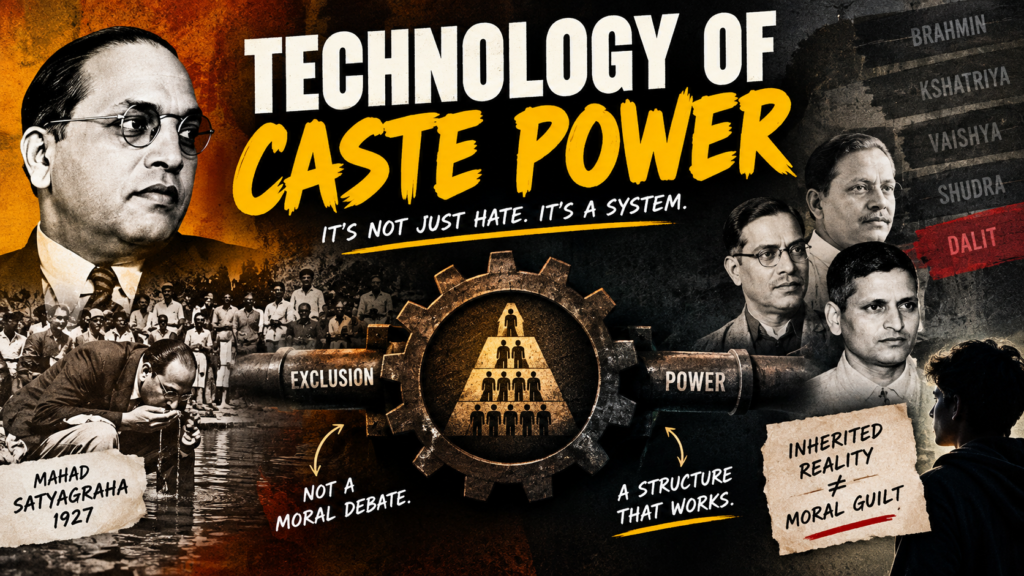
Casteism was never a debate about who was right. It was a hierarchy. And hierarchies are not about truth. They are about power.
Who can make whom drink from a separate vessel. Who can keep whom out of a temple, a well, a classroom, a kitchen, a marriage. Who can humiliate whom and get away with it. Who gets to decide another human being’s place before that human being has done a single thing.
Once you look at caste through power instead of through “good caste versus bad caste,” a lot of comfortable positions stop being comfortable. On every side.
So here’s where this article is going. I’m going to ask some questions that make people uneasy, and I’m not going to answer all of them right away:
Can guilt travel through blood?
When somebody says “Brahmins did this,” which Brahmin, exactly?
If reservation was meant to fix caste, why is caste still here?
And how exactly do you destroy a system while asking everyone, every day, which part of the system they belong to?
Stay with me. Some of this will annoy you. If it annoys everyone equally, I’ve probably done my job.
Part One: What Casteism Actually Did
Before anything clever, the foundation, because everything later depends on it and I refuse to build the argument on sand.
Caste discrimination against Dalits was real. It was serious. It was wrong. It was not a misunderstanding, not a “Western distortion,” and not something invented by the British to divide us. Colonial policy did plenty of dividing, and historians argue seriously about how the British hardened and classified caste. But the untouchable did not need a British census to find out he couldn’t use the village well.
Take one story from Maharashtra, where I come from.
In 1923 the Bombay Legislative Council passed the Bole Resolution, which said public water sources and wells should be open to the “Depressed Classes.” Mahad’s municipality never actually enforced it because upper-caste residents resisted. So on 20 March 1927, B.R. Ambedkar led a satyagraha to the Chavdar tank in Mahad, and Dalits drank the water. The response is the part worth remembering. To “purify” the tank, caste Hindus emptied 108 pots of a cow dung and cow urine mixture into it while Brahmins chanted, and only then declared it fit for upper-caste use again. [15]
Let that sink in. A human being drinks water, and the water has to be ritually cleaned of him.
That is what I mean by power. Nobody in Mahad was debating whether untouchability was correct. They were demonstrating that they could enforce it.
Ambedkar’s own autobiographical notes, published as Waiting for a Visa, describe this world from inside. As a schoolboy in Satara he could not drink from the tap on his own; water was available only if a peon was around to pour it for him. Later, returning to Baroda in 1917 with degrees from Columbia and London, he was thrown out of a Parsi inn once it came out that he was untouchable. [7] The most educated man in the room was still, to the people holding power, a contaminant.
The Constitution eventually said, in plain words, that this was over. Article 17 abolishes “untouchability” and forbids its practice in any form. [1] Parliament backed it with the Untouchability (Offences) Act of 1955, later renamed the Protection of Civil Rights Act, and then the Scheduled Castes and the Scheduled Tribes (Prevention of Atrocities) Act of 1989. [2]
And yet. When the India Human Development Survey, run by NCAER and the University of Maryland across more than 42,000 households, asked about it, about 30 per cent of rural households and 20 per cent of urban households admitted to practising untouchability. [4] Admitted. To a surveyor. Imagine the number who didn’t say so.
The police data tells the same story. The NCRB’s Crime in India 2023 report recorded 57,789 cases of crimes against Scheduled Castes, with Uttar Pradesh reporting the most, followed by Rajasthan and Madhya Pradesh. [3]
So let’s be completely clear before we go anywhere uncomfortable. The argument coming next does not require pretending any of this didn’t happen. If your argument about caste needs you to deny Mahad, your argument is garbage. Mine doesn’t. Mine starts here.
Part Two: Casteism Is a Technology of Power
Here is the lens I want to use for the rest of this article.
Casteism is not an opinion. Opinions are cheap; everyone has them and most are wrong. Casteism is what happens when an opinion about someone’s birth gets enforcement power behind it.
A man who privately thinks he’s superior because of his surname is an idiot. A man who can stop you from entering the temple because of your surname is a casteist. The difference is not the belief. The difference is power.
This matters because it changes what we should be looking for. If casteism is about power, the useful questions are not “which caste is evil?” but:
Who, in this village, this office, this college, this political party, this WhatsApp group, can humiliate whom?
Who can exclude whom?
Who can make someone else feel small for something they didn’t choose?
Historically, for most of Indian history, the answer ran overwhelmingly in one direction. Ritual status, land, access to scripture, social sanction: power was stacked against the people at the bottom, and the people at the top built religious justifications to keep it that way.
But power is not a fixed possession. It moves. It moves with money, with politics, with numbers, with who controls the local police station and who controls the narrative on Twitter. A caste that was dominant in one district can be a minority in another. A community that was ritually “high” can be economically broke. And a community that was oppressed in the past can hold real local power in the present. Political scientists have been writing about “dominant castes” (landholding, numerically strong, often ritually middle-ranked groups) since M.N. Srinivas coined the term in the 1950s, precisely because the textbook ladder with Brahmins on top never matched how power actually worked on the ground.
Here’s the funny part, if anything about this is funny. Everybody loves the power lens when it points at their opponents. The moment it points back at them, suddenly “it’s more complicated.”
It is more complicated. That’s the point. The power lens doesn’t let anyone off. It just refuses to let anyone assume they are permanently the good guy.
Part Three: “This Happened to Me”
Now let’s go somewhere harder.
Suppose a Dalit man in a village is beaten for riding a horse at his own wedding. (This is not a hypothetical category; reports of this exact kind of attack show up in Indian newspapers with depressing regularity.) Here’s what I think is true, with no qualifications:
He is the victim. The suffering belongs to him. The men who beat him are responsible. The state must protect him, the police must register the case, and the courts must punish the attackers. The Atrocities Act exists for exactly this man, and when it works, it is doing something good and necessary.
Nothing in what follows weakens a single word of that paragraph.
But there’s a second thing that happens in public life, and we rarely separate it from the first. The suffering of individuals gradually becomes the property of an identity. It stops being “this happened to him” and becomes “this happened to us,” and then, slowly, “therefore I, personally, am permanently defined by it and entitled to speak with its authority.”
Those are very different sentences.
“This happened to me” is testimony. It is concrete. It has a date, a place, a perpetrator. It demands justice, and justice is possible.
“This happened to my community, so this grievance is who I am” is something else. It isn’t a lie, because communities really did suffer. But it has a way of detaching from the actual people who suffered. The man beaten at his wedding in a village gets nothing from the fact that someone in a city, three generations removed from any untouchability, uses the community’s grievance as a rhetorical trump card in a debate about something else entirely.
And here’s the uncomfortable symmetry. The people who most loudly claim inherited victimhood are very often not the ones currently being victimized. The most actively oppressed people are usually too busy surviving to run the discourse.
That applies to my side too. I’ve seen more than enough “Brahmins are the new Dalits” forwards, written by comfortable men in comfortable apartments, borrowing a grievance they never paid for. It’s the same move, pointed in a different direction.
So here’s the distinction I want to plant firmly:
Justice for a victim and political ownership of victimhood are not the same thing.
Justice is owed to a person. Ownership of victimhood is claimed by a group, often by people who were never victims themselves, and often to win arguments that have nothing to do with the original injury.
The argument is not “stop complaining.” If someone has been discriminated against, they should complain loudly, file the case and name the man who did it. The argument is that a grievance can be true and still be misused, and that the people most harmed by the misuse are frequently the real victims, whose specific suffering gets dissolved into a slogan.
Part Four: Can Guilt Travel Through Blood?
If a man commits a crime, he is guilty. Obvious.
If a man commits a crime because he belongs to caste X, meaning his casteism motivated it, then he is guilty, and his casteism is an aggravating factor. Also obvious.
But does that make every member of caste X guilty? Try it with any other identity and everyone recoils. We don’t say every Gujarati is responsible for a Gujarati fraudster, or every Tamilian answers for a Tamil politician’s corruption. Yet caste discussions slide very easily into collective moral judgment, and nobody seems to notice the slide.
So let me ask the questions directly.
If someone committed a caste atrocity a hundred years ago, what exactly is the moral responsibility of a person born in 2004?
What if his family had nothing to do with it? What if they were poor priests reciting mantras at other people’s weddings for a few rupees? What if his ancestors were in a different district, a different century or a different line of work? What if he himself has been on the receiving end of caste taunts?
Can moral guilt be inherited biologically? Is there a gene for it?
I don’t think these are rhetorical questions with obvious answers, because people who argue the other side aren’t stupid. They’re usually pointing at something real, just with the wrong word. So let’s pull apart six things that get mashed together in almost every caste argument:
Inherited privilege. Real. If your family has been literate for ten generations, you walked into school with an advantage that had nothing to do with your intelligence. Networks, cultural capital, the confidence that comes from never having been told you’re polluting: these are real inheritances, and pretending otherwise is dishonest.
Inherited disadvantage. Also real. If your great-grandfather was forbidden to learn to read, that affected your grandfather’s opportunities, which affected your father’s, which affected yours.
Historical consequences. Real. The past shapes the present distribution of land, education, jobs and confidence.
Moral guilt. This one is personal. Guilt attaches to acts: things you did, or things you knowingly allowed when you could have stopped them. It does not come in your DNA.
Legal liability. Strictly individual. A court needs an accused, an act and evidence. No Indian court will convict you because your great-great-grandfather was a jerk.
Personal responsibility. Present-tense. It is about what you do now: whether you practise discrimination, whether you tolerate it at your dinner table, whether you exploit an unearned advantage while pretending it doesn’t exist.
Pull these apart and a lot of noise disappears. You can inherit a privilege without inheriting guilt. You can inherit a disadvantage without inheriting a permanent moral claim on specific living strangers. And inheriting a privilege does create a responsibility, just not the one people usually mean: not to feel guilty for your ancestors, but to not be the person who keeps the machine running.
That’s a much more demanding standard than guilt, by the way. Guilt is easy. You can feel guilty and do absolutely nothing. Responsibility actually costs you something.
Part Five: Which Brahmin? Give Me His Name.
Now the fun part.
When someone tells me, with great confidence, “Brahmins did this,” my response is simple.
Which Brahmin?
Give me his name. Give me the village. Give me the year. Tell me what he did. Show me the document, whether an inscription, a court record, a letter or a newspaper report. Something.
Was he my father? My grandfather? Was he some distant Pathak who shares my surname and absolutely nothing else? Was I alive? Was my grandfather alive?
If you can’t answer any of that, then what you are accusing me of is not a crime. It’s a genre.
Because “Brahmins did this” is not a historical claim. It sounds like one. It has the costume of one. But try to cross-examine it and it collapses. A historical claim has actors, dates and evidence. “Brahmins did this” has a villain made of millions of strangers across three thousand years and two dozen languages, some of whom were Sanskrit scholars, some of whom were cooks, some of whom fought the British and some of whom worked for them.
It’s like saying “Punjabis did this.” Which Punjabi? Bhagat Singh? Or the guy who cut you off on the expressway this morning?
Now, the serious part, because this section is not “therefore nothing happened.”
History can name names. It can name institutions. It can name systems. And when it does, it should be taken absolutely seriously. The men who “purified” the Mahad tank were real people in a real town on real dates. Temple trusts that barred Dalits were real institutions with real trustees. The rules of ritual pollution were written in real texts that real people used to justify real exclusion. A good historian identifies all of that.
Here’s the thing that surprised me most when I went back to the source. Ambedkar himself did not locate the problem in anyone’s blood. In Annihilation of Caste he writes that the enemy to fight is not the people who observe caste but the shastras that teach them to observe it. He even says Hindus observe caste not because they are inhuman or wrongheaded but because they are deeply religious, and what is wrong is the religion that instilled the notion of caste. [6]
Read that again. The most rigorous anti-caste thinker India ever produced aimed his fire at an idea and its institutions, the authority of scripture and the social order built on it. He did not aim it at a bloodline.
That is intellectually serious. “Brahmins did this,” shouted at a nineteen-year-old in a college canteen, is not.
So yes: identify people, institutions and systems. Put them on trial, historically and, where they’re alive, legally. What I refuse to accept is the conversion of millions of living individuals into morally responsible descendants of unknown people. That isn’t history. It’s the caste system with the arrows reversed.
Part Six: The Man Standing Next to the Thief
Let me try an analogy.
Imagine I see you standing on a street corner chatting with a man. The next day, that man steals my wallet.
I come to you and say: “You were standing with him. Give me my money.”
You say: “What the fuck? I don’t even know the guy.”
I say: “No, no. I saw you with him. You’re responsible.”
Everyone reading this knows that’s absurd. No court, no parent and no reasonable human would accept it. Proximity isn’t guilt.
Now let’s apply that to the most famous murder in modern Indian history.
Mahatma Gandhi was assassinated on 30 January 1948 in the compound of Birla House in New Delhi. The killer, Nathuram Godse, was a Chitpavan Brahmin from Maharashtra.
What followed in Maharashtra is a chapter most Indians have never been taught. In the days after the assassination, mobs attacked Brahmin homes, shops, presses and businesses, especially in the southern Marathi districts: Satara, Kolhapur, Sangli, the Belgaum region, and also in Pune, Bombay and Nagpur.
Here is what can be said with reasonable confidence. The main scholarly study is Maureen L.P. Patterson’s chapter “The Shifting Fortunes of Chitpavan Brahmins: Focus on 1948,” published in 1988. As summarised by journalist Dhaval Kulkarni, Patterson estimated the damage at Rs 6 crore to Rs 10 crore, with thousands of houses burned, thousands left homeless, and serious setbacks to the early industrialisation of southern Maharashtra. The only official inquiry was a commission set up by the ruler of Kolhapur and headed by Justice N.H.C. Coyajee of the Bombay High Court, which held ministers of the princely state culpable. [19]
Here is what cannot be said with confidence: how many people died. You will find claims online of thousands, even tens of thousands, of Brahmins “massacred.” I could not find any documentary or scholarly basis for those figures. One widely repeated account cites a contemporary wire report of about fifteen deaths in Bombay on the first day, and other accounts mention small numbers of officially recorded deaths. Neither amounts to a reliable total. Patterson herself reportedly said that scholars still could not access Maharashtra’s post-independence archives, so a definitive study had yet to be written. The honest position is this: real, widespread, caste-targeted violence and destruction happened; the death toll is unknown; and anyone who gives you a precise large number is guessing or selling something.
Why Brahmins? Because Godse was one, and in the heat of grief and rage his caste became a target you could burn. It also didn’t come out of nowhere. Maharashtra had decades of tension between Brahmins and non-Brahmin communities, dating back at least to Jotirao Phule’s Satyashodhak movement in the nineteenth century, which challenged Brahmin religious and social dominance. Arvind Kolhatkar, who was five and living in Satara at the time, later wrote that the anger may have been the culmination of decades of caste tension, and that mobs attacked innocent Brahmin families on the baseless assumption that all Brahmins shared the guilt for the assassination. His family lived in a mostly non-Brahmin neighbourhood and had always been on cordial terms with its neighbours, and a mob still descended on their home on 1 February 1948. [20]
And here is the detail that wrecks every collective narrative at once. Many non-Brahmins sheltered and protected Brahmin families during the violence, often at risk to their own lives and property. [19]
So the mob was not “the non-Brahmins.” The victims were not “the Brahmins” as a moral unit. There were individuals who attacked, individuals who were attacked, and individuals who opened their doors. Exactly like every other riot in human history.
So let me say it as plainly as I can:
Godse’s crime belongs to Godse.
Not to every Brahmin in Maharashtra. Not to the Kolhatkar family in Satara. Not to me.
(And if you want to talk about the responsibility of the specific organisations and co-conspirators around Godse, that is a legitimate historical question that historians argue over. Notice what that question involves, though: actual membership, actual actions, actual evidence. Not birth.)
And now the principle, applied universally, as principles have to be:
The crime of a casteist individual belongs to that individual. Not to every person born into his caste.
If the 1948 mobs were wrong to punish every Brahmin for Godse, then anyone who holds every living Brahmin responsible for every historical casteist is making the same move, just with words instead of kerosene. The scale is different. The logic is identical.
Part Seven: No, This Is Not a False Equivalence
I can already hear the objection, so let me answer it before someone types it angrily.
“Are you comparing a few days of anti-Brahmin riots to centuries of untouchability?”
No. I’m not.
Untouchability was a structural, religiously sanctioned, multigenerational system of exclusion that shaped every part of a person’s life: where they lived, what they could touch, whether they could learn, whom they could marry, what work they were permitted to do. The 1948 violence was a horrific but time-bound outbreak of mob revenge. Taunts aimed at Brahmins in a modern college are unpleasant, sometimes cruel, and occasionally career-affecting, but they are not the same as being denied water.
These are not the same scale of suffering, and I’m not pretending they are.
What I’m comparing is principles, not magnitudes.
The principle is: punishing people for their birth is unjust. That principle doesn’t become true only when the injustice is big enough. Theft of ten rupees and theft of ten crore are different in scale, but both are theft, and nobody says the small one is fine because the big one is worse.
A principle that applies only to other people’s suffering was never a principle. It was a team jersey.
Part Eight: “The Brahmin” Is Not a Historical Character
There was never a single human being called “the Brahmin” who spent three thousand years oppressing everybody. There were millions of individual Brahmins, and when you look at actual individuals, the neat story falls apart almost immediately.
Consider one tiny sub-caste from coastal Maharashtra: the Chitpavans.
Gopal Krishna Gokhale, a leading Moderate in the Congress and founder of the Servants of India Society in 1905, was someone Gandhi called his political guru. Gokhale was born in 1866 in Ratnagiri district into a Chitpavan Brahmin family. [31]
Nathuram Godse, the man who shot Gandhi: also a Chitpavan Brahmin.
Same small community. One produced Gandhi’s political teacher; another produced Gandhi’s murderer. So which one “represents” Chitpavans? Neither. Both. The question is nonsense.
Keep going.
Gopal Ganesh Agarkar broke away from Kesari and started his own journal, Sudharak, in 1888, which went after caste orthodoxy, gender injustice and religious dogma. He and Bal Gangadhar Tilak, once close collaborators, split over whether social reform or political reform came first, with Agarkar arguing that social reform was the more urgent need. Both men were Chitpavan Brahmins. Two Brahmins, same generation, same city, same newspaper, opposite answers to the most important question of their time. [28]
The Chapekar brothers came from a Chitpavan Brahmin family originally from Chapa near Chinchwad, and were raised by a father known for his kirtans and modest income. They assassinated the British plague commissioner W.C. Rand in Pune in 1897 and were hanged. Colonial officials called them murderers; nationalists call them martyrs. Neither verdict tells you anything about “Brahmins.” [28]
Chandrashekhar Azad was born Chandra Shekhar Tiwari on 23 July 1906 in Bhabhra village, into a Kanyakubja Brahmin family. And if you think “Brahmin” automatically means comfortable, consider that his family’s poverty forced him to work from a young age, and in the early 1920s he went to Bombay and laboured as a coolie in the shipping yard, living in a cramped shack with other workers. [27] Explain to me the “Brahmin privilege” of a teenager hauling cargo in the Bombay docks.
Now go to Mahad in 1927 again, to the same satyagraha where the tank got “purified.” On 25 December 1927, the resolution to burn the Manusmriti was moved by Gangadhar Neelkanth Sahasrabuddhe, a Brahmin associate of Ambedkar, and seconded by P.N. Rajbhoj, a Dalit leader. [15] So in that one town, in that one year, you had Brahmins purifying a tank to keep Dalits out, and a Brahmin standing next to Ambedkar moving the resolution to burn the text that justified it.
And in 1948, Ambedkar married Dr Sharada Kabir. She was born into a middle-class Saraswat Brahmin family, met Ambedkar as his doctor when he was seriously ill, and married him on 15 April 1948, becoming Savita Ambedkar. [29]
Now, I need to be very careful here. Everything I just listed could easily turn into the thing I’m criticising: a highlight reel of “good Brahmins” to prove the caste is secretly virtuous. That would be the same collective thinking, just flattering instead of accusing.
So let me be clear about what the list proves. It doesn’t prove Brahmins were good. For every Agarkar there were orthodox men who fought reform tooth and nail. When Savarkar’s Patitpavan temple opened in Ratnagiri in 1931, Brahmins invited from Kashi, Bombay and Nashik opposed both the temple and the inter-caste dining Savarkar proposed. [16] Those were Brahmins too.
A caste cannot be morally summarised by selecting either its heroes or its villains.
That’s all the list proves. You can build a “Brahmins were saints” case or a “Brahmins were demons” case from the same archive just by choosing which files to open.
And the same is true in the other direction. “Dalits” are not one psychologically identical human being either. There are Dalit bureaucrats and Dalit landless labourers, Dalit Buddhists and Dalit Hindus and Dalit Christians, Dalit conservatives and Dalit communists, and people who don’t want the word “Dalit” to be the first thing anyone knows about them. Collapsing all of them into one aggrieved character is its own kind of disrespect.
People are individuals. That sentence shouldn’t be radical. In caste debates, somehow, it is.
Part Nine: Ambedkar’s Life Was More Complicated Than Anyone’s Slogan
I want to do this section carefully, because Ambedkar gets turned into a mascot by almost everyone now, including people who have never read a page he wrote.
First: Ambedkar faced brutal caste discrimination, repeatedly, as a child and as a highly educated adult. That is documented in his own words. [7] Nothing below softens it.
Second: his life also included many people, from different backgrounds, who helped him. Both things are true. That is the whole point.
Start with Krishnaji Arjun Keluskar, known as Dada Keluskar. According to Changdev Khairmode’s biography, Keluskar was the headmaster of Wilson School, a scholar and author, and a non-Brahmin. He noticed young Bhiva reading in the Charni Road garden, took an interest in him, taught him how to read methodically, and supplied him with books. In January 1908, at a felicitation meeting presided over by S.K. Bole, Keluskar presented him with a book on the life of the Buddha that Keluskar had written himself. [11] It is hard not to see something prophetic in that gift.
Then Sayajirao Gaekwad III, Maharaja of Baroda. Keluskar arranged a stipend of Rs 25 a month from Sayajirao when Ambedkar entered Elphinstone College in 1908. Later Sayajirao funded his studies at Columbia University with a scholarship of £11.5 a month. Ambedkar never forgot it. In a letter dated 10 October 1950, he called Sayajirao “my patron and architect of my fortune,” and said the only way he could repay the debt was to write the Maharaja’s biography. [14] (He never managed to.)
And when he wanted to return to London to finish his studies, Keer records that he used his savings, took help from the Maharaja of Kolhapur, borrowed Rs 5,000 from his friend Naval Bhathena, and sailed back to London in July 1920. [10] That Maharaja was Shahu of Kolhapur, a major patron of the non-Brahmin movement. Bhathena was a Parsi.
Notice something? The people who most shaped his early education in these accounts were a non-Brahmin headmaster, two Maratha rulers and a Parsi friend. So if you came here hoping for “Brahmins made Ambedkar,” sorry. That’s not what the evidence says either.
Which brings me to the famous surname story, the one that gets forwarded around claiming “a Brahmin teacher gave Ambedkar his name.” Here is what I found.
Dhananjay Keer’s biography says a Brahmin teacher offered Ambedkar his surname, but Keer does not name the teacher. Keer’s account says the family name had been drawn from their native village of Ambavade, and that this teacher, who was fond of the boy and shared his own lunch with him, changed it to “Ambedkar” in the school records. [10] Khairmode’s biography also refers to a “master Ambedkar” who taught young Bhiva, and whom Babasaheb later honoured with a suit of clothes and a token gurudakshina. [11] The researcher Hari Narke has said that, based on his research, the primary school teacher Krushnaji Keshav Ambedkar gave him the surname, while also acknowledging that people are divided on the question. Other writers argue there is no solid proof the teacher existed, and say Ambedkar’s father chose to have his sons registered under the village-derived name, which school staff then shortened to “Ambedkar” because the original was awkward to pronounce. [13]
My verdict: it’s plausible, it’s contested, and I’m not building a single argument on it. And frankly, it doesn’t matter. If a Brahmin teacher was kind to him, that proves individual Brahmins could be kind. We already knew that. It doesn’t erase the peon who had to pour his water.
(One more honest note: I also went looking for documentation of a specific role played by Narayan Chandavarkar, the reformer and judge, in Ambedkar’s education, because that claim floats around too. I couldn’t find it established in reliable sources, so he’s not in this article. Leaving someone out is better than inventing them in.)
Now to Ambedkar’s actual ideas, because the mascot version keeps drowning them out.
In 1936 the Jat-Pat Todak Mandal of Lahore, a Hindu reformist group against caste, invited Ambedkar to deliver a presidential address. When they read his text, they asked him to cut parts they found too provocative. He refused, the event was cancelled, and he published the speech himself as Annihilation of Caste. [6] It remains one of the most devastating things ever written about Indian society.
His argument was not “upper castes are evil.” It was structural and relentless. Caste, he argued, is not a division of labour but a division of labourers, graded hierarchically and fixed by birth. It destroys public spirit, charity, fraternity, and any sense of a shared public. And it survives because it has religious sanction.
He also had a precise view of the cure. He dismissed inter-dining as inadequate, because many castes eat together without their caste consciousness weakening at all. He argued instead that only intermarriage could create a genuine feeling of kinship. In his words, “Nothing else will serve as the solvent of caste.” [6] Hold on to that line; it matters later.
And then, the twist most people skip: he immediately says that telling people to intermarry is futile as long as they believe the shastras forbid it. The real remedy, he argues, is to destroy belief in the sanctity of the shastras. Marriage was the solvent, but he thought you couldn’t pour it until the religious sanction was broken.
His conflict with Gandhi was sharp, personal and consequential. In 1932 the British Communal Award granted separate electorates to the Depressed Classes. Gandhi began a fast unto death in Yerwada jail against separating them from the Hindu electorate, and Ambedkar, under enormous pressure, signed the Poona Pact, accepting reserved seats within joint electorates instead. He resented the circumstances for the rest of his life, and in 1945 published What Congress and Gandhi Have Done to the Untouchables, a blistering indictment. [8] When Annihilation of Caste came out, Gandhi responded in Harijan in 1936 with a defence of varna as distinct from caste, and Ambedkar printed a rebuttal in the next edition.
And at the very end of the Constitution-making process, Ambedkar warned the Constituent Assembly on 25 November 1949 that India was about to enter a life of contradictions: political equality through one person, one vote, one value, alongside continuing social and economic inequality. He argued that political democracy would not last unless it rested on social democracy, which meant a way of life that recognised liberty, equality and fraternity as principles of life. [9]
Notice the unit of value in all of this: the individual. Ambedkar’s entire project was about the dignity of the individual human being against a system that assigned worth by birth.
Which is, when you think about it, exactly the argument of this article.
Part Ten: Savarkar, Gandhi and the Marriage Question
Now to the part I specifically wanted to investigate, because I suspected the popular version was too simple. It was.
Savarkar first. After his release from the Andamans, Savarkar was interned in Ratnagiri from 1924 to 1937 and barred from political activity, so he poured his energy into social reform. [16] He attacked what he called the seven shackles of Hindu society: untouchability (sparshabandi), bans on inter-dining (rotibandi), bans on inter-caste marriage (betibandi), restrictions on occupations (vyavasayabandi), the ban on sea travel (sindhubandi), restrictions on Vedic rites (vedoktabandi), and the ban on reconversion to Hinduism (shuddhibandi). [17] He persuaded a Ratnagiri philanthropist, Bhagoji Sheth Keer, to build the Patitpavan temple in 1931 and started an inter-dining project that brought people of all castes to eat together. [16]
That’s real. People who dismiss Savarkar as simply a reactionary on caste haven’t read this part of the record.
But people who turn him into a caste-abolitionist saint haven’t read the rest. The best recent scholarly work, Janaki Bakhle’s Savarkar and the Making of Hindutva (Princeton University Press, 2024), is based on his Marathi writings and complicates the picture in three ways. [16]
First, the tone. Bakhle reads his poems on untouchability as condescending, including one in which a fictional Dalit thanks upper castes for the great favour of being allowed into the temple, and she calls this a measure of Savarkar’s tone-deafness.
Second, the purpose. Bakhle argues that by setting “Hindu” against caste, Savarkar was telling communities doing political work around their caste identity that they should give it up in order to be called Hindu. His caste reform was welded to Hindu nationalist consolidation. You can admire the reform and still see the project it served.
Third, and this directly affects my original thesis, marriage. Savarkar was enthusiastic about marriages across provinces and wrote about restoring love’s right to choose a partner. But on marriages between Shudras and Brahmins, he did not campaign for intermarriage as the route to annihilating caste the way Ambedkar did. He focused instead on arguing that castes had no genetic or blood differences, and suggested that any imposed agenda of intermarriage would fail with both upper castes and untouchables. In a 1913 letter to his brother, he also said he strongly favoured inter-provincial Hindu marriages while being deadly opposed to Indians marrying European women. And in a 1916 letter he used the language of eugenics about marriage, which Bakhle rightly flags as startling today.
So the accurate summary is not “Savarkar championed inter-caste marriage.” It is: Savarkar declared the ban on inter-caste marriage one of the shackles of Hindu society, rejected birth-based caste as mere custom with no basis in blood, supported love marriage and marriage across regional boundaries, organised inter-dining and temple entry in practice, and stopped short of actively campaigning for marriages across the Brahmin and untouchable line, all inside a Hindu nationalist framework.
Not a saint. Not a villain. A man with a record. Which is exactly what I said I’d show.
Now Gandhi, because his views genuinely changed, and anyone who quotes only one period of his life is cheating.
The early Gandhi defended caste. Ambedkar quoted Gandhi’s writings in the Gujarati journal Navajivan from 1921 to 1922, in which Gandhi praised caste’s organising power and said he did not believe inter-dining or intermarriage were necessary for national unity. In 1921 he wrote that Hindu society had survived “because it is founded on the caste system.” At this stage he opposed untouchability fiercely but defended the underlying structure, arguing for varna without hierarchy. [18]
Then he moved. By 1935 he was writing under the title “Caste Must Go” that varnashrama involved no prohibition on inter-marriage or inter-dining. In January 1947, in Noakhali, he advised upper-caste Hindu women to invite a Harijan to dine with them every day. And on marriage specifically, by 1946 he was telling young people that they could not be married at Sevagram Ashram unless one of the partners was a Harijan. The historian Mark Lindley documents that Gandhi also resolved to attend no wedding in which both Hindu partners came from the varnas. [18]
So the Gandhi of 1921 thought intermarriage was unnecessary. The Gandhi of 1946 would bless essentially only inter-caste marriages involving a Dalit partner. That’s a huge journey, and it happened while he was being hammered, publicly and relentlessly, by Ambedkar.
Where did the three differ?
Early Gandhi wanted to abolish untouchability while keeping the rest of the edifice, then gradually dismantled his own position until marriage across the deepest line became his test. Savarkar rejected caste as custom without scriptural or biological basis, pursued inter-dining and temple entry in practice, but approached marriage across the Brahmin and Dalit line cautiously and nested all of it inside Hindu consolidation. Ambedkar said intermarriage was the only real solvent, and that it wouldn’t happen until the religious authority behind caste was broken.
All three, in their different ways, ended up at the same door: the family. The marriage. Which brings me to what I actually believe.
My interpretation, clearly labelled as my interpretation and not as historical fact: if inter-caste marriage had been aggressively normalised across Indian society much earlier, promoted by the national leadership in the 1920s the way temple entry and khadi were, rather than arriving late in Gandhi’s life and at the edges of everyone else’s programme, caste boundaries might be far weaker today than they are.
That’s a counterfactual. Nobody can prove it. Maybe it would have produced a backlash. Maybe honour violence would have spiked. Maybe nothing would have changed, because marriage norms are shaped by families, not speeches. I’m offering it as an argument to think with, not a fact to forward.
And yes, people have already decided what they think about Savarkar without reading what he actually wrote, in both directions: the ones who worship him and the ones who spit at his name. I have a lot more to say about that than fits in an article about caste. Subscribe. That article is coming.
Part Eleven: Why Marriage Is the Engine Room
Here’s why all three reformers kept circling marriage, and why I think they were right to.
Caste is not primarily a belief. You can stop believing in caste entirely and it will still reproduce itself through you, because it isn’t stored in your head. It’s stored in your family.
It survives through surnames, which announce it. Through inheritance, which concentrates land and property within it. Through marriage circles and matrimonial columns (“Brahmin, fair, well-settled, caste no bar except SC/ST,” which is the most Indian sentence ever written). Through community associations, caste hostels, caste-based matrimonial sites, and the uncle who knows a family “from our people.”
Every other mechanism is secondary to one: endogamy. Marry within the group, and the group reproduces itself perfectly every generation, no matter what anyone believes.
So how are we doing? When the India Human Development Survey asked married women aged 15 to 49 whether theirs was an inter-caste marriage, only 5.4 per cent said yes, slightly more in cities than villages, and the proportion was unchanged from the previous survey round in 2004 to 2005. Economists analysing the same data put the rate at 5.82 per cent in 2011, with no upward trend over four decades, and found that the education of the spouses themselves made no difference; what mattered was the education of the husband’s mother. [4] [5]
Ninety-five per cent. After Phule, Agarkar, Gandhi, Savarkar, Ambedkar, the Constitution, the Special Marriage Act, seventy-plus years of democracy, and a generation raised on Bollywood films about love conquering all. Ninety-five per cent of us still marry inside the line.
Which is exactly why inter-caste marriage threatens caste in a way that nothing else does. Every inter-caste marriage breaks a lineage’s chain of reproduction. It mixes the surnames at the family table. It makes the children’s networks messy and overlapping. It makes “our people” a harder category to maintain. Do it at scale for three generations and the categories start losing their grip on real lives.
But (and this is where I have to argue against my own enthusiasm) inter-caste marriage alone cannot automatically finish the job:
Children are still usually assigned a caste, typically the father’s, so the categories can survive the marriage itself.
Families can respond with violence. “Honour” killings exist precisely because some families would rather destroy their own child than lose control of the boundary.
Caste survives outside marriage: in land ownership, in local politics, in who gets hired through whose uncle, in caste certificates, in vote banks.
And Ambedkar’s own warning stands: as long as the religious and social authority behind caste remains intact, individual marriages remain exceptions rather than the rule.
So marriage is the engine room, but you can’t take over a ship by occupying only the engine room. It’s necessary. It’s not sufficient.
Part Twelve: Reservation, and What Problem It Was Built to Solve
Now the section where half my readers are sharpening knives. Relax. I’m not going to start with “reservation is bad.” I’m going to start with the only question that makes the debate intelligent:
What problem was reservation created to solve?
Not “end caste.” That is a common misunderstanding, and it leads to a lazy conclusion. Reservation was designed to address representation and exclusion: to make sure that communities systematically kept out of education, government jobs and legislatures for centuries would actually be present in them.
The constitutional architecture, briefly:
Article 15 prohibits discrimination on grounds including caste, but clause 15(4), inserted by the First Amendment in 1951, allows the state to make special provisions for socially and educationally backward classes and for Scheduled Castes and Scheduled Tribes. Clause 15(5), added by the 93rd Amendment in 2005, extended this to admission in educational institutions, including private ones (minority institutions excepted). [1]
Article 16 guarantees equality of opportunity in public employment, and clause 16(4) permits reservation of posts for backward classes not adequately represented in state services. [1]
Articles 330 and 332 reserve seats for SCs and STs in the Lok Sabha and state assemblies, and Article 334 attached a time limit to these political reservations. That limit has been extended repeatedly, most recently to 2030. [1] This part descends directly from the 1932 Poona Pact.
Scheduled Castes are notified by presidential order under Article 341, and Scheduled Tribes under Article 342. [1]
Ambedkar himself, arguing for Article 16(4) in the Constituent Assembly, framed reservation as an exception to the general rule of equal opportunity, one that should be confined to a minority of posts so the rule itself survived. [9] Keep that in mind; it matters for the creamy-layer debate.
Then came Other Backward Classes. The Second Backward Classes Commission, chaired by B.P. Mandal, was set up on 1 January 1979 and submitted its report at the end of 1980, recommending 27 per cent reservation for OBCs in central government jobs. [30] The report sat on a shelf for a decade until Prime Minister V.P. Singh announced its implementation in August 1990, triggering massive protests.
The Supreme Court settled the fight in Indra Sawhney v. Union of India on 16 November 1992. The nine-judge bench upheld 27 per cent OBC reservation and laid down two important limits: a ceiling of 50 per cent on total reservations, and a bar on reservations based purely on economic criteria. It also required the better-off among OBCs, the “creamy layer,” to be excluded from quota benefits. [21]
Then, in 2019, the 103rd Amendment flipped one of those limits. For the first time the Constitution allowed reservation on a purely economic basis, inserting clause (6) into Articles 15 and 16 so the state could reserve up to 10 per cent of seats and posts for Economically Weaker Sections among citizens not already covered by SC, ST or OBC reservation. A five-judge Constitution Bench upheld the amendment 3 to 2 on 7 November 2022 in Janhit Abhiyan v. Union of India. [22]
At the central level, the result today is roughly: 15 per cent for SCs, 7.5 per cent for STs, 27 per cent for OBCs (non-creamy layer) and 10 per cent for EWS. States have their own structures and percentages, and several have fought long battles over the 50 per cent line.
Part Thirteen: “If Reservation Was Meant to End Caste, Why Is Caste Still Here?”
I promised to come back to this, and here’s why the question is slightly wrong.
Reservation was not designed to end caste. It was designed to put excluded people into rooms they had been shut out of. Criticising it for failing to abolish caste is like criticising a hospital for failing to abolish disease. That was never its job. Its job was treating patients.
But the better version of the question is completely legitimate: if the objective was representation and correction of disadvantage, how do we know whether it’s working?
You’d measure things like literacy, school completion, college enrollment, government representation, income, poverty, wealth, social mobility, rates of discrimination and inter-caste marriage. So let’s look at a few with actual numbers, instead of the usual WhatsApp nonsense.
Literacy first, because I’ve heard people say “most Dalits are still illiterate.” That’s false. Census data shows literacy among Scheduled Castes rose from 10.3 per cent in 1961 to 66.1 per cent in 2011, while total population literacy rose from 28.3 per cent to 73 per cent. For SC women specifically, literacy went from 3.3 per cent to 56.5 per cent. [25]
Read those women’s numbers again. From three in a hundred to more than half. That’s one of the great social transformations in modern history, and it gets almost no airtime because it doesn’t fit anyone’s rage.
Poverty: the share of SCs below the poverty line in rural areas dropped from 53.5 per cent in 2004 to 2005 to 31.5 per cent in 2011 to 2012, and in urban areas from 40.6 to 21.7 per cent. [25]
Representation in government: Ministry of Personnel data for 2019 to 2020 showed about 17.41 per cent of central government employees were Scheduled Caste, 7.42 per cent Scheduled Tribe, and 19.94 per cent OBC. [25] SC representation in central services, overall, is now around their share of the population. (How that representation is distributed across seniority levels is a separate and more contested question.)
So there has been real, measurable progress. Anyone claiming reservation achieved nothing is either uninformed or lying.
And the gaps are real too. SC literacy in 2011 was still about seven points behind the national figure. Untouchability, as we saw, was still admitted by a large share of households. Atrocity cases number in the tens of thousands a year. Inter-caste marriage hasn’t moved.
There’s also a hard analytical problem nobody likes to admit: how much of this progress was caused by reservation, and how much by general economic growth, mass schooling, urbanisation and migration? India’s literacy rose massively for everyone. Disentangling reservation’s specific contribution is a serious empirical question, and honest economists don’t all agree on the size.
So here’s where I land, and I think it’s the only defensible position:
A policy can produce real benefits and still be legitimate to evaluate, reform and question.
Saying “reservation helped” is not the end of the conversation. Saying “reservation should be examined” is not casteism. Mature democracies audit their own policies. Only religions demand that you never ask questions.
Part Fourteen: Make the Weak Person Strong, Don’t Define the Community as Weak
This is my strongest personal conviction in this whole debate, so let me state it and then stress-test it.
Reservation should ultimately make a weak person strong. It should not permanently define an entire community as weak.
There’s something quietly insulting in a system that tells tens of millions of people, generation after generation, that they are defined by weakness. The goal of any support should be to make itself unnecessary for the person receiving it. A crutch that you’re never allowed to put down isn’t support. It’s a label.
But I promised to stress-test it, so here’s the problem: who is weak is not a single-axis question. A person can be economically poor but socially privileged, like a poor Brahmin priest’s son in a small town, who has no money but faces no untouchability. A person can be economically wealthy but socially discriminated against, like a Dalit doctor who still can’t rent a flat in certain housing societies. A person can be a first-generation college student from any background, or from a remote district with terrible schools, or from a historically disadvantaged caste but living in a metro as a second-generation professional, or from a traditionally “upper” caste and genuinely destitute.
Caste and class are not the same thing. Both matter, and they don’t line up neatly.
Caste measures something money doesn’t: humiliation, exclusion, social access. A rich Dalit can still be refused a house, insulted at work or attacked for marrying the wrong person. That’s why many argue caste has to remain central to affirmative action: the harm reservation addresses was never mainly economic.
Class measures something caste doesn’t: whether your family can actually afford coaching, laptops, time, and the risk of failing an exam and trying again. That’s the logic of the EWS quota, and it’s why the Supreme Court majority in Janhit Abhiyan accepted economic criteria.
So what should reservation be based on? Caste alone? Economic status alone? Educational disadvantage? Representation gaps? Some combination?
I’m not going to declare a winner, because each has a real cost. Pure caste-based systems risk benefits concentrating in the most advanced families within a group, while missing poverty elsewhere. Pure economic systems risk ignoring discrimination that has nothing to do with income, and income is notoriously easy to hide in a country with a large informal economy. Combined systems are fairer on paper but harder to administer, easier to game, and politically explosive, because every new criterion creates a new constituency that will fight to protect it.
The Supreme Court has itself recognised that “SC” is not one homogeneous block. In August 2024, a seven-judge bench ruled 6 to 1 that states can sub-classify Scheduled Castes, overruling the 2004 Chinnaiah judgment and holding that historical and empirical evidence shows SCs are a heterogeneous class, not a homogeneous one. [23] In plain language: even within the reserved categories, some groups have been left much further behind than others. Which is, basically, my “weak person” argument, arriving through constitutional law.
Part Fifteen: The Creamy Layer
Which brings us to the most politically radioactive phrase in Indian social policy.
The creamy-layer principle says: within a backward class, exclude those who have already advanced, so benefits reach those who haven’t. Right now, creamy-layer exclusion applies only to OBCs, following the 1992 Indra Sawhney judgment. [21] The income threshold for OBCs has been revised over time and currently stands at Rs 8 lakh a year.
In the 2024 sub-classification case, several judges went further. Four of the six judges in the majority said the creamy layer among SCs and STs should also be identified and excluded from reservation. [23] That observation wasn’t part of the binding operative order, but it landed like a grenade.
The political response was immediate. On 9 August 2024, Information and Broadcasting Minister Ashwini Vaishnaw announced that the Union Cabinet had decided SC and ST reservation should follow the Constitution drafted by B.R. Ambedkar, which contains no provision for a creamy layer for SCs and STs. [24] Opposition leader Mallikarjun Kharge went further, saying reservation should continue as long as untouchability is practised in the country.
So here are the arguments, as fairly as I can put them.
For extending the creamy layer: Benefits get cornered by families who have already made it. The IAS officer’s son competes for the same reserved seat as the landless labourer’s daughter, and usually wins, because he had better schools, coaching and confidence. If the goal is to lift the weakest, then the people who’ve already been lifted should step aside. Otherwise a small elite within the group captures a policy meant for everyone in it.
Against: Untouchability was never about income. A wealthy Dalit is still a Dalit to the casteist. Discrimination in housing, marriage and the workplace doesn’t check your salary slip first. Excluding “advanced” SCs could also mean seats go unfilled or revert to the general category, and it could decapitate the community’s emerging professional class, which provides role models, representation and political voice. And there’s a reasonable fear that the creamy layer becomes a tool to shrink reservation quietly, rather than to target it better.
Both arguments are serious. Anyone who tells you one side is obviously stupid hasn’t listened to the other.
My own instinct remains “make the weak person strong.” But I can’t honestly pretend the counter-argument, that the weakness in question isn’t primarily financial, is foolish. It isn’t. It’s the exact argument I’d make about why Brahmin taunts are wrong even when aimed at a rich Brahmin: prejudice doesn’t check your bank balance.
Part Sixteen: The Paradox That Nobody Wants to Look At
Now the philosophical heart of this article.
We say: “Destroy caste.”
Then we ask, constantly: “What caste are you?”
The form asks. The college asks. The job application asks. The matrimonial site definitely asks. The political party asks, not in words but in ticket distribution. And now the nation is asking at a scale not seen since the British.
On 30 April 2025, the Cabinet Committee on Political Affairs, chaired by the Prime Minister, decided to include caste enumeration in the next census. Census 2027 runs in two phases, house listing from April to September 2026 and population enumeration in February 2027. India last counted all its castes in 1931; since independence, census reports have published figures only for Scheduled Castes and Scheduled Tribes. When a petition asked the Supreme Court to keep caste out of the census, the court dismissed it in May 2026, with Chief Justice Surya Kant remarking that any government needs to know how many people are backward and need welfare, and calling it a matter of policy. [26]
And he has a point. You can’t fix a disadvantage you refuse to measure. You can’t target reservation without categories. You can’t prove discrimination statistically without knowing who’s who. Colour-blindness, as Americans discovered, is a very convenient philosophy for whoever already holds the advantages.
But look at the paradox squarely.
Can you dismantle a system while continuously organising society around the categories that system created?
Every caste certificate is a tiny official reaffirmation that caste is real and matters. Every caste-based vote bank gives politicians a reason to keep caste identities sharp, not blurry. Every caste association exists partly to lobby for its members, which means it has an institutional interest in its own survival. Nobody running a caste organisation wakes up hoping caste disappears; that’s their job gone.
I don’t think there’s a clean answer. The best I can offer is an analogy. When you have a fever, you use a thermometer. The thermometer is essential; without it, you can’t tell whether the treatment is working. But the thermometer is not the cure, and nobody builds their personality around their thermometer.
Caste data is a thermometer. It becomes a problem when we mistake it for an identity, when counting becomes belonging, measurement becomes mobilisation, and the category built to repair a harm becomes the thing people are proudest of.
The test for any caste-based policy should be whether it is designed to make the category less relevant over time or more relevant. Honestly, I’m not sure most of our current politics passes that test. And I’m not sure anyone has a strong incentive to make it pass.
Part Seventeen: What I Actually Think
I promised not to tell you which opinion to hold. I’ll keep that promise. But I’ll tell you where all of this has left me, and you can fight me on it.
We cannot build a casteless society by becoming more obsessed with caste identity.
We cannot punish people for crimes they did not commit.
We cannot erase historical injustice by pretending it never happened.
We cannot demand that victims shut up.
We also cannot turn victimhood into hereditary moral authority.
We cannot treat an entire caste as guilty.
We cannot pretend caste disadvantage disappeared because the Constitution outlawed untouchability. The surveys say otherwise. The crime data says otherwise. The matrimonial columns say otherwise.
We cannot pretend reservation has solved every problem.
And we cannot pretend reservation has achieved nothing, not with SC women’s literacy going from three per cent to more than half.
So the question that remains is not “who was right?” and not even “who suffered more?” It’s this:
How do we build a society where the caste of the person standing in front of me becomes steadily, genuinely irrelevant?
Not by pretending not to see it. By making it stop mattering: in who gets the flat, the job, the seat, the vote, the girl, the dignity. That’s the actual destination. Everything else, including reservation, data, law and marriage, should be judged by whether it moves us toward that or away from it.
Where I Leave It
I’m Brahmin. People have said casteist things to me because of it. At school, in college, and still sometimes today.
I’ve responded. I’ve joked about it. I’ve argued back. I’ve quoted history at people who were sure history was on their side, and watched them discover it wasn’t quite. I’ve sometimes just laughed at how stupid the whole thing is.
But here is what I refuse to do. I refuse to let my identity become “I am a Brahmin, therefore I am a victim.” That would be a prison, just a newer and more fashionable one than the old prisons. It would mean handing my sense of self over to the very people who insulted me and letting their stupidity define me.
And I’d say the same, gently, to anyone on the other side of the old line. Your ancestors’ suffering was real. It deserves to be remembered, taught, never denied. Some of it was inflicted by people who shared my surname’s caste, and I have no interest in defending them. But I don’t think that suffering should become the entire definition of your life, any more than an insult should become the definition of mine. You are more than what was done to your great-grandfather. You are also more than what might still be done to you.
A person can honour what happened to their ancestors without letting it become the only thing they are.
So here’s the whole article in four lines:
You are not guilty for what your ancestors did.
You are not entitled to someone else’s guilt because of what your ancestors suffered.
If someone harms you, name him, and make him pay.
Otherwise, judge the person standing in front of you.
Casteism was always about power. Who could humiliate whom. Who could exclude whom. Who could decide another person’s place before that person had done a single thing.
So the strongest person in this story was never the one who inherited the highest caste.
It’s the person who finally refuses to measure human beings by caste at all.
Sources and Further Reading
Numbers in square brackets in the text refer to this list. Every link below was checked against live search results in September 2026. Books without a stable free online copy are listed without a link.
[1] Government of India, Ministry of Law and Justice, Legislative Department. The Constitution of India (Articles 15, 16, 17, 330, 332, 334, 341, 342, and Constitution Amendment Acts including the First, 93rd, 103rd and 104th Amendments). https://legislative.gov.in/constitution-of-india
[2] Government of India. The Scheduled Castes and the Scheduled Tribes (Prevention of Atrocities) Act, 1989 (Act 33 of 1989), India Code. The Protection of Civil Rights Act, 1955 (originally the Untouchability (Offences) Act) is also on India Code. https://indiacode.nic.in/handle/123456789/1920?locale=en
[3] National Crime Records Bureau, Ministry of Home Affairs. Crime in India 2023 (released September 2025). Figures as summarised by Shankar IAS and Vision IAS. https://www.shankariasparliament.com/current-affairs/crime-in-india-report-2023 ; https://visionias.in/current-affairs/news-today/2025-09-30/social-issues/national-crime-records-bureau-ncrb-releases-crime-in-india-2023-report
[4] NCAER and University of Maryland. India Human Development Survey (IHDS-II, 2011 to 2012). Findings reported in “Just 5% of Indian marriages are inter-caste: survey,” The Hindu, 13 November 2014, reproduced by NCAER. https://ncaer.org/publication/just-5-of-indian-marriages-are-inter-caste-survey/
[5] Tridip Ray, Arka Roy Chaudhuri and Komal Sahai. “Whose education matters? An analysis of inter-caste marriages in India.” Ideas for India. https://www.ideasforindia.in/topics/social-identity/whose-education-matters-an-analysis-of-inter-caste-marriages-in-india
[6] B.R. Ambedkar. Annihilation of Caste (1936). In Dr. Babasaheb Ambedkar: Writings and Speeches, Vol. 1, Government of Maharashtra. Excerpts consulted via The Wire and Janata Weekly. https://thewire.in/caste/on-ambedkar-jayanti-remembering-the-annihilation-of-caste ; https://janataweekly.org/articles/on-ambedkar-jayanti-revisiting-the-annihilation-of-caste
[7] B.R. Ambedkar. Waiting for a Visa (written c. 1935 to 1936). In Dr. Babasaheb Ambedkar: Writings and Speeches, Vol. 12, Government of Maharashtra.
[8] B.R. Ambedkar. What Congress and Gandhi Have Done to the Untouchables. Thacker & Co., Bombay, 1945. In Writings and Speeches, Vol. 9.
[9] Constituent Assembly Debates. Ambedkar’s concluding speech of 25 November 1949 (Vol. XI), full text at RGICS and excerpted by The Week; and the debate on draft Article 10, later Article 16 (30 November 1948, Vol. VII), in the Lok Sabha digital library. https://www.rgics.org/?p=3178 ; https://www.theweek.in/magazine/theweek/cover/2023/01/21/dr-b-r-ambedkar-final-speech-in-the-constituent-assembly.html
[10] Dhananjay Keer. Dr. Ambedkar: Life and Mission. Popular Prakashan, Bombay (first published 1954). Page-referenced summary compiled at eSamskriti. https://esamskriti.com/e/History/Great-Indian-Leaders/About-Ambedkar-Education–1.aspx
[11] Changdev Bhavanrao Khairmode. Dr. Bhimrao Ramji Ambedkar (Marathi biography), excerpts translated by Frances W. Pritchett and colleagues, Columbia University; Pritchett’s Ambedkar timeline; and the chronology at drambedkarbooks.com. https://franpritchett.com/00ambedkar/timeline/khairmode_shukla.html ; https://franpritchett.com/00ambedkar/timeline/1900s.html ; https://drambedkarbooks.com/about
[12] Columbia University Center for New Media Teaching and Learning. Ambedkar timeline, citing K.N. Kadam, Dr. Babasaheb Ambedkar and the Significance of His Movement: A Chronology (Popular Prakashan, 1991). https://ccnmtl.columbia.edu/projects/mmt/ambedkar/web/timeline_files/timeline_content03.html
[13] On the surname dispute: Alt News fact-check (11 August 2022); The Logical Indian fact-check (18 August 2022); and, representing the dissenting view, Global Ambedkarites (an advocacy site, cited only to show the dispute). https://www.altnews.in/fact-check-did-brahmins-play-a-role-in-key-events-of-dr-ambedkars-life/ ; https://thelogicalindian.com/fact-check/did-brahmins-have-in-dr-ambedkars-education-upbringing-and-life-37037 ; https://globalambedkarites.org/ambedkar-surname-is-not-given-by-any-brahmin-teacher/
[14] The Week. “How Baroda became special part of Ambedkar’s journey.” January 2023. https://www.theweek.in/theweek/cover/2023/01/21/how-baroda-became-a-special-part-of-dr-ambedkar-s-journey.amp.html
[15] Mahad Satyagraha: SabrangIndia, “Why did Dr Babasaheb Ambedkar publicly burn the Manu Smruti on Dec. 25, 1927?” (2017); StudyIQ summary of the Bole Resolution and the satyagraha; Wikipedia, “Mahad Satyagraha” (used for the tank purification detail; confirm against Keer or Anupama Rao, The Caste Question). On Sahasrabuddhe: R.K. Kshirsagar, Dalit Movement in India and Its Leaders (M.D. Publications, 1994), as cited in secondary sources. https://sabrangindia.in/why-did-dr-babasaheb-ambedkar-publicly-burn-manu-smruti-dec-25-1927/ ; https://www.studyiq.com/articles/mahad-satyagraha-1927/ ; https://en.wikipedia.org/wiki/Mahad_Satyagraha
[16] Janaki Bakhle. Savarkar and the Making of Hindutva. Princeton University Press, 2024. Excerpts published by Scroll.in (7 May 2024) and ThePrint (24 February 2024). https://scroll.in/article/1067485/what-did-vinayak-damodar-savarkar-think-about-dalits-praying-in-temples-and-eating-with-brahmins ; https://theprint.in/pageturner/excerpt/savarkar-accepted-intercaste-marriages-for-one-reason-it-kept-hindus-within-the-community/1976873/
[17] V.D. Savarkar. Jatyuchchhedak Nibandh (Essays on the Abolition of Caste), in Samagra Savarkar Vangmay. English translations of excerpts on the “seven shackles” at savarkar.org (a site run by Savarkar admirers; used only for his own list of categories, with interpretation drawn from Bakhle). https://savarkar.org/en/encyc/2017/5/23/Veer-Savarkar-as-a-social-reformer-Part-I.html ; https://savarkar.org/en/encyc/2017/5/22/Seven-shackles.html
[18] On Gandhi: M.K. Gandhi, Collected Works of Mahatma Gandhi (Publications Division, Government of India), including Navajivan 1921 to 1922 and Harijan, November 1935. Secondary: Mark Lindley, “Changes in Mahatma Gandhi’s views on caste and intermarriage”; Janata Weekly, “Gandhi’s Approach to Caste and Untouchability: A Reappraisal”; Indian History Collective, “A Historian Recommends: Gandhi Vs. Caste” (citing Dennis Dalton, Mahatma Gandhi: Nonviolent Power in Action, Columbia University Press, 1993); ThePrint, 2 October 2018. https://www.academia.edu/326347/Changes_in_Mahatma_Gandhi_s_views_on_caste_and_intermarriage ; https://janataweekly.org/gandhis-approach-to-caste-and-untouchability-a-reappraisal/ ; https://indianhistorycollective.com/a-historian-recommends-gandhi-vs-caste/ ; https://theprint.in/opinion/this-leader-forced-mahatma-gandhi-to-change-his-views-on-caste/128108/
[19] Maureen L.P. Patterson. “The Shifting Fortunes of Chitpavan Brahmins: Focus on 1948.” In D.W. Attwood, M. Israel and N.K. Wagle (eds.), City, Countryside and Society in Maharashtra. University of Toronto Centre for South Asian Studies, 1988. Accessed through secondary summaries by journalist Dhaval Kulkarni and by Drishtikone (citing Vikram Sampath, Savarkar: A Contested Legacy, Penguin, 2021, p. 468). Please check the original chapter before relying on specific figures. https://x.com/dhavalkulkarni/status/1752678156425891962 ; https://www.drishtikone.com/drishtikone-newsletter-335/
[20] Arvind Kolhatkar. “Gandhi Assassination Backlash in Satara.” India of the Past (first-person memoir). https://indiaofthepast.org/node/90
[21] Supreme Court of India. Indra Sawhney v. Union of India, 1992 Supp (3) SCC 217, decided 16 November 1992. Summary with citations at Wikipedia. https://en.wikipedia.org/wiki/Indra_Sawhney_and_Others_v._Union_of_India
[22] Supreme Court of India. Janhit Abhiyan v. Union of India, WP (C) 55/2019, decided 7 November 2022. Supreme Court Observer case page. https://www.scobserver.in/cases/janhit-abhiyan-union-of-india-ews-reservation-case-background/
[23] Supreme Court of India. State of Punjab v. Davinder Singh, 2024 INSC 562, decided 1 August 2024. LiveLaw commentary and Supreme Court Observer case page. https://www.livelaw.in/amp/articles/sub-classification-scheduled-castes-reservation-creamy-layer-debate-comment-state-punjab-davinder-singh-7-judge-bench-judgment-266418 ; https://www.scobserver.in/court-case/scheduled-castes-preferential-treatment
[24] Union Cabinet statement on the creamy layer for SCs and STs, 9 August 2024, as reported by The Tribune; Mallikarjun Kharge’s response as reported by Onmanorama (with PTI). https://www.tribuneindia.com/news/india/union-cabinet-says-no-to-creamy-layer-for-scs-and-sts ; https://www.tribuneindia.com/news/india/wont-bring-in-creamy-layer-clause-for-sc-st-quota-pm-modi ; https://onmanorama.com/news/india/2024/08/10/supreme-court-creamy-layer-observation-parliament-kharge.html
[25] Ministry of Social Justice and Empowerment. Handbook on Social Welfare Statistics (2016 and 2021 editions), summarised by the People’s Archive of Rural India library. https://ruralindiaonline.org/en/library/resource/handbook-on-social-welfare-statistics-2016/ ; https://ruralindiaonline.org/or/library/resource/handbook-on-social-welfare-statistics-2021/
[26] Caste enumeration in Census 2027: All India Radio News, 30 April 2025; Supreme Court dismissal of the PIL against caste enumeration, 20 May 2026, reported by All India Radio News and Bar and Bench. https://newsonair.gov.in/govt-decides-to-include-caste-enumeration-in-forthcoming-census-exercise ; https://newsonair.gov.in/supreme-court-dismisses-plea-against-caste-enumeration-in-census/ ; https://www.barandbench.com/news/supreme-court-rejects-pil-to-exclude-caste-enumeration-from-population-census
[27] The Wire. On Chandrashekhar Azad’s early life and ideas (2021); Wikipedia, “Chandra Shekhar Azad” (confirm family details against a published biography). https://thewire.in/history/chandrashekhar-azad-ideology-against-communal-politics-religion ; https://en.wikipedia.org/wiki/Chandra_Shekhar_Azad
[28] On Agarkar and Tilak: Centre for Indic Studies, “Tilak and Agarkar: Between Reform and Revival” (2025); Wikipedia, “Gopal Ganesh Agarkar.” On the Chapekar brothers: Vajiram & Ravi. For deeper reading: Richard Cashman, The Myth of the Lokamanya (University of California Press, 1975) and Stanley Wolpert, Tilak and Gokhale (University of California Press, 1962). https://cisindus.org/?p=34947 ; https://en.wikipedia.org/wiki/Gopal_Ganesh_Agarkar ; https://vajiramandravi.com/upsc-exam/chapekar-brothers/
[29] Savita Ambedkar. Babasaheb: My Life with Dr Ambedkar, translated by Nadeem Khan. Penguin Random House India, 2022. https://www.penguin.co.in/book/babasaheb/
[30] Government of India. Report of the Backward Classes Commission (Mandal Commission), 1980. Background on the Commission’s appointment summarised at Lawlex. https://lawlex.org/lex-bulletin/case-summary-indra-sawhney-etc-vs-union-of-india-and-others-1992/26399
[31] Nehru Archive, “Gopal Krishna Gokhale”; Vajiram & Ravi, “Gopal Krishna Gokhale.” https://nehruarchive.in/people/gopal-krishna-gokhale ; https://vajiramandravi.com/upsc-exam/gopal-krishna-gokhale/
Further Reading
Anupama Rao, The Caste Question: Dalits and the Politics of Modern India (University of California Press, 2009). Christophe Jaffrelot, Dr Ambedkar and Untouchability (Permanent Black, 2004). Susan Bayly, Caste, Society and Politics in India (Cambridge University Press, 1999). M.N. Srinivas, Caste in Modern India and Other Essays (Asia Publishing House, 1962). Rajmohan Gandhi, Mohandas (Penguin, 2006). Vikram Sampath, Savarkar (2 vols., Penguin, 2019 and 2021), a sympathetic counterpoint to Bakhle.
Discover more from niranjanpathak.info
Subscribe to get the latest posts sent to your email.
Comments are off here. Come find me on social instead — I answer everything.