And before you close this tab… I’m not talking about the other side. I’m talking about you.
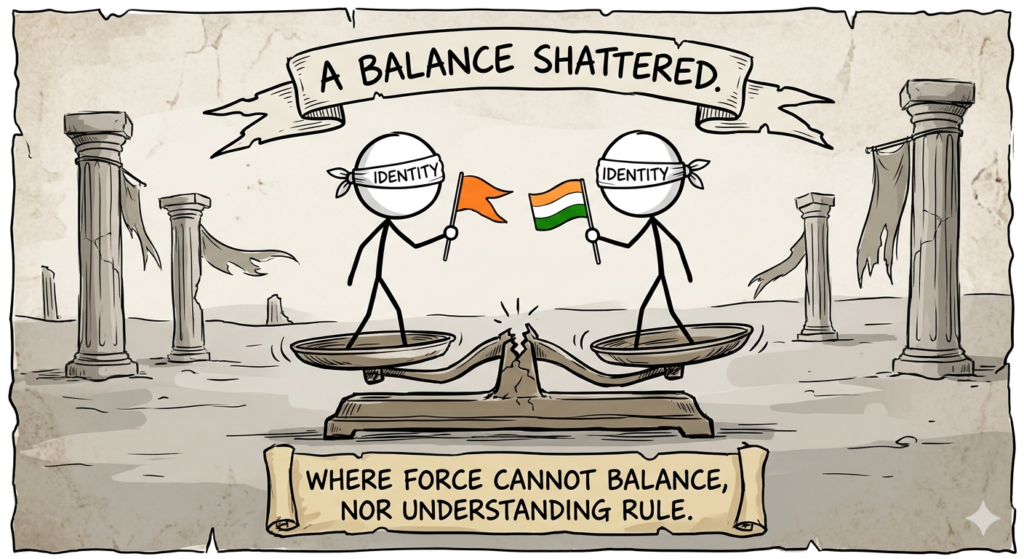
I was just bouncing between whoever made the better argument last, like a confused tennis ball.
That’s the most honest summary of my political life for the better part of a decade. Someone would make a passionate case for one party, and I’d think: wow, these guys have their shit together, maybe I should support them. A week later, someone else would tear the same party apart, and I’d think: WTF, how does anyone support these clowns?
BJP. Congress. That one regional party whose name I can never pronounce correctly but whose supporter at my cousin’s wedding held me hostage for forty-five minutes near the buffet table. All of them. Same reaction. Different week.
For a long time, I thought something was wrong with me. Like everyone else had received a political instruction manual at birth and mine got lost in the mail. Meanwhile I was out here completely unable to pick a side, feeling vaguely embarrassed about it, like I’d somehow failed a test I didn’t know I was taking.
But here’s what I eventually figured out.
I wasn’t confused because I was stupid.
I was confused because I was actually paying attention.
The people who seemed certain the ones who always knew exactly which party was right and which was evil weren’t smarter than me. They’d simply stopped asking certain questions. At some point, they’d picked a team, handed their brain over to that team, and what came out the other end looked a lot like confidence but was actually just the absence of doubt.
That’s not confidence. That’s intellectual surrender with a party flag on top.
I found this profoundly annoying. So I decided to run a little experiment.
The Unofficial Sting Operation
The experiment was simple, slightly unhinged, and completely free.
I pretended to be a BJP supporter in front of Congress supporters. And a Congress supporter in front of BJP supporters.
No hidden cameras. No government funding. No IRB approval. Just me, a series of chai sessions, and a willingness to be mildly dishonest in the name of understanding human stupidity.
I want to be clear about what I was not trying to do. I wasn’t trying to prove which party is right. I have opinions, but this wasn’t about my opinions. I wasn’t trying to trap anyone or make them look foolish. And I wasn’t doing this with randos on Twitter, where everyone performs for an audience and the goal is to humiliate, not understand.
I did this with people I know. Friends. Colleagues. Family members. People I’ve eaten meals with and who’ve seen me cry at movies. Smart, educated, functional adults who somehow transform, the moment politics enters the room, into entirely different versions of themselves.
I wanted to understand that transformation. What triggers it. What it looks like from the outside. And whether it looks different depending on which side you’re watching.
The answer, as it turns out, is: badly. Beautifully, fascinatingly, almost poetically badly.
And the same on both sides.
The BJP Supporter: A Scene
What follows is a composite… real conversations collapsed into one, names changed, but every quote and every reaction is something I actually witnessed.
Let’s call him Vikram. Mid-thirties. Software engineer. Genuinely one of the sharpest people I know. The kind of guy who can explain cloud architecture to you while simultaneously tracking a cricket score and debating whether Jiro Dreams of Sushi is actually a good film. Brilliant at his job. Thoughtful about most things.
We were having chai at his place when I raised the question of inflation. Nothing provocative. I cited a fairly mainstream economic concern one that had been discussed in non-partisan outlets. The kind of thing a reasonably curious citizen might read and go, “huh, that’s something to think about.”
Vikram’s face did something interesting. For about two seconds, something passed across it that I can only describe as the beginning of consideration. A flicker of “you know, that’s actually…”
And then it was gone.
What replaced it was a pivot so fast it almost gave me whiplash.
“But what about what they did? The UPA years? Manmohan Singh just sat there while the scams happened.”
I acknowledged the scams. They happened. They were bad. I said so.
“So why don’t you talk about those? Why is it always about criticizing this government?”
I pointed out that I was talking about a current issue, not a historical one, and that one set of failures doesn’t cancel out another.
“You sound like a Congress supporter.”
I blinked. “I’m asking about inflation, Vikram.”
“That’s what Congress supporters ask about.”
And just like that, the conversation had changed subjects. We were no longer talking about inflation. We were talking about what kind of person I was. The data I’d cited didn’t get examined. I got examined. Which is, if you think about it, a genuinely sophisticated way to never have to engage with anything uncomfortable.
When I pushed a little harder, citing specific reports, actual numbers, the Immunity Shield went up. I’d describe it as a kind of informational force field that forms around certain people, decisions, and incidents, making them completely immune to scrutiny. I could have shown Vikram a graph drawn by an economist he respected, published in a newspaper he trusted, citing data from a government source he considered credible and it would have bounced off.
Not because Vikram was dumb. Because the information was threatening something more important to Vikram than accuracy.
It was threatening his team.
And here’s the thing I want to be fair about, because I genuinely mean it: there was also a side of Vikram in those conversations that I found moving. When he talked about India’s growing global stature, the space program, the UPI revolution, the infrastructure projects visible to anyone who’s traveled across the country recently, his face lit up in a way that had nothing to do with party politics. He was proud of his country. That pride was real and warm and entirely legitimate.
The problem wasn’t the pride. The problem was that somewhere along the way, the party had borrowed the pride as a shield. So criticizing the government had started to feel, to Vikram, like criticizing India itself. Like I was rooting against his home team. Like I was… and I heard this word more than once… anti-national.
I wasn’t anti-national. I was asking about inflation.
But in Vikram’s mind, in that moment, those two things had become the same.
The Congress Supporter: A Scene
Same deal. Composite. Real reactions. Call this one Priya.
Priya is a journalist, freelance, sharp, reads everything, always three news cycles ahead of the rest of us. Exactly the kind of person you want in a political conversation if you want things to get interesting.
I played the defender. Pointed to real things: highway construction data, the digital payments infrastructure that genuinely impressed the world, India’s improved ranking in a few global indices. Things that exist. Things I could point to on a map or find on a government dashboard that even opposition economists haven’t seriously disputed.
Priya’s response was not “okay, fair, but here’s the context.”
Priya’s response was suspicion with a law degree.
“Where did you get that data?”
Government source. “Propaganda.”
Independent report. “Who funds them?”
International index. “These rankings are designed to make governments look good.”
I pointed out that the same indices were cited approvingly when the rankings were bad. She didn’t love that point.
“You sound like a bhakt,” she said.
“I cited an international economic report, Priya.”
“That’s what bhakts do.”
I genuinely laughed. Not mockingly, I laughed because it was the exact mirror image of my conversation with Vikram, running in the opposite direction. Different party, different labels, same architecture. If Vikram’s brain was an Immunity Shield, Priya’s was a Suspicion Engine. Every piece of good news had to be fed into the engine, processed, and converted into evidence of something darker underneath.
I started to wonder, and I want to be honest about this, because it troubled me, whether some of the people I was talking to would be quietly devastated if something genuinely, unambiguously good happened in India. Not because they hated the country, but because their entire identity had been built around a narrative of things going wrong. Good news wasn’t just irrelevant. It was destabilizing.
But again and I mean this just as much as I meant it about Vikram and Priya had qualities I respected enormously. She tracked things that never trended. She read court orders. She noticed when institutions shifted quietly. She was paying attention to the plumbing of democracy: unglamorous, mostly invisible, but genuinely important. That kind of attention is rare and valuable and the country needs more of it.
The problem wasn’t the skepticism. A democracy without skeptics is just a cult with better elections. The problem was that Priya’s skepticism had curdled into something that no longer required evidence. It had become a conclusion in search of facts, rather than facts in search of a conclusion. Everything was already bad. Every number was already fake. The verdict had already been delivered; we were just going through the motions of a trial.
That’s not skepticism.
That’s just pessimism wearing skepticism’s clothes.
The Most Surprising Thing I Found
Here’s what I expected: two groups of people with opposite beliefs, going about their political ignorance in opposite ways.
Here’s what I actually found: the same person, running the same software, wearing different jerseys.
The mirror realization didn’t come in one dramatic moment. It came slowly, conversation by conversation, as the patterns started stacking up. By the fourth or fifth time I’d watched both sides do the exact same thing in the exact same sequence, with the same timing, using different words. I stopped being surprised and started being unsettled.
Because the implication was uncomfortable. If both sides were running identical cognitive programs, then the conflict between them wasn’t really about truth versus lies, or good versus evil, or patriots versus traitors. It was about something much smaller and much more human.
It was about which team you joined when you were nineteen.
Here’s what both Vikram and Priya did, without exception:
They cherry-picked facts that supported their narrative and treated the rest as suspicious or irrelevant. They assigned motives to critics before engaging with the criticism. They used the same three or four labels as cognitive shortcuts ways of sorting people into boxes so they didn’t have to actually listen to them. They defended their side with the energy of someone defending their own family. And they were each absolutely, serenely convinced that they were the independent thinker and the other person was the brainwashed one.
That last part is the darkest joke in Indian politics.
Every BJP supporter I spoke to had arrived at their views through careful reasoning, they told me. Every Congress supporter told me the same about themselves. They cannot both be right. And yet the confidence was completely identical. It’s like two people at a party, each one telling you they’re the only sober person in the room, and you can smell the whiskey on both of them.
Here’s the thing I had to admit to myself, somewhere in the middle of all this: I’m not immune either. There were moments in these conversations where I caught myself hoping Priya would say something I could use as evidence for my thesis. Where I was slightly more patient with Vikram than I deserved to be, because I was more skeptical of his party and unconsciously wanted him to confirm that. Where my own confirmation bias was quietly running in the background, selecting for the data that supported the argument I’d already decided to make.
I’m writing about tribalism while being, in small ways, tribal.
That’s not a comfortable thing to type. But if I’m asking you to be honest with yourself, I should probably try it first.
Why Your Brain Is Designed to Do This
Here’s the thing none of this is your fault, exactly. And none of it makes you stupid. It makes you a member of a species that needed to stay alive for 300,000 years before refrigerators were invented, and the brain that helped you do that is now spectacularly bad at navigating group politics in the age of Twitter.
The deepest reason political tribalism feels so natural is this: for most of human history, your group was your survival. Being expelled from the tribe didn’t mean you’d have to find new friends. It meant you’d probably die, alone, in the dark, without tools or fire. The brain treats threats to group membership as physical threats. Not metaphorically. Neurologically. The same circuits that fire when someone punches you fire when someone says your political party is corrupt.
This is why political arguments feel so personal. Because to your brain, they are.
When Vikram said “you sound like a Congress supporter,” he wasn’t making a logical point. He was responding to a threat. When Priya called me a bhakt, she wasn’t offering a rebuttal. She was protecting her tribe. These felt like rational responses to them. They were survival responses dressed up in rational clothing.
This is also why political arguments almost never change anyone’s mind. You think you’re having a debate about facts. You’re actually having a confrontation about belonging. You’re not exchanging evidence. You’re fighting a boundary war in someone’s drawing room over chai, and the stakes, as far as ancient brain circuitry is concerned, are life and death.
No wonder nobody ever says “hmm, you’ve convinced me.”
Layer on top of this the modern gift of social media algorithms which figured out that outrage keeps you scrolling three times longer than nuance, and therefore serve you a relentless, carefully curated feed of people who think exactly like you and you have a machine specifically designed to make everyone feel like the last sane person on earth surrounded by dangerous idiots.
After six months inside that machine, a completely reasonable person starts to sound like a pamphlet.
After two years, they’re forwarding voice notes at 1 AM.
We’ve all been in that zone. Probably more than once. I have. The trick isn’t to pretend the machine doesn’t pull you. The trick is to notice when you’re being pulled.
The Fan Club Problem
At some point and historians of stupidity will one day identify exactly when Indian political culture stopped treating politicians like public servants and started treating them like protagonists in a Netflix series.
I need you to sit with that shift for a moment, because it changes everything.
A public servant is someone you hired to do a specific job with your tax money. The relationship is transactional in the best sense: they deliver, you renew the contract. They fail, you don’t. You don’t need to love them. You don’t need to defend them at parties. You definitely don’t need to feel personally wounded when someone criticizes their policy decisions, because their policy decisions are, in the most direct sense possible, none of your ego’s business.
But somewhere we crossed a line. Politicians became characters. Characters became heroes. Heroes became identity. And once a politician becomes part of your identity once their success starts to feel like your success and their failures start to feel like attacks on you personally you have made a terrible trade. You’ve handed a stranger the keys to your self-worth, and that stranger has every incentive to exploit it and zero incentive to deserve it.
Political supporters defend their politicians the way football fans defend their clubs. Which would be fine, except football fans are at least honest about the irrationality. A Pune FC fan will tell you, straight-faced, “I know we played like we’d never seen a football before, but I still love my team.” Beautiful. Honest. Not pretending to be anything else. Political fans operate with identical irrationality but have convinced themselves they’re being logical, which is somehow so much worse.
Most people don’t follow politics. They follow political teams.
The jersey-swap test is the cleanest way to see this. Take any political action a scheme, a decision, a statement, a controversy and imagine it performed by the opposite party. If your evaluation changes based purely on who did it, you are not analyzing politics. You are doing sports commentary.
A welfare scheme from your party is visionary governance. The same scheme from the opposition is desperate vote-bank politics. A corruption allegation against your side is a motivated, politically timed hit job. The same allegation against the other side is damning proof of systemic moral failure.
The facts haven’t changed. Only the jersey.
Once a politician becomes part of your identity, facts become your enemy.
This is the mechanism that makes otherwise intelligent people say spectacularly dumb things in political conversations. It’s not that they’ve suddenly lost IQ points. It’s that they’re no longer trying to understand the world. They’re trying to protect something they’ve built their sense of self around.
And nobody I want to be really clear about this nobody thinks this is happening to them. Everyone in this game believes they’re the exception. The one clear-eyed citizen surrounded by captured dumbasses.
If your politician can do no wrong, you’re not a supporter. You’re a disciple.
The WhatsApp Uncle: India’s Most Dangerous Political Institution
There is, in every Indian family, a WhatsApp Uncle.
You know exactly who I mean. Sometimes it’s an uncle. Sometimes it’s an aunt with strong opinions and an even stronger data connection. Occasionally it’s a cousin who “did his own research” and needs you to know about it immediately.
This individual maintains an average forward rate of approximately fifteen to twenty messages per day. Some are patriotic videos set to music that makes you want to both cry and salute. Some are crime statistics that are, let’s say, loosely tethered to reality. Some are things “the mainstream media doesn’t want you to know,” which is a phrase that should function as a warning label but somehow functions as an endorsement. And some my personal favorites are quotes attributed to Chanakya, Ambedkar, Swami Vivekananda, or Albert Einstein that those people absolutely, verifiably, one hundred percent never said.
But here is the crucial thing about WhatsApp Uncle that nobody in the family ever says out loud:
There are two of them.
WhatsApp Uncle Version One forwards things about how India is ascending to its rightful global throne, the economy is actually booming if you know where to look, all critics are either paid by foreign interests or suffering from a psychiatric condition called “anti-nationalism,” and the Western media hates us because we’re winning.
WhatsApp Uncle Version Two forwards things about how democracy is on life support, fascism is arriving in stages, every institution has been compromised, every development is either fake or sinister, and if you’re not outraged you’re not paying attention.
Both of them are forwarding misinformation with the calm authority of a Reuters correspondent. Both of them believe they are performing an important civic service. Both of them would be genuinely, deeply hurt if you suggested they were the problem. Both of them have muted you in the family group at some point for insufficient enthusiasm.
The WhatsApp Uncle is not a bad person. This bears repeating. The WhatsApp Uncle is what happens when the ancient tribal brain meets a modern algorithm, falls completely in love with the validation loop, and starts treating the dopamine hit of “I knew it!” as a substitute for the harder work of actually figuring things out.
We have all been WhatsApp Uncle at least once.
Don’t make me check your sent folder.
How Smart People Become Political Fanboys (Without Noticing)
This is the part of the essay where I’m supposed to give you a crisp list of psychological concepts with bold headers. Confirmation bias. Cognitive dissonance. Echo chambers. Each one neatly explained, as if understanding the name of the trap is the same as not being in it.
I’m not going to do that.
Instead, let me tell you about a specific kind of conversation I’ve had dozens of times.
It goes like this. I say something mildly critical of any political party. The other person smart, educated, genuinely lovely in other contexts immediately does three things in sequence so fast they happen almost simultaneously. First, they search for a way to discredit the source. Second, they find something the other party did that’s worse. Third, they subtly reframe the conversation so that my concern is no longer about a policy but about my loyalties.
In under ninety seconds, we’ve gone from “is this policy working” to “whose side are you on.”
Notice what didn’t happen. The concern wasn’t addressed. The data wasn’t examined. The possibility that the criticism might be legitimate was never seriously considered. The entire defensive operation was executed with the speed and confidence of someone who has done it many, many times because they have.
Here’s the uncomfortable truth about that operation: it works. It doesn’t resolve the original concern, but it doesn’t need to. Its purpose isn’t resolution. Its purpose is tribal protection. And at that, it’s extraordinarily effective.
The brain doesn’t run this program because you’re dumb. It runs it because you’re human. For most of history, questioning the group was dangerous. Defending the group was survival. The brain learned that lesson so thoroughly, over so many generations, that it now runs the defense protocol automatically, before conscious thought has a chance to intervene.
The only way out of the trap is to notice you’re in it.
Which is, genuinely, one of the hardest things a person can do in the middle of a heated conversation. I’ve failed at it plenty. The moment someone challenges something I’ve invested in, the same circuits fire in me that fired in Vikram and Priya. I feel the pull toward deflection. Toward “but what about.” Toward finding something wrong with the source rather than engaging with the content.
The difference on my good days is that I’ve learned to notice the pull. Not always before I’ve already started pulling back. But sometimes. And that sometimes is where intellectual honesty actually lives. Not in the absence of tribal instincts, but in the moment you catch yourself having them.
What Democracy Actually Needs From You
Here’s what nobody says at the dinner table: democracy is a mechanism for solving collective problems, and it runs on the quality of its citizens’ thinking. That’s it. That’s the whole thing.
When citizens think tribally when they defend their side and attack the other side regardless of the actual merits the mechanism breaks. Not because of corruption at the top, though that’s real too. But because the mechanism requires a certain baseline of honest evaluation from the people it’s supposed to serve. Without that, it doesn’t produce solutions. It produces winning.
And winning isn’t the point.
The goal of democracy is not to win arguments. The goal is to solve problems.
Winning and solving are not only different objectives they produce completely different behavior. Winning requires you to defend your position. Solving requires you to question it. Winning means the other side must be wrong. Solving means the other side might have information you need.
The most destructive thing about extreme political tribalism isn’t what it does to national discourse, as real as that damage is. It’s what it does to each side’s ability to hold their own team accountable.
When Vikram refuses to acknowledge the legitimate concerns about the current government, he isn’t protecting the government. He’s protecting the government from the pressure that might make it better. When Priya dismisses every positive development, she isn’t keeping power accountable. She’s making her opposition less credible, which makes her less useful, which ultimately serves the people she’s opposing.
Blind support and blind opposition are twins pretending to be enemies. Both of them serve the powerful. Neither of them serves you.
This is the part of the essay where I’ve historically lost people, because it sounds like I’m saying “both sides are the same.” I’m not. Parties are different. Policies have different consequences for different people. Elections matter enormously and the outcomes are not interchangeable.
What I’m saying is simpler and more uncomfortable than “both sides are the same.”
I’m saying both sides use the same broken thinking. And broken thinking produces bad outcomes regardless of which flag is flying above it.
The Ten Seconds Before You Type
I want to end with something specific. Not a list. Not a manifesto. Just one question, asked at one specific moment.
Before you respond to the next political post. Before you forward the next WhatsApp message. Before you open your mouth at the next dinner table when your uncle says the thing he always says pause for ten seconds and ask yourself one question.
Am I about to say this because I’ve thought about it, or because my team expects me to say it?
That’s it. That’s the whole ask.
Not “be more nuanced” that’s too vague. Not “read both sides” that’s too much homework for a Tuesday evening. Just ten seconds. One honest question. Directed not at the other person’s motives but at your own.
I’ve been thinking about Vikram and Priya a lot while writing this. Both of them are good people. I mean that sincerely. I’ve seen Vikram show up for his friends in ways that would embarrass most people’s definitions of loyalty. I’ve seen Priya do journalism that held genuinely powerful people to account. They’re not the villains of this story.
They’re the story. Because if it’s happening to people like them intelligent, educated, self-aware people who would be offended to be called tribal then the problem isn’t a handful of bad actors somewhere. The problem is baked into the system, and the system includes all of us.
There was a moment near the end of my conversation with Vikram after I’d pushed a bit too hard on something, and he’d pushed back harder than he meant to, and there was a small silence where I saw it again. That flicker. Two seconds of something that wasn’t defense or attack or loyalty or fear. Something quieter. Something that looked almost like the beginning of “you know, actually…”
He didn’t say it. The moment passed. The talking points resumed.
But it was there.
And here’s what I’ve come to believe about that flicker, after all these conversations, all this observing, all this performing of positions I don’t hold in order to understand how positions get held: that flicker is not weakness. That flicker is not confusion. That flicker is the only genuinely intelligent response to a complicated world.
That flicker is what thinking looks like before tribalism smothers it.
India doesn’t have a shortage of opinions. We have more opinions per square kilometer than anywhere else on earth. They’re generating at a rate no factory could match. Loud opinions. Confident opinions. Opinions delivered with the moral authority of someone who has personally verified every fact and weighed every consequence and arrived at the only rational conclusion.
What India has a shortage of is people willing to feel that flicker and not immediately kill it.
The smartest political position isn’t blind support. It isn’t blind opposition. It isn’t the exhausted cynicism of “they’re all the same, why bother” which is just tribalism with better aesthetics. It’s the willingness to say: I might be wrong about this. Let me actually look.
That willingness is not comfortable. The tribe doesn’t reward it. The algorithm doesn’t amplify it. It won’t make you popular in the family WhatsApp group.
But it’s the only version of political engagement that has any chance of producing something real.
Everything else is just very passionate noise.
And we’ve got plenty of that already.
This is not an endorsement or criticism of any political party, leader, or ideology. It is an observation about human behavior in Indian political discourse. If you feel personally attacked actually, don’t sit with it. Ask yourself why, then come back and read it again.
Niranjan Pathak is a writer, stand-up comedian, and professional overthinker from Nashik. He has six published literary anthologies, a comedy career that involves making rooms full of strangers uncomfortable about themselves, and a website at niranjanpathak.info where he writes about the strange things people do when they think nobody is paying attention and sometimes when everyone is.
Discover more from niranjanpathak.info
Subscribe to get the latest posts sent to your email.
Comments are off here. Come find me on social instead — I answer everything.