Part 1 dropped a few days ago. The response was exactly what I expected, which is to say: everyone thought it was about the other guy.
BJP supporters sent it to their Congress friends with “dekh, tumhare baare mein likha hai.” Congress supporters forwarded it to their BJP uncles with the same energy. Two completely opposite tribes. Same essay. Each group convinced it was aimed at the enemy and totally oblivious to the bullet aimed directly at their own forehead.
Which means I did something right. And also something wrong.
The most common criticism I kept hearing was this: “You were too soft, bhai. Zero outrage. Your Vikram and Priya sounded like they were having a polite chai disagreement, not an actual Indian political argument. Real Indian political conversations sound like a building collapse, loud, chaotic, terrifying, and structurally unsound.”
Fair. Completely fair.
So this is Part 2. No diplomacy. No softening the edges. We’re going into actual events, actual people, the very specific nonsense that has been happening in Indian political discourse over the last month, and we’re going to treat it with the same blunt instrument I should have used the first time.
Grab your chai. This one’s going to take a while.
The Setup: A Chief Justice, A Cockroach, And 22 Million Idiots (Affectionate)
Let me set the scene.
May 2026. India’s Chief Justice Surya Kant, the single most powerful judicial position in the country, the man literally constitutionally obligated to protect citizen rights, is sitting in open court, looking at a country where nearly a third of its graduates can’t find work, where NEET papers have been leaking like a tap someone forgot to close, where young people are eating instant noodles in ₹15,000-a-month PGs while their parents’ generation bought houses on government salaries.
And this man. In open court. On record. Said that “there are youngsters like cockroaches, who don’t get any employment and don’t have any place in the profession. Some of them become media, some of them become social media, RTI activists and other activists, and they start attacking everyone.”
Cockroaches. The Chief Justice of India called struggling young people cockroaches.
Now look. I’m not going to do the thing where I spend four paragraphs performing outrage about this. You already know it was wrong. You felt it. The whole country felt it. Even people who generally don’t care about judiciary stuff felt it, because there’s something deeply visceral about the highest judge in the land using vermin imagery for people who are simply broke and frustrated.
The statement was bad. Let’s move on to what came next. Because what came next is where this story gets genuinely fascinating, and also genuinely depressing, and also kind of hilarious if you’re the type of person who laughs at things that should probably make you cry.
Within 24 hours of the Chief Justice’s statement, a 30-year-old Indian student sitting in Boston, Abhijeet Dipke, a recent graduate in public relations, asked on social media: “What if all cockroaches came together?” He then built a website, launched Instagram and X accounts, and called it the Cockroach Janta Party. Within days: the CJP had garnered more followers on some social media platforms than India’s main political parties. 22 million Instagram followers. 350,000 sign-ups. Nationwide protests in Delhi, Pune, Lucknow, Hyderabad, Jaipur, Nagpur, Bengaluru.
And the entire country split in the most tediously predictable way imaginable.
Half the country said: THIS IS THE REVOLUTION. THE YOUTH HAVE SPOKEN. COCKROACHES UNITE. HERE IS MY COCKROACH DP.
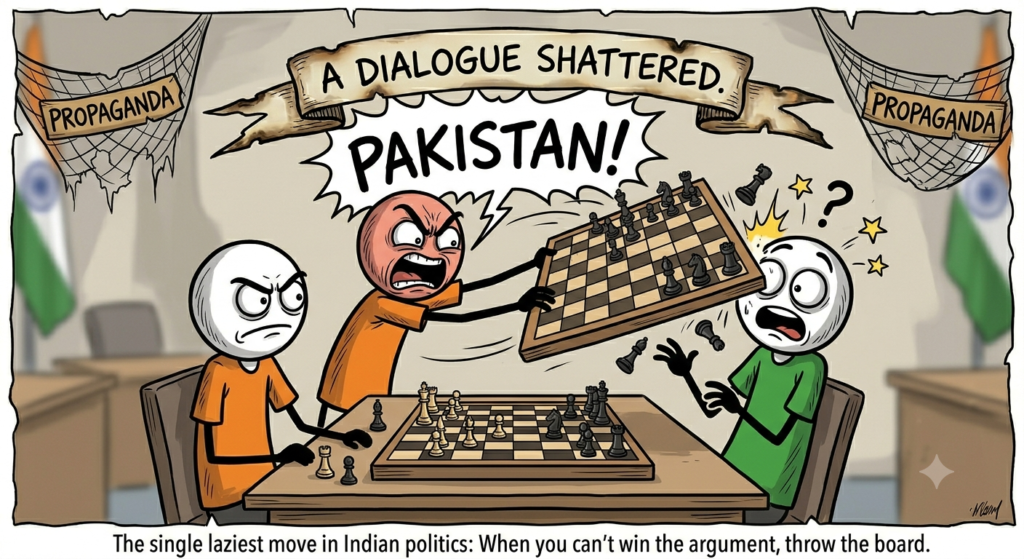
The other half said: Pakistan. Foreign funding. Anti-national. CIA. George Soros. Urban Naxals.
Both sides performed their assigned roles with the commitment of people who have rehearsed this exact script for the last decade.
And both sides completely missed the actual story.
Let’s Start With What’s Obviously True (Because Fairness Matters, Apparently)
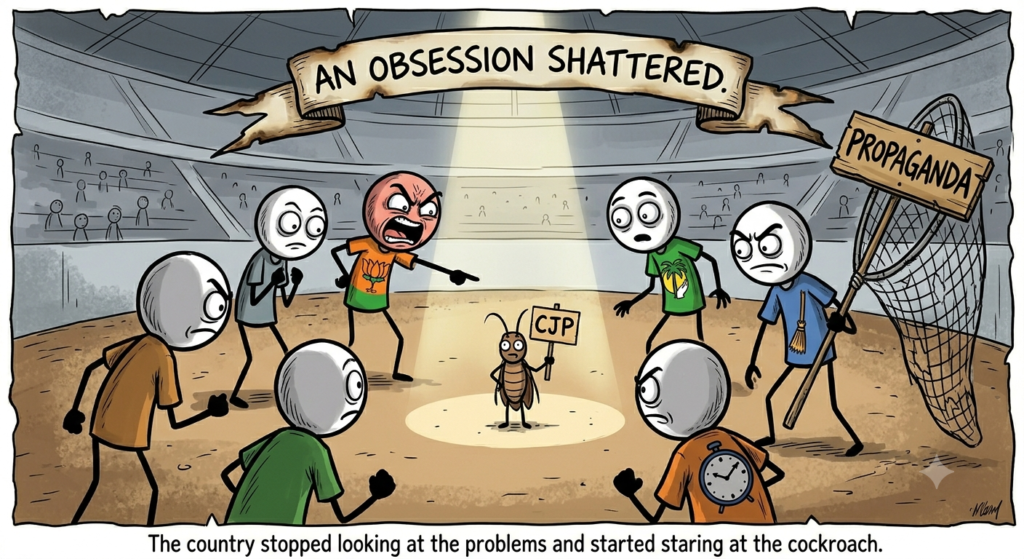
The Chief Justice called young people cockroaches. That was wrong. I said it once. I mean it.
India produces more than eight million graduates a year, and the unemployment rate among them stands at 29.1 percent, nine times higher than for those who never attended school. That’s a demographic emergency that deserves serious, sustained attention from every institution in this country.
The paper leaks are real. Students who spent years preparing for NEET had their futures disrupted by a broken examination system. That’s a genuine policy failure. Those kids deserved better.
The anger is legitimate. Full stop. The anger is legitimate.
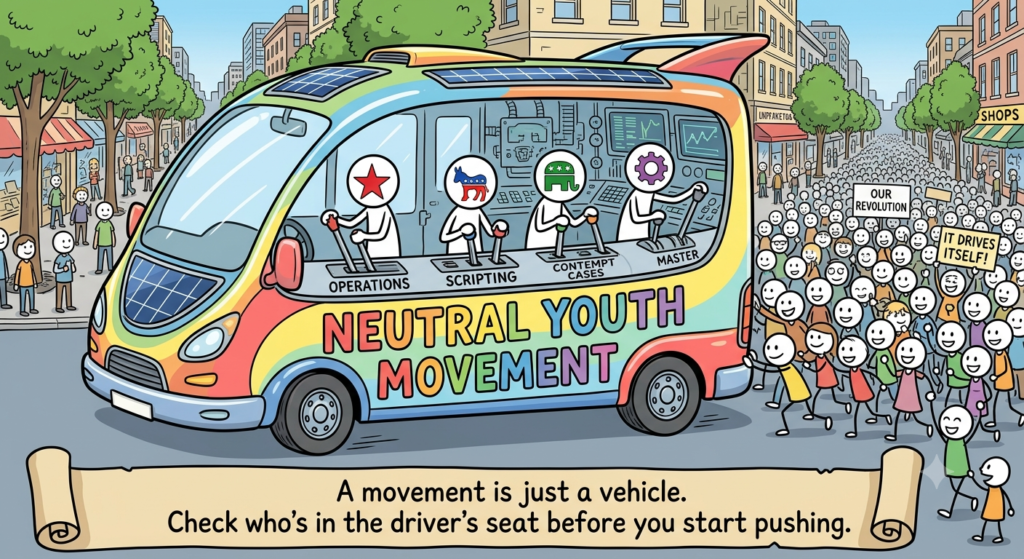
What the anger did NOT deserve was the delivery vehicle it got. And the delivery vehicle is what I want to talk about. Because the delivery vehicle, the cockroach, the meme, the viral Instagram movement, the “neutral youth party”, is the most elegant piece of political engineering I’ve seen in Indian public life in years, and almost nobody called it what it was.
So let me do that.
Meet The Cockroach Crew: Your “Neutral” Movement’s Very Non-Neutral Leadership
Here is a question that should have been asked on Day One by every journalist, every citizen, every chronically online person who shared a cockroach meme.
Who. The fuck. Are these people?
Because “spontaneous youth movement led by a random guy who just cares about India” is not the full story. Not even close. Let’s go through the team one by one, shall we? Since the CJP was kind enough to formally announce their people, we don’t even have to work hard here. They just handed us the list.
Abhijeet Dipke, Founder, “Neutral Youth Leader,” Boston Resident
Dipke is 30 years old. He is studying public relations at Boston University. He is Indian. He is currently in America.
He built a movement demanding Indian government accountability. From America. Let’s just sit with that geography for a moment. The man organizing nationwide protests demanding that an Indian minister resign is sitting in a city that is approximately 13,000 kilometres from Jantar Mantar. He returned to India for exactly one protest, went straight from the airport to the rally like a visiting dignitary, and, following the stunning response to his initiative, Dipke returned to India on June 6 and reportedly went straight from the airport to New Delhi’s Jantar Mantar.
That’s commitment. Or it’s optics. Or it’s both. It’s almost certainly both.
Now. Background. During the 2020 Delhi Assembly elections, Dipke was described as a 23-year-old from Pune who was behind AAP’s social media transformation. He was quoted explaining how political messaging had to be simplified for millennials and first-time voters through memes and videos. He reportedly reported to AAP IT media head Ankit Lal.
So Dipke is not a random guy who suddenly cares about India. He is a trained, experienced political communications operative. A meme warfare professional. The specific person responsible for teaching AAP how to talk to young people online. This is his skill set. This is what he does.
And then he appears with a “neutral” movement and 22 million people, many of whom pride themselves on media literacy and critical thinking, follow him without asking a single question about who he is or why he’s doing this.
That’s the magic trick. Not the cockroach. The meme man with the political past making 22 million people forget to ask about his political past.
Then there’s the Umar Khalid situation. In CJP’s own Discord channel, users pointed out Dipke’s support for Umar Khalid. On June 7, in the Hindi Video Chat section, one user dreamt of Dipke as the Prime Minister of India and Umar Khalid as the Defence Minister. The man booked under UAPA for alleged conspiracy in the Delhi riots that killed 53 people. Someone in the CJP’s own Discord channel wants him as Defence Minister.
And at the Jantar Mantar protest itself? Several CJP supporters expressed solidarity with Umar Khalid. One supporter said: “Future President & PMs like Sharjeel Imam & Umar Khalid have been JAILED. They are educated enough to get jobs in America.”
Sharjeel Imam. The man who publicly called for cutting off Assam from the rest of India. A future Prime Minister material, apparently, in the world of the people holding CJP flags.
Not a fringe voice. Not one weird comment on Discord. At the physical protest. In Delhi. On camera.
And then there’s the Kashmir history. Before the CJP went viral, Dipke had faced a complaint over some of his Kashmir-related social media posts. The complaint, submitted in August 2019 to Pune Police by Legal Rights Observatory, alleged that the posts promoted narratives sympathetic to Kashmiri separatists. No FIR was ultimately filed. But the complaint existed. And the posts that triggered it existed.
A man with documented AAP political operations background. Documented soft corner for Umar Khalid. Documented complaint over Kashmir-sympathetic posts. Now running a “neutral youth movement.”
If you think this is all coincidence, I have a bridge in Kashmir to sell you. And several cockroach memes to go with it.
Saurav Das, Chief Spokesperson, “Independent Journalist,” Professional Outrage Artist
The CJP’s Chief Spokesperson. The face they put in front of cameras. The man who speaks for the cockroach to the nation.
Saurav Das is an investigative journalist renowned for his work on governance, transparency, and judicial accountability. He has contributed to various major publications, including The Caravan, Article 14, Al Jazeera, The Wire, and The Hindu.
Impressive CV. Publication list reads like a bingo card for a specific type of political leaning that I won’t spell out because I trust you to read a list of publications and form your own conclusion.
Now. The interesting stuff.
Das is working on a debut book titled “Complicit Silence: The Court’s Role in India’s Quiet Suffering,” which he describes as exploring how the Indian judiciary has contributed to the nation’s slide into electoral autocracy under the right-wing Hindu nationalist Prime Minister, Narendra Modi.
That’s his book. That’s the thing the Chief Spokesperson of the “neutral, apolitical youth movement” is writing in his spare time. Not “India’s governance challenges.” Not “systemic failures across political parties.” Specifically: how Modi-era judiciary has contributed to electoral autocracy. That is the book. That is the man’s stated project.
And he is the Chief Spokesperson of a movement that keeps telling everyone it has no political agenda.
But let’s be fair. Everyone has opinions. Maybe he keeps them separate from his CJP work.
Except, Das faced contempt of court proceedings before the Delhi High Court over a report concerning alleged conflict of interest involving Justice Swarana Kanta Sharma, the judge hearing the AAP excise policy case. The Delhi High Court issued notice to Das and AAP leader Gopal Rai in the same contempt petition.
So Das is slapped into the same contempt petition as an AAP leader. In a case involving AAP. The case where he was writing articles that critics said were essentially fighting AAP’s legal battles through journalism.
Das denied the allegations and called them “RUBBISH.” Fine. People deny things. Courts decide.
But here’s the pattern: Das writes for publications that primarily criticise the BJP. Das writes a book specifically about Modi’s judicial autocracy. Das gets tagged in contempt proceedings alongside AAP politicians. Das stays conspicuously silent on AAP government failures, critics noted he amplified Delhi pollution concerns only after BJP came to power, despite AAP governing Delhi for a decade with the same pollution every year.
And now Das is the Chief Spokesperson of a “neutral” movement.
I’m not calling him a liar. I’m just asking you to look at the pattern and ask yourself how many coincidences you’re comfortable with before you stop calling them coincidences.
Vijeta Dahiya, Spokesperson, Filmmaker, Dhruv Rathee’s Scriptwriter
This is the one that made me genuinely pause.
Vijeta Dahiya is a political researcher, author, filmmaker and content creator who was appointed as an official spokesperson of the Cockroach Janta Party. He completed his education at Delhi Technological University and has worked in political research and content development for several YouTube creators.
“Several YouTube creators.” Sounds broad. Sounds neutral.
Except, his entry into digital political content came through YouTuber Dhruv Rathee, whom he approached after seeing a public call for writers and researchers. He went on to work as a scriptwriter and researcher for Rathee’s videos.
Dhruv Rathee. For those who don’t spend their lives on YouTube, Dhruv Rathee is the single most popular political commentator on YouTube in India, with over 20 million subscribers, known for videos that are almost exclusively critical of the BJP government. Some people think his content is courageous journalism. Some people think it’s sophisticated opposition propaganda packaged as neutral explainer content. The truth is probably somewhere between those two poles. But nobody, nobody, would describe Dhruv Rathee’s channel as politically neutral.
The scriptwriter and researcher for Dhruv Rathee’s channel is now a CJP spokesperson.
But fine. Let’s look at Dahiya’s own track record. Following his appointment, clips from his older videos resurfaced online. Critics accused him of promoting politically motivated narratives and questioned some of his past remarks. Some highlighted his perceived ideological links with groups such as the Bhim Army and his alleged association with activists like Umar Khalid and Sharjeel Imam. Dahiya also drew criticism over remarks related to Hindu religious history.
The remarks about Hindu religious history, specifically comments about dietary practices attributed to Lord Ram, generated serious anger. I’m going to be careful here because I don’t want to put words in anyone’s mouth about their specific statements. But I’ll say this: a person making inflammatory statements about Hindu religious figures is not a neutral person. They are a person who has chosen to poke a very specific group in a very specific way. That is a choice. And choices tell you about values.
And this person is the spokesperson of a movement that says it doesn’t have a political agenda.
The literary influences Dahiya lists, Arundhati Roy, Aravind Adiga, Kafka, Orwell, Sartre, Ghalib, and Faiz Ahmed Faiz, are excellent writers, genuinely. But it’s also a very specific list. It’s the list of someone who has a very particular worldview and has read very particular authors to build and reinforce that worldview. Which is fine! Everyone has a worldview. The problem is when your worldview is emphatically, demonstrably not neutral, and you then claim to represent a neutral movement.
Ashutosh Ranka, Spokesperson, IIT-LSE-McKinsey Guy, The “Credibility Hire”
Ranka is the one they brought in to make the whole thing look serious. And I understand the logic. You’ve got a meme page founder in Boston, an AAP journalist who’s in a contempt case, a Dhruv Rathee scriptwriter who makes videos about Hindu religious figures. You need someone who went to IIT and McKinsey to stand at the press conference so journalists don’t immediately ask obvious questions.
Originally from Jaipur, Rajasthan, Ashutosh Ranka holds a B.Tech from IIT Kanpur, where he served as President of the Students’ Gymkhana. He pursued a Master’s in Public Administration at the London School of Economics and later joined McKinsey & Company in London. He returned to India and has been involved with public policy and activism.
IIT. LSE. McKinsey. These are the credentials that make Indian aunties immediately stop asking uncomfortable questions and start offering biryani. And I’ll be honest, he sounds genuinely impressive on paper.
Except. Ranka’s work with the AAP-led Delhi government and activism on high-profile issues positions him as a credible voice on governance. AAP-led Delhi government. Again. Again with the AAP connection. Dipke is AAP. Das is essentially fighting AAP’s courtroom battles through journalism. Ranka worked with the AAP-led Delhi government.
The “neutral” movement has at minimum three of its four key public faces with documented AAP connections.
At the press conference, Ranka was asked about prior affiliations. He stated: “Our past affiliations are not important. This fight is bigger than that. CJP is bigger than an individual or any organisation.”
“Our past affiliations are not important.”
Wow. That’s a fascinating thing to say. Especially from a McKinsey consultant, because McKinsey consultants are famously obsessed with due diligence. They build entire careers on the philosophy that background, track record, and past behavior are the most reliable predictors of future behavior.
Unless, apparently, that background is your own.
“Our past affiliations are not important” is the political equivalent of going on a first date and saying “don’t worry about my exes, that’s all in the past.” Every person with functional relationship instincts hears that and thinks: oh, we’re definitely going to talk about the exes eventually.
The Pattern That Nobody Wanted To Notice
Let me lay out what we have, clean and simple, so you can’t miss it even if you’re reading this on your phone at 1 AM after three beers.
Dipke: AAP meme war operative. Documented sympathy for Umar Khalid. Kashmir-sympathetic posts complaint. Currently in Boston. Claiming to run a “neutral” movement.
Das: Writes exclusively for left-leaning publications. Writing a book specifically about Modi’s autocracy. Tagged in contempt proceedings alongside AAP politicians in an AAP court case. Chief Spokesperson of the “neutral” movement.
Dahiya: Dhruv Rathee’s scriptwriter. Alleged links to Bhim Army and Umar Khalid/Sharjeel Imam ecosystem. Controversial remarks about Hindu religious figures. Spokesperson of the “neutral” movement.
Ranka: Worked with AAP-led Delhi government. Returned to India for activism. Spokesperson of the “neutral” movement.
And at the actual protests, on actual video, CJP supporters chanting in favour of Umar Khalid and Sharjeel Imam. Those rallies also saw slogans rejecting the BJP’s “Hindu-Muslim” politics.
Tell me again about the neutrality.
Here’s the thing that I keep coming back to, that makes me genuinely respect the engineering of this even as I’m deeply skeptical of it: they picked a real grievance. Graduate unemployment is real. Paper leaks are real. The Chief Justice’s statement was real and was genuinely bad. You don’t manufacture the anger. You locate existing, legitimate anger and then you build a vehicle around it with your branding on the side.
The genius is that anyone who questions the vehicle gets called a bhakt, a government stooge, an enemy of the youth. The anger becomes a shield. The cockroach costume is both the product and the protection.
If you criticize CJP you’re pro-paper-leak. You’re pro-cockroach-insults. You hate students and love unemployment. That’s the trap, and it was built deliberately, by people who know exactly how to build traps.
Dipke didn’t build a movement. He built a machine. The movement is the fuel. The machine is what matters. And the machine has a direction, and that direction is very much not “neutral.”
A Conversation At A Pune Café That Sent Me Into A Minor Existential Crisis
Last month. A friend’s place. Mix of people, startup founders, a doctor, someone who teaches at a college, a journalist friend. All educated. All the kind of people who forward “fact-check this” articles and consider themselves politically sophisticated.
The CJP came up.
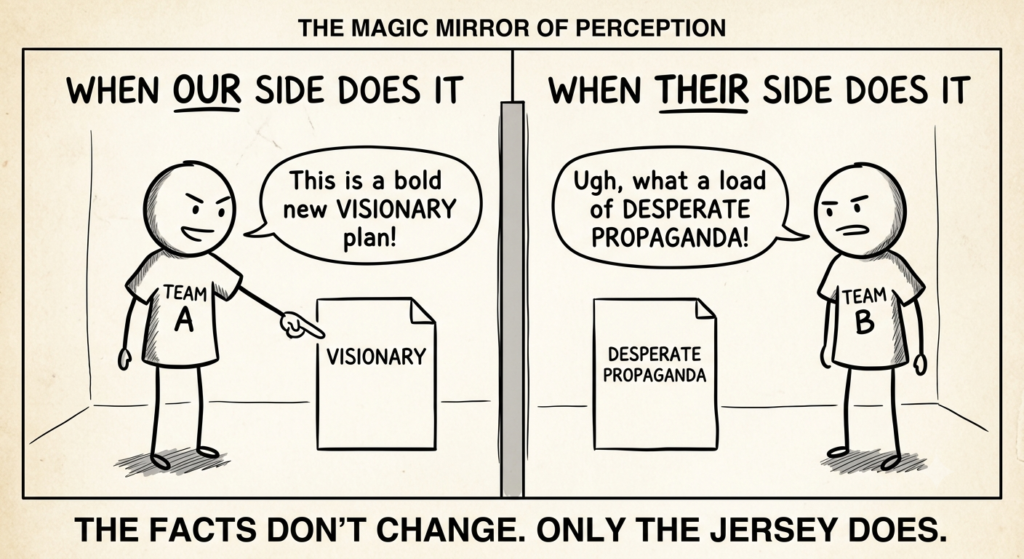
Within forty-five seconds, I timed it in my head because I’m that kind of person, the room had split into two teams and both teams were operating on feelings rather than facts, which is precisely what I wrote an entire essay warning people not to do.
Team CJP (three people): “It’s amazing, bhai. Finally the youth is waking up. This is exactly what India needs.”
Team Sceptic (two people): “It’s all foreign funded. Pakistan ke paise hain.”
One person, bless her, was just sitting quietly eating chips.
I was doing the experiment. Staying neutral. Watching.
Here’s what nobody in that room said:
Nobody said: “Let me look up who Abhijeet Dipke is.”
Nobody said: “Who are the spokespersons and what’s their background?”
Nobody said: “What specific policy changes has the CJP articulated beyond ‘Pradhan must resign’?”
Nobody said: “Why does an education reform movement keep producing anti-Hindu-Muslim-politics slogans at its protests?”
Nobody asked any of those questions. The CJP supporters were excited about the vibe. The sceptics were reaching for Pakistan. The chips person was the wisest person in the room.
After about twenty minutes I asked my CJP-enthusiast friend, sharp guy, reads constantly, the kind of person who’ll send you a 2000-word voice note about geopolitics at 11 PM, “Did you know Dipke worked for AAP’s meme operations during 2020 elections?”
“Okay, so? AAP isn’t BJP.”
“And did you know his Chief Spokesperson is literally writing a book specifically about Modi’s autocracy?”
“Good, someone should.”
“And that another spokesperson wrote scripts for Dhruv Rathee?”
“Dhruv Rathee does good work.”
“And that another one worked with the AAP-led Delhi government?”
“So?”
I looked at this man. This intelligent, well-read, politically engaged man. And I said: “Bhai, if I told you that the leader of a supposedly neutral movement had BJP connections, all his spokespeople had BJP connections, and his protests were producing pro-RSS slogans, you’d call it a BJP political operation in a second.”
Silence.
“Different jersey,” I said. “Same logic.”
He ate his chips. The chips person nodded slightly. Progress.
The Thing About “Our Past Affiliations Don’t Matter”
I want to go back to Ranka’s line at the press conference. “Our past affiliations are not important.” Because I think it’s the most revealing thing any CJP person has said publicly, and it’s got almost no coverage.
Past affiliations not important. Past history not important. Just trust us, we’re neutral now.
Let me apply this logic to other situations and see how it holds up.
A doctor who previously falsified medical records wants to perform surgery on you. “My past affiliations are not important. This operation is bigger than that.”
A financial advisor who previously ran a Ponzi scheme wants to manage your money. “My past affiliations are not important. Your portfolio is bigger than that.”
A communications professional who spent years running political meme wars for a specific party wants to lead a “neutral” youth movement. “Our past affiliations are not important. This fight is bigger than that.”
In all three cases, the correct response is: actually, your past affiliations are exactly what’s important. Past behavior is the most reliable predictor of future behavior that we have. This is not a controversial psychological finding. This is just how evidence works.
The only people who tell you their past affiliations don’t matter are people whose past affiliations matter a great deal.
The Government’s Response: Also Bad, Since We’re Being Honest
I want to be absolutely clear about something, because I know some people will read everything above and think: “Great, Niranjan is on the BJP side now.”
I am not. And the government’s response to the CJP was embarrassing.
Union minister Sukanta Majumdar alleged that 49% of CJP followers are from Pakistan and only 9% are from India. However, a screen recording from Dipke shows that over 94% of the audience is Indian.
49% from Pakistan. That number was fabricated, or at minimum, pulled from somewhere so methodologically unsound that it should never have been stated publicly by a Union minister. It was wrong. Demonstrably, provably, screenshot-your-own-analytics wrong. And the minister didn’t apologize. Didn’t correct himself. Just moved on to the next outrage.
This is the behavior of someone who knows his audience doesn’t care if the number is accurate. They just care if it sounds damaging. And that is a profound contempt for the intelligence of your own supporters.
The Cockroach Janta Party’s official X account was withheld in India, with the Ministry of Electronics and Information Technology citing “national security concerns” and a threat to the “sovereignty of India.”
A cockroach meme page. National security threat. The sovereignty of India. These words were used, by the government, about a satirical Instagram account.
If the CJP is genuinely just political packaging with a hidden agenda, and I’ve made the case that it is, then the correct response is to say so publicly, with evidence, and let citizens make their own assessment. Instead, the government blocked it. Which does two things simultaneously: it confirms the CJP’s narrative that the government is afraid of dissent, and it successfully prevents citizens from seeing the evidence that might make them question the CJP’s own agenda.
The government essentially chose to protect the CJP from scrutiny by making it a free speech martyr. Brilliant strategy, in the same way that setting your own car on fire is a brilliant strategy for getting attention.
So: CJP leadership is not what it presents itself to be. Government response was clumsy, authoritarian, and backfired badly. Both things are true. They sit comfortably together.
The Movement Factory: A Playbook India Keeps Falling For
Here is a pattern. I want you to really look at it.
Step 1: Find a real grievance. Something that affects real people. Preferably involving young people, who have energy and phones and nowhere to put their anger.
Step 2: Build a vehicle with neutral branding. No party flags. No obvious affiliations. Something fun, relatable, internet-native. The cockroach was perfect. It’s relatable, funny, self-deprecating, impossible to disagree with as a symbol.
Step 3: Move fast. You need critical mass before fact-checkers catch up. 22 million followers in under a week doesn’t give journalists time to do background research on the founder.
Step 4: Staff the vehicle with your people. But make sure they all have plausible cover stories. An “investigative journalist.” A “filmmaker.” An “IIT-McKinsey consultant.” Impressive titles. Hidden connections.
Step 5: Insert the actual agenda gradually. Protest slogans about Hindu-Muslim politics. Discord channels celebrating Umar Khalid. Opposition politicians immediately endorsing the movement, Mamata Banerjee, Abhishek Banerjee, Shashi Tharoor, Samajwadi Party’s Akhilesh Yadav all expressed support. The entire opposition bench lining up to endorse the “neutral” movement with no political agenda.
Step 6: Weaponize the question-askers. Anyone who asks “wait, who are these people?” gets immediately called a bhakt, a government agent, someone who supports paper leaks and hates students. The anger of the movement becomes a wall that protects it from scrutiny.
This playbook has been run before. It will be run again. And every time, some significant portion of educated, intelligent, supposedly critically-thinking people falls for it completely. Because the grievance is real. And when the grievance is real, it’s really hard to make yourself look critically at the vehicle.
That’s the move. That’s always been the move.
What The Students Actually Deserved
I want to say something that I mean completely sincerely, without any sarcasm, because I’ve been sarcastic for about 4,000 words and I think I owe you a moment of genuine feeling.
The students whose NEET papers were leaked deserved better than this.
The graduates who can’t find work despite degrees that their families sacrificed enormously for deserve better than this.
The young people who heard the Chief Justice call them cockroaches and felt that specific kind of anger, the anger of someone who has done everything right and still got nothing, they deserve better than this.
They deserved a movement actually built around their needs. Actually led by people with no prior political operations experience. Actually focused on the specific, boring, technical, unglamorous policy work that would fix examination systems and create jobs.
Instead they got a viral moment. An aesthetic. A meme that had 22 million followers and produced zero policy change. Dipke himself said he would not engage with what protesters called “godi media” and would mainly rely on the power of social media. Social media. Social media is the strategy. For fixing examination systems and graduate unemployment. Social media.
Pradhan did not resign. The examination system has not changed. Graduate unemployment is unchanged. The cockroach meme has faded. The students are still where they were.
But Dipke has 22 million followers. Das has a high-profile spokesperson role for his next press conference. Dahiya has a platform he couldn’t have bought. And Ranka has the kind of credibility boost that money can’t buy.
The students got a costume. The leadership got careers.
Funny how that works.
The Ten Seconds You Owed Yourself
In Part 1, I gave you one question to ask before you engage with any political content: Am I about to say this because I’ve thought about it, or because my team expects me to say it?
This time I’m adding another one.
Before you follow a movement. Before you share a meme. Before you put on a costume. Before you go to a protest. Ask yourself:
Who built this vehicle, where were they before they built it, and where do they actually want to take it?
That’s it. Not a detailed investigative report. Not three weeks of research. Just: who are these people, and what’s their actual history?
Because here’s what happens when you don’t ask: you become content. Your anger becomes fuel. Your legitimate grievance gets turned into raw material for someone else’s project. Your face at a protest becomes B-roll for someone else’s narrative. Your 22 million follows become someone else’s credibility.
And the problem you were actually angry about, the paper leaks, the unemployment, the Chief Justice’s cockroach comment, remains exactly as unsolved as before. Because solving it was never really the point.
You were the point.
Closing Thought, For Real This Time
Vikram from Part 1, my BJP supporter friend who deflects every uncomfortable question by asking if you’re a Congress supporter, messaged me after I posted Part 1. Said it made him think. He didn’t say about what. He didn’t say he’d changed his mind about anything specific. Just: “Made me think.”
I’ve been thinking about what “made me think” actually means, in the context of Indian political discourse.
I think it means: for approximately two minutes, before the next WhatsApp forward arrived and the next viral moment hit and the next outrage cycle began, a person sat with the discomfort of not being entirely sure. Of holding two things at once. Of acknowledging that their team’s jersey might not be a reliable guide to truth.
Two minutes. That’s all I’m asking for.
Two minutes before you follow the cockroach. Two minutes before you share the forward. Two minutes before you put on the costume.
Two minutes to ask who built the meme and why.
The cockroach will still be there when you get back. If it was worth following, it’ll survive two minutes of scrutiny.
If it won’t, well. That’s the most important information you could have.
This is just the 2nd part. I think I would love to write more about this topic. I’m not done yet…
Niranjan Pathak is a writer, stand-up comedian, and professional overthinker from Nashik. He has six published anthologies, a comedy career that involves making rooms full of strangers deeply uncomfortable about themselves, and a website at niranjanpathak.info. He does not have a political party. He does have opinions. These are two different things, and the difference matters.
This article is not a defense of the BJP government, the Chief Justice, or anyone who called young people cockroaches. Unemployment is real. Paper leaks are real. Student anger is legitimate. This is an article about what happens to legitimate anger when a political machine gets its hands on it, and whether you’re capable of noticing the difference between a genuine movement and a very well-branded operation. If you’re offended: good. Sit with it. Ask yourself why.
Discover more from niranjanpathak.info
Subscribe to get the latest posts sent to your email.
Comments are off here. Come find me on social instead — I answer everything.