Introduction: The Emotional Gym Membership You Keep Paying For But Never Use
Let’s start with an uncomfortable truth.
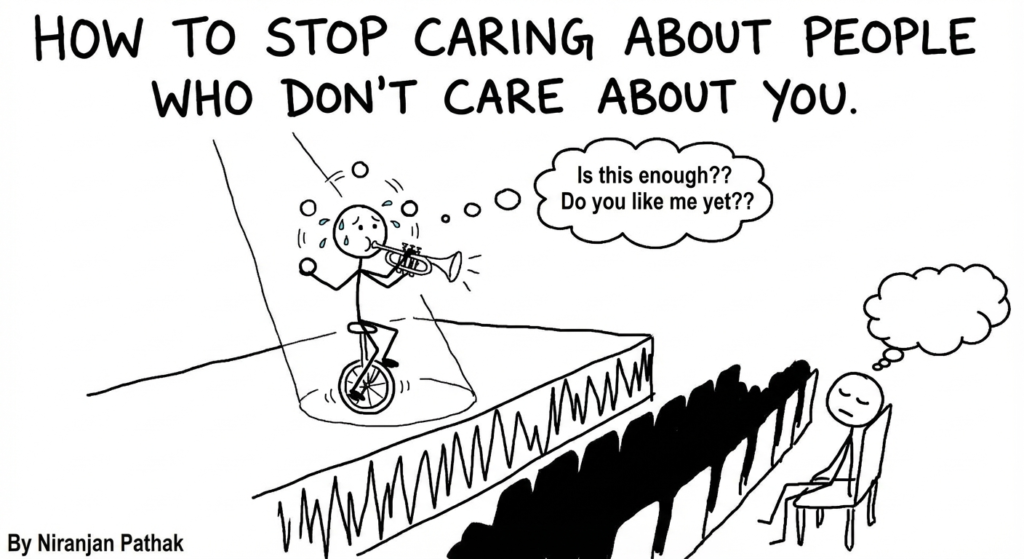
You care too much about people who barely remember your existence.
You reply instantly.
They reply after three business days.
You check their mood.
They don’t check if you’re alive.
You overthink their silence.
They don’t even notice your presence.
And still, somehow, you’re emotionally invested like a full-time employee in a company that hasn’t paid you in months.
This is not kindness.
This is emotional self-harm.
And the worst part?
You already know they don’t care.
Yet you still hope.
You still wait.
You still explain their behavior to yourself like a lawyer defending a criminal.
“He’s busy.”
“She’s bad at expressing.”
“They’re going through something.”
No bro. Sometimes the truth is simpler.
They just don’t give a shit.
And before you start beating yourself up, let me say this clearly.
You are not stupid.
You are not weak.
You are not desperate.
You are just human, emotionally wired, and conditioned to seek validation from the wrong places.
This article is not about becoming cold.
It’s about becoming sane.
1. Why This Topic Hurts More Than We Admit
Caring about people who don’t care about you hurts because it attacks your self-worth.
Not your ego.
Your identity.
It makes you ask questions like:
• Am I boring?
• Am I not enough?
• Did I do something wrong?
• Why do I always care more?
And the scary part?
You start adjusting yourself to be liked.
You become quieter.
More agreeable.
More available.
Less demanding.
You slowly shrink yourself hoping they’ll finally choose you.
That’s not love.
That’s emotional bargaining.
2. The Harsh Truth You’ve Been Avoiding
Here it is. No sugarcoating.
Some people will never care about you the way you care about them.
Not because you’re unlovable.
But because emotional capacity is different.
Some people:
• lack empathy
• are emotionally unavailable
• are self-absorbed
• are dealing with their own shit
• simply don’t value you the same way
And that’s not your job to fix.
You sabotage yourself when you keep investing where the return is zero.
That’s not loyalty.
That’s bad emotional finance.
3. Why You Keep Chasing People Who Don’t Care
Let’s talk psychology, not Instagram quotes.
You don’t chase them because they’re special.
You chase them because of:
• validation hunger
• fear of abandonment
• people-pleasing tendencies
• childhood conditioning
• unresolved self-worth issues
If you grew up:
• needing approval
• earning love through behavior
• being ignored emotionally
• praised only when useful
Your brain learned one thing.
Love must be earned.
So now, when someone doesn’t care, your brain goes:
“I’ll try harder.”
That’s not romance.
That’s trauma repeating itself.
4. Validation Is a Drug And You’re Addicted
Let’s call it what it is.
You’re not attached to the person.
You’re attached to the feeling of being chosen.
That one reply.
That one compliment.
That one moment of attention.
It hits like dopamine.
And when it disappears, you feel anxious, restless, empty.
So you try again.
Text again.
Call again.
Show up again.
Not because you enjoy it.
But because your brain wants another hit.
That’s addiction, not affection.
5. The “Maybe They’ll Change” Lie
This is the most dangerous lie you tell yourself.
“Maybe they’ll realize my value.”
“Maybe they’re just going through a phase.”
“Maybe one day they’ll care.”
Let me be blunt.
If someone wanted to care, they would.
People make time for what matters to them.
They show effort where there is interest.
You’re not asking for too much.
You’re asking the wrong person.
6. Signs You’re Over-Caring (Be Honest With Yourself)
If you relate to more than three of these, congratulations, you’re emotionally over-invested.
• You always initiate conversations
• You feel anxious waiting for replies
• You make excuses for their behavior
• You feel guilty for asking basic respect
• You downplay your needs
• You feel drained after interactions
• You replay conversations in your head
• You feel happy with breadcrumbs
• You blame yourself for their distance
This is not love.
This is an emotional imbalance.
And imbalance always leads to exhaustion.
7. Caring Too Much Is Not a Virtue
Society romanticizes over-caring.
They say things like:
“You have a big heart.”
“You’re too nice.”
“You’re very understanding.”
No one tells you the downside.
Caring too much without boundaries:
• drains your energy
• kills your self-respect
• attracts emotionally lazy people
• keeps you stuck
• turns love into suffering
Kindness without boundaries is self-destruction.
Read that again.
8. Why Being “Nice” Is Fucking You Over
Being nice is safe.
Being real is risky.
Nice people:
• avoid confrontation
• suppress emotions
• say yes when they mean no
• tolerate disrespect
• fear being disliked
So they keep caring quietly while resentment builds internally.
And one day, they explode or collapse.
Stop confusing niceness with goodness.
You can be kind and still walk away.
You can be caring and still choose yourself.
9. Silence Hurts Because You’re Making It Personal
When someone doesn’t respond, your brain goes:
“What’s wrong with me?”
But most of the time, silence is about them.
Their priorities.
Their emotional limits.
Their distractions.
Not everything is a reflection of your worth.
Stop turning their indifference into your self-judgment.
10. Emotional Attachment Without Reciprocity Is Self-Betrayal
This is the line you need to tattoo on your brain.
If someone doesn’t reciprocate, continuing to care is betraying yourself.
Read it slowly.
You are choosing them over your own dignity.
And every time you do that, your self-respect takes a hit.
You don’t lose them.
You lose yourself.
11. People-Pleasing Is Not a Personality Trait. It’s a Survival Strategy That Expired
Let’s clear something up.
You’re not “naturally caring.”
You’re not “just emotional.”
You’re not “too sensitive.”
In many cases, you’re a people-pleaser because at some point in life, pleasing people kept you safe.
Maybe you learned that:
- love comes when you behave
- approval means security
- conflict leads to rejection
- silence is better than disagreement
So you adapted.
You became agreeable.
You became available.
You became low-maintenance.
You became the person who understands everyone.
Except yourself.
Now as an adult, that survival strategy is outdated.
But you’re still running it like old software.
And that’s why you care about people who don’t care about you.
Because pleasing them feels familiar.
Even if it hurts like shit.
12. The Fear of Being Alone Is Making You Emotionally Desperate
Let’s talk about the fear nobody admits.
Loneliness.
Not the “I’m single” loneliness.
The deeper one.
The fear that if you stop caring, there will be nobody left.
So you tolerate:
• dry replies
• inconsistent effort
• emotional unavailability
• disrespect masked as humor
• being an option instead of a priority
You tell yourself:
“At least they’re still here.”
But here’s the truth that stings.
Being alone is better than being emotionally abandoned while still present.
One hurts quietly.
The other destroys your self-esteem slowly.
13. You Mistake Emotional Familiarity for Emotional Connection
This one messes people up badly.
Just because someone feels familiar doesn’t mean they’re good for you.
Familiarity often comes from:
• repeated emotional patterns
• unresolved childhood wounds
• similar dynamics you’ve lived before
Your brain confuses “this feels known” with “this feels right.”
That’s how you keep caring about people who trigger you, ignore you, or barely show up.
Comfort doesn’t always mean healthy.
Sometimes comfort is just pain you’ve gotten used to.
14. Social Media Is Making This Shit Worse
Social media has completely fucked emotional boundaries.
You see:
• stories
• likes
• online status
• last seen
• mutual interactions
And your brain goes into detective mode.
“They saw my story but didn’t reply.”
“They liked someone else’s post but ignored me.”
“They’re online but not responding.”
Congratulations.
You’re now emotionally invested in pixels.
Social media creates the illusion of closeness without real effort.
And you fall for it because it feels like connection.
It’s not.
It’s access without intimacy.
15. Why Silence Hurts More Than Rejection
Rejection is clear.
Silence is ambiguous.
And ambiguity is mental torture.
Silence makes you:
• overthink
• self-blame
• hope
• doubt
• wait
Your brain hates uncertainty.
So it fills the gap with self-criticism.
That’s why you keep caring.
Because silence gives you hope.
False hope is addictive as hell.
16. You’re Over-Caring Because You’re Under-Valuing Yourself
Let’s flip the lens.
People who value themselves don’t beg for attention.
They don’t:
• chase
• explain
• over-invest
• wait endlessly
• tolerate breadcrumbs
Not because they’re arrogant.
But because they know their worth.
Self-worth doesn’t shout.
It walks away quietly.
And that’s what scares you.
Walking away feels like losing.
But staying is losing more.
17. Caring Becomes Emotional Self-Harm When It’s One-Sided
Here’s the uncomfortable question.
If a friend treated you the way this person treats you, what would you tell them?
You’d probably say:
“Why the fuck are you tolerating this?”
Yet you tolerate it yourself.
Because self-sabotage feels normal when it’s emotional.
You call it loyalty.
You call it patience.
You call it love.
But when caring only flows one way, it becomes self-harm.
No dramatic music needed.
Just facts.
18. You Keep Hoping They’ll Become Who You Need
This is a big one.
You’re not attached to who they are.
You’re attached to who they could be.
You imagine:
• if they opened up
• if they communicated better
• if they tried more
• if they understood you
But you’re not in love with reality.
You’re in love with potential.
And potential is the most dangerous drug.
Because it keeps you stuck waiting for a version of them that may never exist.
19. Emotional Detachment Is Not Coldness
Let’s kill this myth right now.
Detachment does NOT mean:
• being heartless
• becoming rude
• suppressing emotions
• acting superior
Detachment means:
• caring without clinging
• loving without losing yourself
• walking away without hatred
• choosing peace over chaos
You can still wish them well.
Just not at the cost of your sanity.
20. The Moment You Stop Chasing, Things Get Clear
Something interesting happens when you stop caring excessively.
You stop initiating.
You stop explaining.
You stop overthinking.
And suddenly:
• their effort becomes visible
• the imbalance becomes obvious
• the truth shows itself
Either they step up.
Or they disappear.
Both outcomes are clarity.
And clarity is freedom.
21. Your Ego Is Secretly Keeping You Hooked
This one is uncomfortable, so stay with me.
Sometimes you don’t care because you love them.
You care because your ego is bruised.
Your ego keeps asking:
• Why don’t they want me?
• Why am I not enough?
• Why do they treat others better?
And instead of letting go, your ego says:
“I’ll prove my worth.”
So you:
• try harder
• show more effort
• give more access
• lower your standards
That’s not self-respect.
That’s ego fighting rejection.
The moment you stop needing to be chosen, your power comes back.
22. Why Letting Go Feels Like Losing (Even When It’s Not)
Letting go hurts because your brain treats attachment like survival.
Your nervous system doesn’t understand logic.
It understands patterns.
So when you detach, your brain panics.
It says:
“What if this was my only chance?”
“What if I regret this?”
“What if I’m alone forever?”
That fear is temporary.
The peace that follows is permanent.
Loss is loud.
Freedom is quiet.
That’s why you confuse the two.
23. Emotional Boundaries Without Guilt (This Is Key)
Boundaries are not punishments.
They’re instructions.
Here’s what boundaries look like in real life:
• not replying immediately
• not over-explaining
• not chasing after silence
• not tolerating disrespect
• not giving unlimited access
And here’s what they don’t look like:
• yelling
• threatening
• dramatic exits
• emotional manipulation
You don’t owe people access to you.
Guilt fades.
Self-respect stays.
24. How to Stop Caring Step by Step (No Motivation Bullshit)
This is where change actually happens.
Step 1: Reduce Access
- Reply less
- Initiate less
- Stop checking their socials
- Distance creates clarity.
Step 2: Redirect Energy
- Gym
- Work
- Learning
- Friends who reciprocate
- Yourself
Energy has to go somewhere.
Step 3: Feel the Discomfort
- Don’t numb it
- Don’t distract immediately
- Sit with it
- This is where healing starts.
Step 4: Stop Fantasizing
- Kill the imaginary version of them
- Deal with who they actually are
- Reality > hope.
Step 5: Choose Yourself Repeatedly
- Even when it’s hard
- Especially when it’s hard
- Consistency rewires attachment.
25. Cutting People Off Without Drama
You don’t need a speech.
You don’t need closure.
You don’t need their understanding.
Sometimes cutting off looks like:
- Silence
- Distance
- No explanation
- Choosing peace
Not everything needs confrontation.
Growth is often quiet.
26. When You Should Walk Away Immediately
Some signs are non-negotiable.
- Disrespect
- Manipulation
- Gaslighting
- emotional neglect
- constant inconsistency
- breadcrumbing
If someone makes you feel anxious more than safe, walk away.
Your nervous system is smarter than your heart.
27. Stop Romanticizing Struggle
You’ve been taught that caring deeply means suffering.
That love is pain.
That patience fixes people.
That staying proves loyalty.
No.
Healthy love feels calm.
Not confusing.
Not draining.
Not anxiety-inducing.
If caring feels like punishment, it’s not love.
28. What Happens When You Finally Let Go
This part is underrated.
When you stop caring excessively:
- Your sleep improves
- Your anxiety reduces
- Your self-respect grows
- Your standards rise
- Your energy returns
And here’s the funny part.
Some people suddenly notice you.
Not because you changed.
Because you stopped chasing.
29. You Will Miss Them (And That’s Normal)
Letting go doesn’t mean you won’t miss them.
You will.
You’ll miss:
- the idea
- the routine
- the familiarity
Missing doesn’t mean going back.
Healing is not forgetting.
It’s choosing differently.
30. Build a Life That Doesn’t Revolve Around Other People
This is the real solution.
When your life is empty, people become the center.
When your life is full, people become a part.
Fill your life with:
- Purpose
- Routines
- Growth
- Hobbies
- Goals
- Discipline
Then no one’s attention controls your mood.
31. Common Mistakes People Make While Trying to Detach
Most people don’t fail at detaching because they’re weak.
They fail because they do it wrong.
Here are the most common fuck-ups.
• They announce their detachment instead of just doing it
• They detach physically but stay emotionally obsessed
• They stalk social media while pretending to “move on”
• They expect instant peace and panic when pain shows up
• They detach to punish the other person, not to heal
• They replace one emotional dependency with another
Detachment is not a performance.
It’s an internal shift.
If you’re still hoping they notice your absence, you haven’t detached yet.
32. Why You Feel Empty After You Stop Caring
This part scares people, so listen carefully.
When you stop caring about someone who consumed your emotional energy, you feel empty.
Not because you made a mistake.
But because that space was occupied for too long.
That emptiness is not loss.
It’s space.
Space for clarity.
Space for growth.
Space for yourself.
Most people rush to fill it again.
Don’t.
Sit in it.
Let it teach you who you are without emotional addiction.
33. How to Rebuild Self-Worth After Over-Caring
Self-worth doesn’t come from affirmations.
It comes from behavior.
Here’s how you rebuild it practically.
• Keep small promises to yourself
• Say no without explaining
• Walk away when disrespected
• Choose discomfort over self-betrayal
• Do things that make you proud privately
Every time you choose yourself, your nervous system learns something new.
“I am safe even when I don’t chase.”
That’s power.
34. Stop Expecting Closure From People Who Never Gave You Clarity
Let this sink in.
People who confuse you will not suddenly explain themselves honestly.
Closure doesn’t come from them.
It comes from you deciding:
“This behavior is enough information.”
Waiting for closure is just another form of attachment.
Decide.
Accept.
Move on.
35. You Don’t Become Cold. You Become Selective
This is important.
After detaching, you might hear:
“You’ve changed.”
“You’re distant now.”
“You’re not the same.”
Good.
You didn’t become cold.
You became selective.
You stopped giving emotional access to people who didn’t deserve it.
That’s not cruelty.
That’s maturity.
36. Frequently Asked Questions (FAQs)
Q1. Is it wrong to care deeply about people?
No. It’s wrong to care deeply about people who consistently don’t care back.
Q2. How do I stop caring without becoming bitter?
Detach with acceptance, not resentment. You’re not punishing them. You’re choosing peace.
Q3. What if they suddenly start caring after I detach?
Observe behavior, not words. Consistency over time matters more than temporary effort.
Q4. Why do I always care more than others?
Because you’re emotionally available in a world full of emotionally unavailable people. Channel that depth wisely.
Q5. How long does it take to stop caring?
There’s no timeline. It gets easier when you stop reopening emotional wounds.
37. The Final Truth Nobody Tells You
You don’t stop caring by forcing yourself not to care.
You stop caring when you finally understand this:
Someone not choosing you is not a reflection of your worth.
The moment you truly accept that, something shifts.
You stop chasing.
You stop explaining.
You stop proving.
And suddenly, peace becomes more attractive than attention.
Conclusion: Choose Yourself Without Apology
Let me say this clearly, and then I’ll shut up.
Caring about people who don’t care about you does not make you noble.
It makes you exhausted.
You were never asking for too much.
You were asking the wrong people.
The moment you stop pouring into empty cups, your life changes.
More energy.
More clarity.
More self-respect.
More calm.
And one day, you’ll look back and realize:
Walking away wasn’t losing them.
It was finding yourself.
Written by: Niranjan Pathak
Discover more from niranjanpathak.info
Subscribe to get the latest posts sent to your email.
Comments are off here. Come find me on social instead — I answer everything.